Note: This website was automatically translated, so some terms or nuances may not be completely accurate.
 Reflecting on Japan's Present and Future Through the 2019 Japan Brand Survey [3/7]
What Kind of Travel Destination is Japan? ~ Where Do Visitors Come From? What Do They Do? ~
This series explores insights for future inbound business based on the "Japan Brand Survey 2019" conducted in 20 countries and regions in December 2018. Starting this installment, we will consider the future of inbound tourists by comparing past and present data.
According to the Japan National Tourism Organization (JNTO), the annual number of foreign visitors to Japan (inbound tourists: estimated figures) in 2018 reached approximately 31,191,900, an 8.7% increase from the previous year, finally surpassing the 30 million mark.
While numbers are expected to grow even more after 2020, where do these visitors come from, and what draws them to Japan?
Nearly 80% want to visit Japan! Will European visitors increase in the future?
First, let's look at the 2019 intention to visit Japan (the combined total of those who "plan to travel to Japan within the next year" and those who "have not decided on a date but want to go someday"). Across all 20 countries and regions, the result was very high at 77.4%.
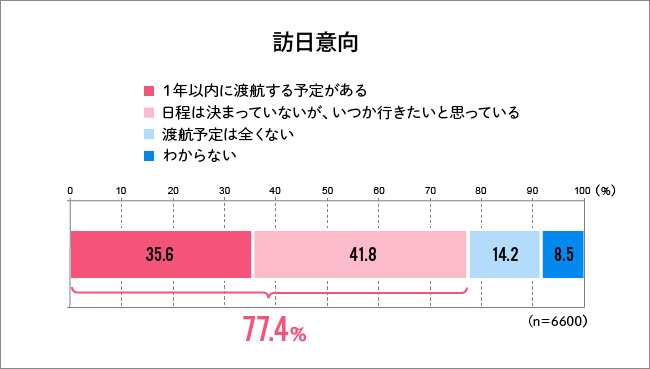
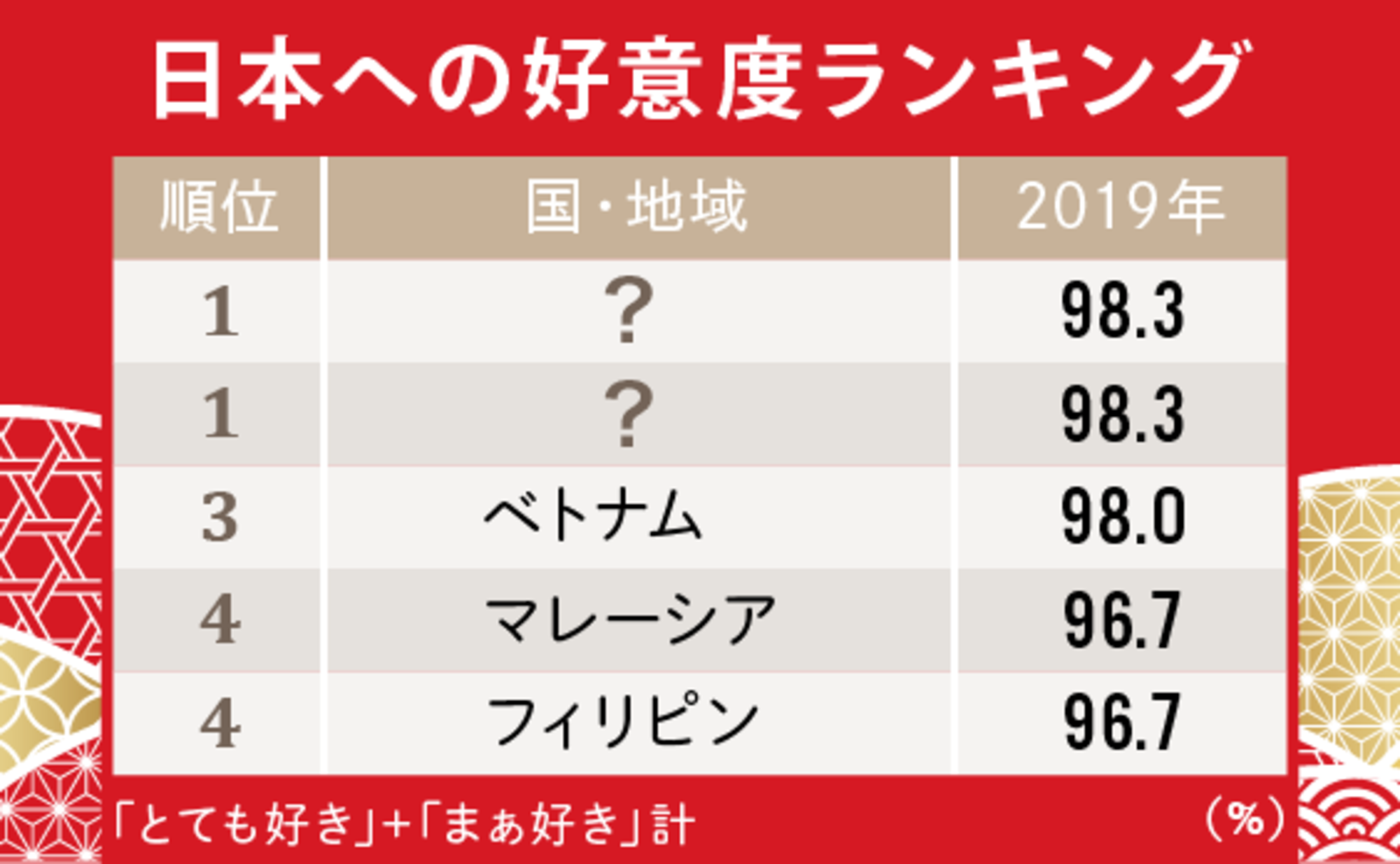
Compared to fiscal year 2018, this is +1.4 points, essentially flat, but still maintaining a high score. Looking at individual countries/regions, Hong Kong had the highest at 98.3%. This means almost everyone wants to visit Japan.While Asian countries and regions generally scored high, other areas also showed strong interest: Italy (81.7%), Russia (73.3%), and Turkey (71.7%) had many respondents who answered "I like Japan" (Series Part 1 ).
Compared to fiscal year 2018, scores increased in France (+5.4pt), Germany (+7.7pt), Italy (+10pt), and Russia (+5.3pt), suggesting an expected rise in tourists from Europe.
When we began surveying in 2012, the overall intention to visit Japan was 67.7%. While an exact comparison is difficult due to changes in the surveyed regions, it is surprising that the score has increased by about 10 points over seven years.
Comparing by country/region, those showing a score increase of 10 points or more are Hong Kong (+20.5pt), Thailand (+20pt), the United States (+17.7pt), the United Kingdom (+11.5pt), and Australia (+18.5pt). This indicates a significant rise in visit intentions not only from Asia but also from countries in the Europe, America, and Australia region.
Japan is the most popular destination in Asia. Its competitors are the United States, Italy, and Australia?
So, how popular is Japan as a travel destination compared to other countries worldwide? When respondents were asked which countries they would like to visit in the future, choosing from a list of popular tourist destinations including Japan, Japan ranked first overall across 20 countries and regions with 48.6%. The United States came in second (38.9%), followed by Australia in third (37.9%).
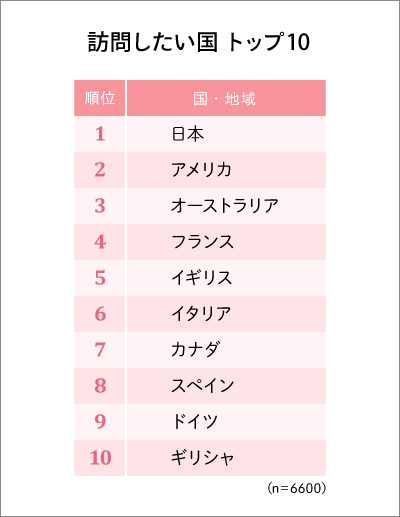
However, there are regional differences, and Japan isn't number one in every country or region.
While Japan ranked first in most Asian countries and regions, in North America, European countries like Italy and Australia were more popular, with Japan placing eighth. In Europe, the United States topped the list with Japan second, while in Australia, Canada ranked first with Japan tied for second place with the United States.
Even within North America, Europe, and Australia, Japan remains the top destination among Asian countries for "countries they wish to visit in the future." However, the number of visitors to Japan from these regions is still low, and compared to competing countries in Europe, America, and Australia, Japan's presence cannot be said to be significant.
When asked about barriers to visiting Japan, the top overall reason was "high travel costs."
Furthermore, in the UK, France, and Germany—where interest in visiting Japan is growing—the top reason cited was not high travel costs, but rather "it's far away/takes too long to get there." This suggests potential visitors who would come to Japan during periods when they can take extended vacations, given the right incentive.
Presenting experiences unique to Japan and "how to enhance its presence as a travel destination" appears to be the key to increasing the number of visitors to Japan going forward.
Many visitors come seeking authentic Japanese cuisine. Is travel shifting toward "things + experiences"?
Finally, let's examine what visitors seek when coming to Japan. When asking those with an intention to visit Japan about "things they want to do in Japan," "eating Japanese food" was the overwhelming top choice. It led the second-place "nature/scenic spot sightseeing" by over 20 percentage points.
Results vary slightly by country/region, but "Japanese cuisine" is popular enough to rank first in every single one. While a global Japanese food boom is underway, it seems people who have experienced Japanese cuisine in their home countries are coming to Japan seeking the authentic taste.
Furthermore, in the survey four years prior (2015), the top five things to do in Japan were: "Eat Japanese food," "Visit natural and scenic spots," "Visit historical sites and buildings," "Bathe in hot springs," and "Experience the four seasons." In 2019, the results were: "Eat Japanese food," "Visit natural and scenic spots," "Bathe in hot springs," "Go shopping," and "Stroll through downtown areas."
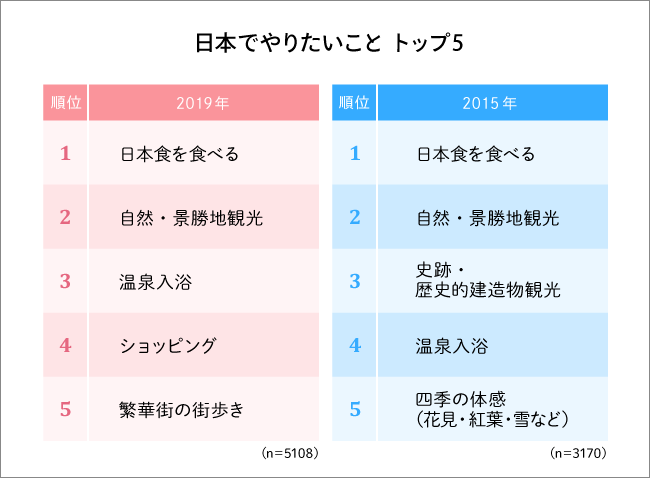
Since it's often said that the travel style of visitors to Japan has shifted from "things" to "experiences," "shopping" might seem surprising. However, especially among tourists from Europe and America, many tend to buy souvenirs like kimonos or knives that embody Japanese tradition and craftsmanship. "Shopping" here isn't just about the items; it also encompasses cultural experiences.
Going forward, rather than choosing between goods or experiences, a travel style combining both goods and experiences is likely to become mainstream.
Furthermore, based on the findings of this survey, it is predicted that tourists will increasingly come from countries farther away, such as Europe, America, and Australia.
As more people visit from countries with historically lower numbers of visitors to Japan, and as travel styles evolve, increasingly diverse needs may emerge, potentially creating new business opportunities.
Next time, we will delve deeper into the travel destinations of international tourists in Japan.
【Contact for Inquiries Regarding This Matter】
Dentsu Inc. Japan Brand Project Team
japanbrand@dentsu.co.jp
Japan Brand Research Hub Page
https://www.dentsu.co.jp/knowledge/japan_brand/
[Purpose of the Dentsu Inc. Japan Brand Survey]
Dentsu Inc.'s proprietary survey initiated in 2011 to understand how the Japan Brand was perceived globally when reputational damage occurred to Japanese agricultural and marine products and inbound tourism following the Great East Japan Earthquake. In 2022, it evolved into a cross-company project activity to enhance expertise through a fundamental restructuring of survey design, analytical approaches, and outputs.In 2025, it will newly plan and build a public knowledge portfolio, aiming to create social value grounded in consumer insights.
The Japan Brand Survey regularly gauges the awareness and actual attitudes of overseas consumers regarding the Japan Brand as a whole, covering areas such as inbound tourism, regional revitalization, food, Japanese products, content, values, lifestyles, and social trends. It visualizes the changing sentiments of consumers and the challenges and potential of the Japan Brand, contributing to increasingly complex corporate activities while also promoting cross-cultural understanding within Japanese society.
【Dentsu Inc. Japan Brand Survey 2019: Survey Overview】
・Target Areas: 20 countries/regions (Mainland China, Hong Kong, Taiwan, South Korea, India, Singapore, Thailand, Indonesia, Malaysia, Vietnam, Philippines, Australia, USA, Canada, UK, France, Germany, Italy, Russia, Turkey)
・Sample Size: 6,600 (Breakdown: United States 600, Mainland China 600, Other Countries/Regions 300 each)
・Survey Period: December 2018
・Respondent criteria: Men and women aged 20–59 (middle-income and above)
・Survey Method: Internet survey
・Research Organizations: Dentsu Inc. (Principal Investigator), Video Research Ltd. (Implementation Support)
[Notes and Disclaimers]
※1: Mainland China coverage primarily limited to Tier 1 cities; Australia limited to the Sydney metropolitan area; Southeast Asia primarily limited to metropolitan areas.
※2: Definition of middle-income level: Criteria set per country based on national average income (e.g., OECD statistics) and social class classification (SEC).
※3: Samples were collected with equal allocation by gender and age group for each country/region, then weighted to match the population composition.
※4: Proportions in this survey are rounded to the second decimal place (or first decimal place for some integer values), so totals may not add up to 100%.
※5: Country and region names used in this survey report and on the website follow the longstanding views of the Japanese government, Japanese social norms, and business practices.
※6: In creating the charts and graphs for this survey, the names of countries and regions analyzed use the international standard ISO Country Code (ISO 3166-1 alpha-2/3), with some exceptions.
United States/US/USA, Canada/CA/CAN, Australia/AU/AUS, United Kingdom/UK/GBR, Germany/DE/DEU, France/FR/FRA, Italy/IT/ITA,Spain/ES/ESP, Finland/FI/FIN, United Arab Emirates/UAE, Saudi Arabia/SA/SAU, India/IN/IND, Indonesia/ID/IDN, Singapore/SG/SGP, Malaysia/MY/MYS, Philippines/PH/PHL, Thailand/TH/THA,Vietnam/VN/VNM, Mainland China/CN/CHN, Hong Kong/HK/HKG, Taiwan/TW/TWN, South Korea/KR/KOR, Turkey/TR
※7: Country and region names used in this survey are for statistical or analytical convenience only and do not indicate any political stance or viewpoint.
※8: The maps used in this survey (world map and Japan map) have been partially modified and cropped to suit the analysis content and page layout. They do not necessarily accurately reflect national borders or territorial boundaries.
Was this article helpful?
Share this article


Newsletter registration is here
We select and publish important news every day
For inquiries about this article
Back Numbers
Author

Katsura Nakazato
Dentsu Inc.
Fourth Marketing Bureau
Communications Director
Since joining the company, I have been part of the Marketing Section. I have been responsible for communication planning for companies and government agencies across diverse fields including food, beverages, cosmetics, and apparel. I have also worked on numerous overseas public relations projects for government agencies and local governments. Since 2013, I have been in charge of conducting the 'Dentsu Japan Brand Survey.' I am a member of the Dentsu Inc. Team Cool Japan.