Note: This website was automatically translated, so some terms or nuances may not be completely accurate.
 Reflecting on Japan's Present and Future Through the 2019 Japan Brand Survey [7/7]
Japan in the Age of "Food" ~ What Japanese Cuisine Is Sought After Today? ~
In Part 3 of this series, we introduced that "eating Japanese food" ranked as the top thing people want to do in Japan. In Part 5, we showed that "Japanese food" topped both the list of Japanese things respondents thought were excellent and the list of Japanese things they were interested in.
You see Japanese restaurants even in destinations Japanese people frequently visit, like Asian countries, Hawaii, and New York. While "Japanese food" used to be almost synonymous with "sushi," what is the situation now?
This series explores insights for future inbound business from the "Japan Brand Survey 2019," conducted in 20 countries and regions in December 2018. This time, we focus on "Japanese cuisine" and delve deeper.
"Sushi is synonymous with Japanese food" remains true. New additions: "Japanese sake" and "ramen"!
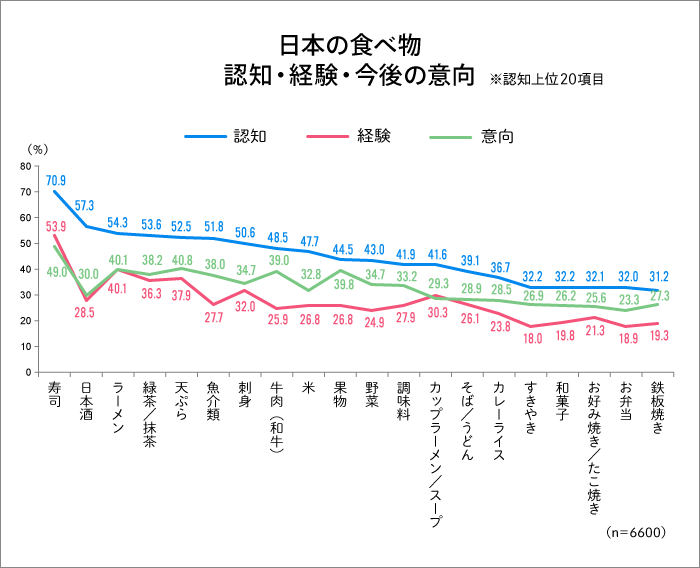
When asked what Japanese foods they know, "sushi" ranked highest. Next came "sake" and "ramen." While awareness of "sake" is high, perhaps due to it being an alcoholic beverage, experience and future interest levels are not as high. "Ramen," which has high experience and future interest levels, seems to be more popular globally.
Breaking it down by gender and age group, women, especially younger women in their 20s and 30s, tended to be more familiar with Japanese food, particularly Japanese cuisine. Among women in their 20s, awareness of "ramen" exceeded 60%, and "soba/udon" was known by half, showing generally high scores overall.
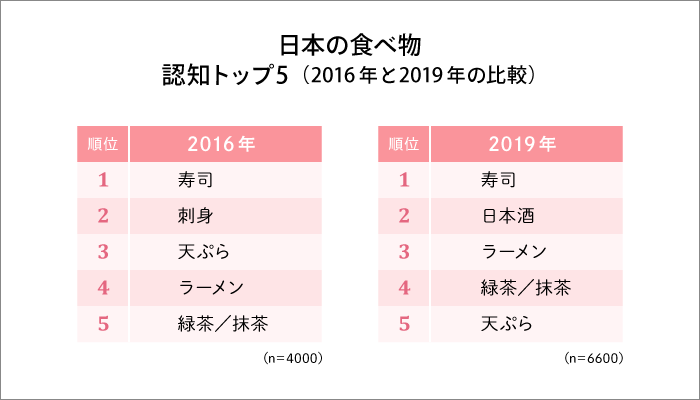
Looking at the results from three years ago (2016), "sushi" ranked first in awareness, experience, and future intent. This trend has remained unchanged since the survey began, maintaining its unshakable top position.
However, comparing "awareness" specifically reveals significant shifts in the rankings below first place, indicating a rapid expansion in the breadth of Japanese cuisine over these three years. "Sake," previously unranked in the top positions, rose to second place, while "ramen," previously fourth, surpassed "sashimi" and "tempura"—long considered synonymous with Japanese food—to rank third.
This shift is likely significantly influenced by the experiences and word-of-mouth sharing of the many foreign tourists visiting Japan.In the 2018 survey, when visitors to Japan were asked "What did you do in Japan?", "Eating Japanese food" ranked first, cited by over 80% of respondents. Furthermore, videos showing foreign tourists surprised by the differences between Japanese food in Japan and what they eat back home have gone viral. The dissemination of the authentic appeal and deliciousness of Japanese cuisine is likely deepening understanding and increasing interest in it.
Asia craves Wagyu beef, while Europe and America prefer vegetables and fruit. What people want to eat varies by region!
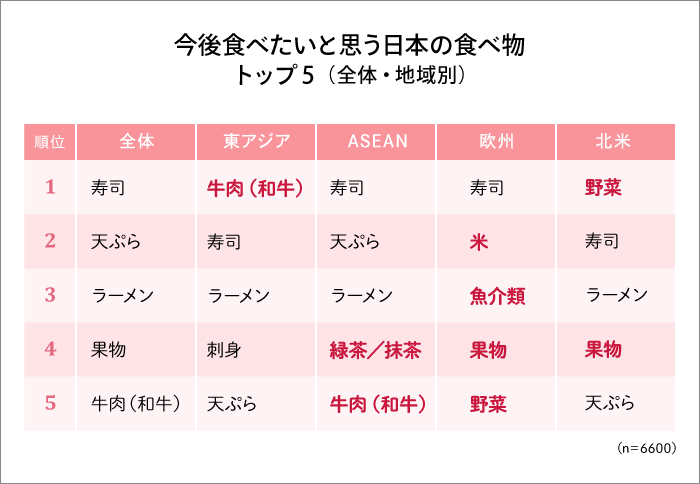
Next, looking at responses for "Japanese foods they want to try in the future" by region reveals distinct trends. In East Asia, "beef (Wagyu)" topped the list, surpassing "sushi." Beef also ranked 5th in ASEAN, highlighting Wagyu's popularity across Asia.
In contrast, "vegetables" ranked highest in North America. In Europe, the top five were dominated by ingredients: "rice," "seafood," "fruit," and "vegetables." While Westerners, especially Europeans, may be less familiar with the variety of Japanese cuisine, their strong interest in ingredients is a defining characteristic.
The 2018 survey asked about "the image of Japanese ingredients," with items like "high quality" and "attractive appearance (color, shape, etc.)" ranking highly.
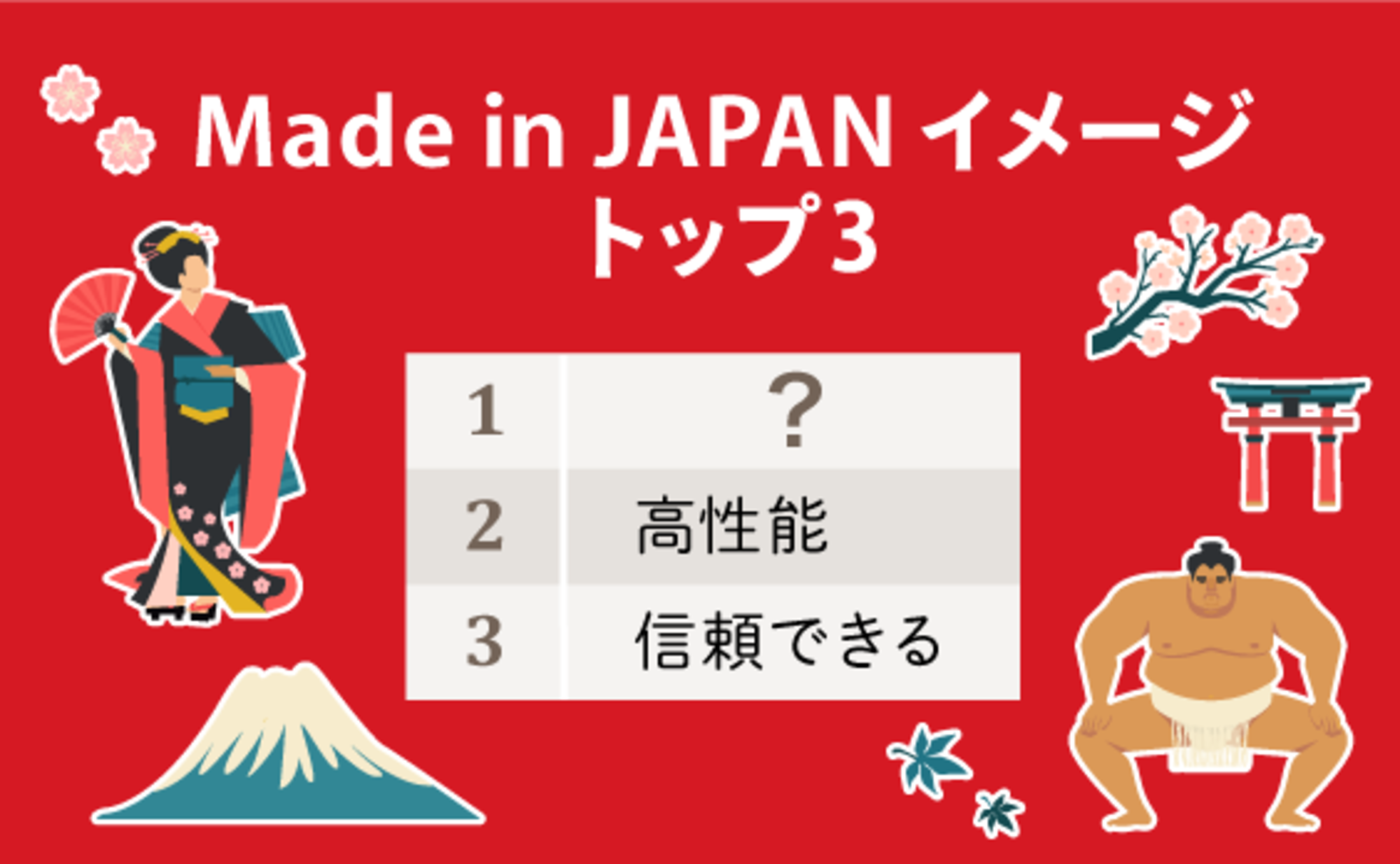
As mentioned in the previous article regarding the image of Made in JAPAN, high quality is highly valued. This same image applies to ingredients, suggesting future potential for visually appealing foods.
When do people want to buy Japanese food? Focusing on regional differences
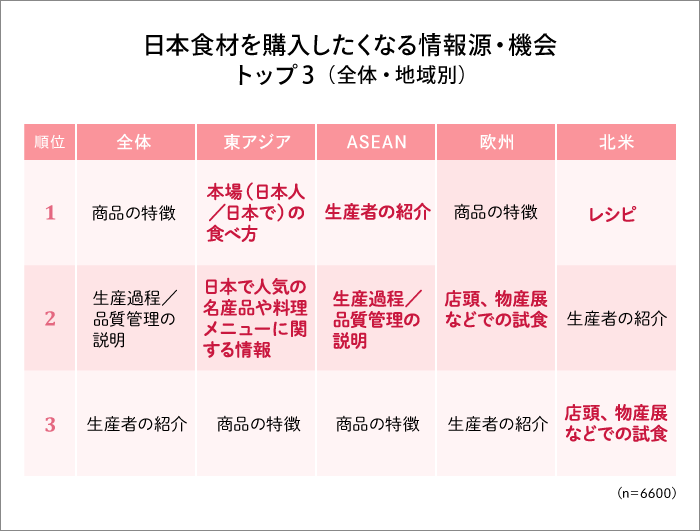
Japanese ingredients and foods are highly sought after in Europe and America, and with the Japanese government's promotion, exports are expected to increase significantly in the future. What kind of initiatives would be effective in getting people to buy Japanese ingredients and foods?
In East Asia, where Japan is well-known, many people want to know "how it's evaluated and eaten in Japan itself." In ASEAN countries with high pro-Japan sentiment, there's a tendency to focus on "how the product was made in Japan," such as introducing producers and explaining production processes.
In Europe and North America, where Japanese cuisine is still relatively unknown, there is a clear tendency for consumers to first want to understand what the products are through "tasting" and learn how to use them. These findings highlight the need to reconsider sales approaches tailored to each region and country, taking into account differences in psychological distance from Japan and the penetration level of Japanese cuisine.
Through this series focused on inbound tourism, I've realized that not only are foreign tourists increasing, but starting with them, we can see the growing image and appreciation of Japanese products, along with the spread of Japanese cuisine. It also became clear again that perceptions of Japan vary significantly by region.
Looking ahead to 2020 and the 2025 Osaka-Kansai Expo, business opportunities originating from inbound tourism will continue to expand. Next year, in particular, marks a pivotal turning point that will shape Japan's future. How can we leverage this opportunity to engage those who have not yet visited Japan or shown interest? We hope these survey findings will inform the development of strategies that can be sustained into subsequent years.
[Contact for Inquiries Regarding This Matter]
Dentsu Inc. Japan Brand Project Team
japanbrand@dentsu.co.jp
Japan Brand Survey Hub Page
https://www.dentsu.co.jp/knowledge/japan_brand/
[Purpose of the Dentsu Inc. Japan Brand Survey]
Dentsu Inc.'s proprietary survey initiated in 2011 to understand how the Japan Brand was perceived globally when reputational damage occurred to Japanese agricultural and marine products and inbound tourism following the Great East Japan Earthquake. In 2022, it evolved into a cross-company project activity to enhance expertise through a fundamental restructuring of survey design, analytical approaches, and outputs.In 2025, it will newly plan and build a knowledge portfolio for the general public, aiming to create social value grounded in consumer insights.
The Japan Brand Survey regularly gauges the awareness and actual attitudes of overseas consumers regarding the Japan Brand as a whole, covering areas such as inbound tourism, regional revitalization, food, Japanese products, content, values, lifestyles, and social trends. It visualizes the changing sentiments of consumers and the challenges and potential of the Japan Brand, contributing to increasingly complex corporate activities while also promoting cross-cultural understanding within Japanese society.
【Dentsu Inc. Japan Brand Survey 2019: Survey Overview】
・Target Areas: 20 countries/regions (Mainland China, Hong Kong, Taiwan, South Korea, India, Singapore, Thailand, Indonesia, Malaysia, Vietnam, Philippines, Australia, USA, Canada, UK, France, Germany, Italy, Russia, Turkey)
・Sample Size: 6,600 (Breakdown: United States 600, Mainland China 600, Other Countries/Regions 300 each)
・Survey Period: December 2018
・Respondent criteria: Men and women aged 20–59 (middle-income and above)
・Survey Method: Internet survey
・Research Organizations: Dentsu Inc. (Principal Investigator), Video Research Ltd. (Implementation Support)
[Notes and Disclaimers]
※1: Mainland China coverage primarily limited to Tier 1 cities; Australia limited to the Sydney metropolitan area; Southeast Asia primarily limited to metropolitan areas.
※2: Definition of middle-income bracket: Criteria set per country based on national average income (OECD statistics, etc.) and social class classification (SEC).
※3: Samples were collected with equal allocation by gender and age group for each country/region, then weighted to match the population composition.
※4: Proportions in this survey are rounded to the second decimal place (or first decimal place for some integer values), so totals may not add up to 100%.
※5: Country and region names used in this survey report and on the website follow the longstanding views of the Japanese government, as well as Japanese social norms and business practices.
※6: In creating the charts and graphs for this survey, the names of countries and regions analyzed use the international standard ISO Country Code (ISO 3166-1 alpha-2/3), with some exceptions.
United States/US/USA, Canada/CA/CAN, Australia/AU/AUS, United Kingdom/UK/GBR, Germany/DE/DEU, France/FR/FRA, Italy/IT/ITA,Spain/ES/ESP, Finland/FI/FIN, United Arab Emirates/UAE, Saudi Arabia/SA/SAU, India/IN/IND, Indonesia/ID/IDN, Singapore/SG/SGP, Malaysia/MY/MYS, Philippines/PH/PHL, Thailand/TH/THA,Vietnam/VN/VNM, Mainland China/CN/CHN, Hong Kong/HK/HKG, Taiwan/TW/TWN, South Korea/KR/KOR, Turkey/TR
※7: Country and region names used in this survey are for statistical or analytical convenience only and do not indicate any political stance or viewpoint.
※8: The maps used in this survey (world map and Japan map) have been partially modified and cropped to suit the analysis content and page layout. They do not necessarily accurately reflect national borders or territorial boundaries.
Was this article helpful?
Share this article


Newsletter registration is here
We select and publish important news every day
For inquiries about this article
Back Numbers
Author
Katsura Nakazato
Dentsu Inc.
Fourth Marketing Bureau
Communications Director
Since joining the company, I have been part of the Marketing Section. I have been responsible for communication planning for companies and government agencies across diverse fields including food, beverages, cosmetics, and apparel. I have also worked on numerous overseas public relations projects for government agencies and local governments. Since 2013, I have been in charge of conducting the 'Dentsu Japan Brand Survey.' I am a member of the Dentsu Inc. Team Cool Japan.