
Note: This website was automatically translated, so some terms or nuances may not be completely accurate.
Japan Brand Weekly Chart
(Updated November 12, 2025)
Challenges in Regional Tourism
Travelers who have actually visited regional areas cited various challenges, including communication infrastructure, Wi-Fi availability, lack of multilingual support, and accessibility. Furthermore, the specific challenges perceived differ significantly by country and region. For example, in South Korea and Taiwan, which have high repeat visit rates, travelers seek vastly different elements: accessibility from urban centers, tourist facilities and attractions, and interaction with local residents. Therefore, it is crucial to be mindful of these differing segment characteristics.
Given the limited total volume of visitors to regional areas (based on total foreign overnight stays) – approximately 30% of the total – and its skewed distribution (with East Asia accounting for about 50%*3), strategic market selection is essential to expand business opportunities in regional tourism.After relatively comparing cultural receptivity and maturity in visiting Japan, it is essential to accurately identify markets that should be cultivated mid-to-long term and those that can contribute to the regional economy in the short term. This requires the courage and initiative to proactively formulate and execute a vision, including measures to expand local consumption.
(Updated November 5, 2025)
Convenience Stores and Drugstores
Among experiences attracting high interest in inbound travel are "Japanese cuisine" and "natural scenic spots" as symbols of Japanese culture, alongside "experiencing the four seasons," "strolling through downtown areas," and "experiencing traditional culture." Notably, "shopping at convenience stores" garners significant interest despite appearing like an everyday activity.
Looking at purchasing intentions at commercial facilities, convenience stores show relatively high selection rates, while drugstores have room for future growth in terms of understanding and penetration. Furthermore, focusing on "quantity selection" as another indicator of consumption intent reveals particularly high levels of consumption intent in Southeast Asian markets, excluding Singapore.
(Updated October 23, 2025)
Generative AI Utilization
Clear regional differences exist in the usage rate of generative AI in daily life. Notably, ChatGPT usage is exceptionally high in India and Southeast Asian countries like Malaysia, Indonesia, Vietnam, and the Philippines, while developed nations such as South Korea, Europe, the US, and Australia still exhibit a cautious stance.
The proportion of people using generative AI as a source of information for overseas travel also shows a stark contrast: while it remains around 10% in developed countries, it is exceptionally high in Malaysia, Vietnam, Saudi Arabia, Indonesia, and India.In these regions, the expansion of usage is likely driven by factors including easy access to English-language services, high digital adaptability characteristic of mobile-first societies, a population structure centered on younger demographics, and a culture favoring efficient and low-cost choices.
In emerging economies where the conditions of "necessity × flexibility × youth × growth orientation" converge, the adoption of generative AI as an "everyday tool" or "personal travel advisor" is rapidly advancing. Conversely, in developed countries, adoption is proceeding cautiously due to concerns about information accuracy, reliability, and security. These regional differences suggest that information gathering for tourism and daily life will become increasingly diverse and complex in the future.
(Updated October 16, 2025)
Ramen & Udon
Southeast Asian countries like the Philippines, Indonesia, Malaysia, Thailand, and Vietnam show a high affinity for Japanese noodle dishes overall, with acceptance levels notably higher than in other regions. Hong Kong, Taiwan, South Korea, and Singapore tend to strongly recognize ramen as a symbolic Japanese food. Conversely, Saudi Arabia, Western countries (excluding Canada), China, and India are primarily below average for both ramen and udon.
Saudi Arabia, in particular, ranks significantly lower than other countries and regions. This trend contrasts sharply with fellow Islamic countries like Indonesia and Malaysia, highlighting an intriguing diversity of preferences that cannot be explained solely by religious background.
While ramen enjoys high global recognition and represents Japanese cuisine worldwide, udon sees strong support primarily in Southeast Asia, revealing regional preferences. This suggests that despite being everyday dishes, udon's flavor diversity, dashi culture, and unique texture are accepted as embodying Japan's distinctive dedication and ingenuity.
Yakitori & Tonkatsu
The Philippines shows a notably high interest in meat dishes overall, demonstrating strong preferences for Japanese yakitori and tonkatsu.In Western countries like the UK, France, Canada, and the US, "yakitori, which aligns with snack or bar culture," is readily embraced. However, interest in tonkatsu, seen as "a dish embodying Japan's unique fried food culture," tends to hover around the overall average. This relatively lower interest is likely due to recent health trends and fat-restriction concerns.
In Saudi Arabia, due to religious restrictions, interest in chicken yakitori is significantly higher than in pork-based tonkatsu. Furthermore, the positioning of the Philippines and China, or Italy and other European countries, clearly shows differences in preferences rooted in each region's food culture.
(Updated October 8, 2025)
Transportation Preferences
The Shinkansen, often cited as a symbol of Japan, has become an essential experience for many visitors. Many travelers likely find themselves instinctively choosing the bullet train over air travel.
This survey analyzed domestic travel methods for inbound tourism. The proportion choosing the Shinkansen was particularly high in Taiwan, Singapore, South Korea, and Thailand. Conversely, the UK, US, India, and Saudi Arabia fell below the overall average. Notably, in India, Saudi Arabia, and the US, there was little difference in preference between the Shinkansen and domestic air travel.
How Travelers View Transportation in Japan
The top reasons for not choosing air travel were "enjoying the scenery along land routes" and "wanting to enjoy the journey itself," clearly indicating a tendency to view the travel experience itself as part of the tourism, rather than prioritizing speed or efficiency. Additionally, one in four respondents cited "short travel distances."
Particularly in East and Southeast Asia, there is a strong tendency to value the Shinkansen as a symbolic and sensory experience without a clear reason, suggesting that travel is perceived as a special time to "experience Japan."
(Updated October 2, 2025)
Visiting Japan and Pilgrimage
Among prospective visitors to Japan (hereafter referred to by country name only, e.g., UK), those from the UK show particularly high interest in World Heritage sites. They surpass American visitors in areas rooted in nature, tradition, history, and culture, such as natural scenic spots, Japanese gardens, visiting shrines and temples, viewing historic sites and buildings, and experiencing traditional culture. This indicates a strong desire to deeply and multifacetedly appreciate Japan's value.Meanwhile, Americans show greater interest in nightlife, tending to be drawn to urban entertainment and modern experiences. We will now delve deeper from these two perspectives.
Point of Focus ① Pilgrimage to Sacred Sites
Mount Fuji enjoys overwhelming popularity in the US, holding an unshakable status as a symbol of Japanese tourism. In contrast, the UK sees Fushimi Inari Taisha rivaling Mount Fuji in popularity, and also surpasses the US in interest toward destinations with high religious and spiritual significance like Ise Grand Shrine, Kumano Kodo, and Kamakura. This confirms a strong affinity for history and traditional culture.Meanwhile, the US shows strong interest in urban culture like Harajuku, while also displaying relatively high interest in certain natural and traditional landscapes such as Yakushima Island, Gokayama and Shirakawa-go, and the Shikoku 88 Temple Pilgrimage.
When considering strategies for regional tourism promotion, it is crucial to recognize that even among countries with similar languages and cultures, there are distinct differences in preferences.
Key Insight #2: Kumano Kodo
Overall, approximately 30% of respondents expressed a desire to experience the Kumano Kodo, indicating a certain level of demand. From a religious perspective, Saudi Arabia, the birthplace of Islam, shows over 50% interest, while within the Christian cultural sphere, the Philippines and Spain exhibit particularly high tendencies.Spain shows a higher preference than other Western countries (US, Australia, UK, Italy), potentially influenced by cultural resonance with the Santiago de Compostela pilgrimage route—a World Heritage site and one of Christianity's three major pilgrimage destinations.
The Kumano Kodo possesses potential as a "global pilgrimage route" transcending religious boundaries, sharing three common elements: ① evoking the universal spirituality of pilgrimage (walking the path of faith), ② the union of nature and spirituality (an environment surrounded by deep forests and mountains where walking and prayer become one), and ③ the practice of curiosity (experiencing shared human spiritual activities alongside historical practices of different cultures).For practical implications, when promoting visitor distribution to regions with culturally and spiritually rich tourism resources, incorporating pattern recognition that transcends specific religious or cultural backgrounds—while grounded in a global liberal arts perspective—is expected to generate new demand.
(Updated September 24, 2025)
Reuse Value
From a circular economy perspective, the reuse of secondhand goods is a crucial element. This survey revealed that interest in Japanese secondhand goods is exceptionally high overall and attracts attention regardless of country or region.
In particular, Japanese products are highly valued by consumers for their "good condition" and "high durability." These characteristics contribute to the competitive strength of Japanese goods, underpinned by Japan's unique reliability and values. Such evaluations can also serve as a foundation for creating and expanding circular industries and for differentiation strategies that are difficult to imitate.
Product Image
Japanese products are highly valued primarily for their functionality. Specifically, they receive higher ratings than rival German products on axes such as "high performance," "high-tech," "high quality," "meticulous craftsmanship," and "practicality."
Conversely, Korean products, which strongly emphasize global expansion, stand out for their design aspects like "stylish," "cool," "beautiful," and "simple," suggesting they gain support more for their aesthetic appeal than for functionality.
While human lifespans are increasing, the period during which companies can remain consistently successful—the so-called winners—is shorter than ever before. However, as long as free competition is demanded, we cannot afford to neglect the efforts required to survive. Product image is merely one element constituting a product or brand. Yet, it is precisely by diligently contextualizing these "points" that we can uncover clues leading to the future.
Know your enemy and know yourself, and you will fight a hundred battles without danger. Recalling this famous saying by Sun Tzu, who lived roughly contemporaneously with Socrates and Plato in ancient Greece, it is truly fascinating that military strategy from so long ago remains applicable to modern competitive strategy.
(Updated September 17, 2025)
Information Acquisition Methods
A common feature across countries is that Google search and YouTube serve as primary information sources, while newspaper (print) usage remains low overall. YouTube surpasses television in four out of six countries, particularly notably in South Korea, Thailand, and Vietnam.
Generative AI (ChatGPT) shows high usage in Vietnam, while in many countries it remains limited, around 30%. Furthermore, while television and newspapers are often seen as declining, television still holds significant presence in Spain and the UK. In Spain and Vietnam, newspapers (web) also maintain a certain level of usage.
The information acquisition environment is growing increasingly complex due to country-specific structures of information access, markets where digital dominates, traditional media that still wields influence, and the rapid, irreversible penetration of generative AI. Regardless of one's role—whether executive, marketer, or consumer—it is crucial to be mindful that framing the situation through simple dichotomies like "digital shift" or "mass media decline" carries the risk of misrepresenting reality.
(Updated September 10, 2025)
Disparities in Environmental Awareness
Renewable energy garners higher awareness and interest than carbon neutrality in many countries and regions. Southeast Asian nations, in particular, show high levels for both metrics. This is likely due to factors like rising energy demand and power supply concerns, making the adoption of solar power and similar technologies more concretely relatable for consumers.
Conversely, in developed Western nations, both indicators are relatively low. This may stem from insufficient penetration of the abstract concept of carbon neutrality, coupled with "eco-fatigue/decarbonization fatigue/sustainability fatigue" driven by concerns over rising energy prices and industrial competitiveness.Furthermore, while carbon neutrality strongly resembles a policy goal for nations and corporations, making it harder to connect with consumers' direct experiences, renewable energy is easier to visualize with tangible benefits like "visible installations" and "direct impact on electricity bills." This difference in perceived benefits is also likely a factor in the disparity in awareness and interest.
This disparity likely stems from a combination of factors: the concreteness of the concept, economic rationality, industrial structure, stage of development, and even variations in translation. Even in environmentally advanced nations, cutting-edge environmental concepts do not necessarily permeate or get implemented at the consumer level, and this gap emerges as a characteristic feature across countries and regions.
Preventive Healthcare and Mental Health
In many countries and regions, interest in "mental health support" tends to exceed interest in "preventive healthcare/disease prevention," a trend particularly pronounced in the Philippines, India, and Western countries. This suggests that mental health is increasingly recognized as a broad societal issue. Conversely, in South Korea, Italy, and France, preventive healthcare dominates, likely influenced by cultures and healthcare systems emphasizing physical health management.
Vietnam and Malaysia stand out for their high and comparable levels of interest in both areas, reflecting a parallel focus on both physical and mental health awareness. In East Asia, while the levels themselves are not exceptionally high, a certain degree of interest in both areas is evident. Countries like France show lower levels of interest in mental health, suggesting that the maturity and openness of societal discourse may influence the level of penetration.
(Updated September 3, 2025)
Japanese Identity
Understanding "Japanese-ness" as perceived overseas is essential for creating demand. The impression of "Japanese-ness" influences various Japan-related consumption scenarios, such as dining, visit timing, destination regions, and overseas exports. The top symbols foreigners associate with Japan were "sushi," "cherry blossoms," and "Mount Fuji."
However, examining this by country/region reveals significant differences in actual cultural reception.Among the top three repeat visitor markets (South Korea, Taiwan, Hong Kong), South Korea showed a distinctly different trend from the others. In Southeast Asia, Thailand appears to have a relatively well-established image of Japan. Turning to English-speaking regions, while the United States is the largest source of visitors, it showed a relatively lower level of understanding regarding specific elements of Japanese-ness. In Europe, neighboring countries Germany and France showed contrasting results.
This research series also conducted domestic surveys on how Japanese people themselves perceive "Japan-ness," and the results differed significantly from overseas perceptions. This discrepancy is not limited to this specific item; the Japan-ness that domestic audiences wish to promote does not necessarily align with the Japan-ness that is actually perceived overseas. Understanding this gap and strategically designing points of mutual connection is essential.
(Updated August 27, 2025)
Inbound Foundational Strength
When comprehensively examining prefectural-level awareness, visit experience, and future visit intentions among inbound travelers, "Tokyo" stands out overwhelmingly above others, followed by widely known tourist destinations like Hokkaido, Osaka Prefecture, and Kyoto Prefecture. Notably, there has been little significant change in this top tier over the past decade, suggesting that brand strength at the prefectural level has become somewhat fixed.
At the city level, Sapporo, Osaka, and Kyoto stand out with exceptionally high recognition, clearly distinguishing themselves from other government-designated cities and core cities.While other cities also enjoy some recognition, there is a clear gap in visitation experience compared to the top cities, and little difference within the same group. This highlights the dilemma between awareness and action: mere recognition does not directly lead to visits, yet without recognition, a destination won't even be considered as a visit option.
The analysis across prefectures and major cities reveals a strong Matthew Effect* at work in inbound tourism fundamentals, creating a structural challenge of "concentration due to strength."Challenges manifest across multiple dimensions: disparities in awareness and visit experience in regional areas, uneven distribution of visit timing, skewed understanding of "Japan-ness," and regional gaps in awareness and visit intent for commercial facilities. These issues demonstrate the multifaceted nature of overtourism and the high difficulty of addressing it.
※Matthew Effect = Cumulative advantage. A phenomenon where favorable evaluations of outstanding individuals or organizations tend to lead to further success.
Japan Brand from a Gen Z Perspective
What does the Japan brand mean to Generation Z? To answer this question, this chart visualizes the positioning of actual corporate and product brands by integrating three evaluation axes: awareness, favorability, and usage experience.
First, the three companies representing the general electronics, game/toy, and apparel industries are considered to have the highest impact as Japan brands. They significantly outpace others in favorability and usage experience, demonstrating overwhelming presence. On the other hand, many brands are closely matched in terms of awareness. While achieving a certain level of recognition, numerous brands have not yet deepened engagement through favorability or usage experience.
For Generation Z, mere awareness acquisition is insufficient. Deepening engagement—transitioning from awareness to usage experience—is the key factor that will determine the future of Japanese brands.
(Updated August 20, 2025)
Image of Japanese Food Products
The image overseas residents hold of Japanese ingredients is overwhelmingly positive, strongly associated with elements like "delicious," "fresh," and "high quality." This perception is likely driven not only by the inherent quality of the ingredients themselves but also by the added value associated with the "Made in Japan" origin. However, significant differences in perception exist between countries and regions, necessitating finely tuned marketing strategies for each export destination.
"Umami" is often emphasized as a key differentiator from other countries' ingredients. In 1908, glutamic acid, the main component of kombu dashi, was discovered and identified as the essence of umami. Subsequently, the Japanese term "UMAMI" became a common noun in English, French, German, Italian, and other languages, spreading globally.
However, umami is not necessarily a taste universally and intuitively understood by everyone, like sweetness, sourness, saltiness, or bitterness. Japan Brand surveys revealed that while understanding of umami is exceptionally high in Hong Kong, it is not necessarily well-established in Korea or English-speaking countries. This indicates that the domestic common understanding of "Japanese cuisine = umami" does not necessarily translate directly overseas.
Comparing Soft Power
Evaluating a country's appeal from a consumer perspective across five axes—"desire to live," "desire to work," "desire to study," "desire to travel," and "desire to collaborate as a business partner"—reveals significant regional differences. When asked whether Japan holds an advantage over comparison countries, perceptions and actual data often show divergent results.
In evaluations from East Asia, which sends the most visitors, Singapore holds an overall advantage. Particularly regarding work intention, Singapore significantly outperformed Japan. This is likely due to a combination of factors: higher salary levels and purchasing power, lower income tax rates, a concentration of high-value-added industries, acceptance of language and multiculturalism, and opportunities for career development – reflecting the influence of economic, social systems, and living environments.
(Updated August 13, 2025)
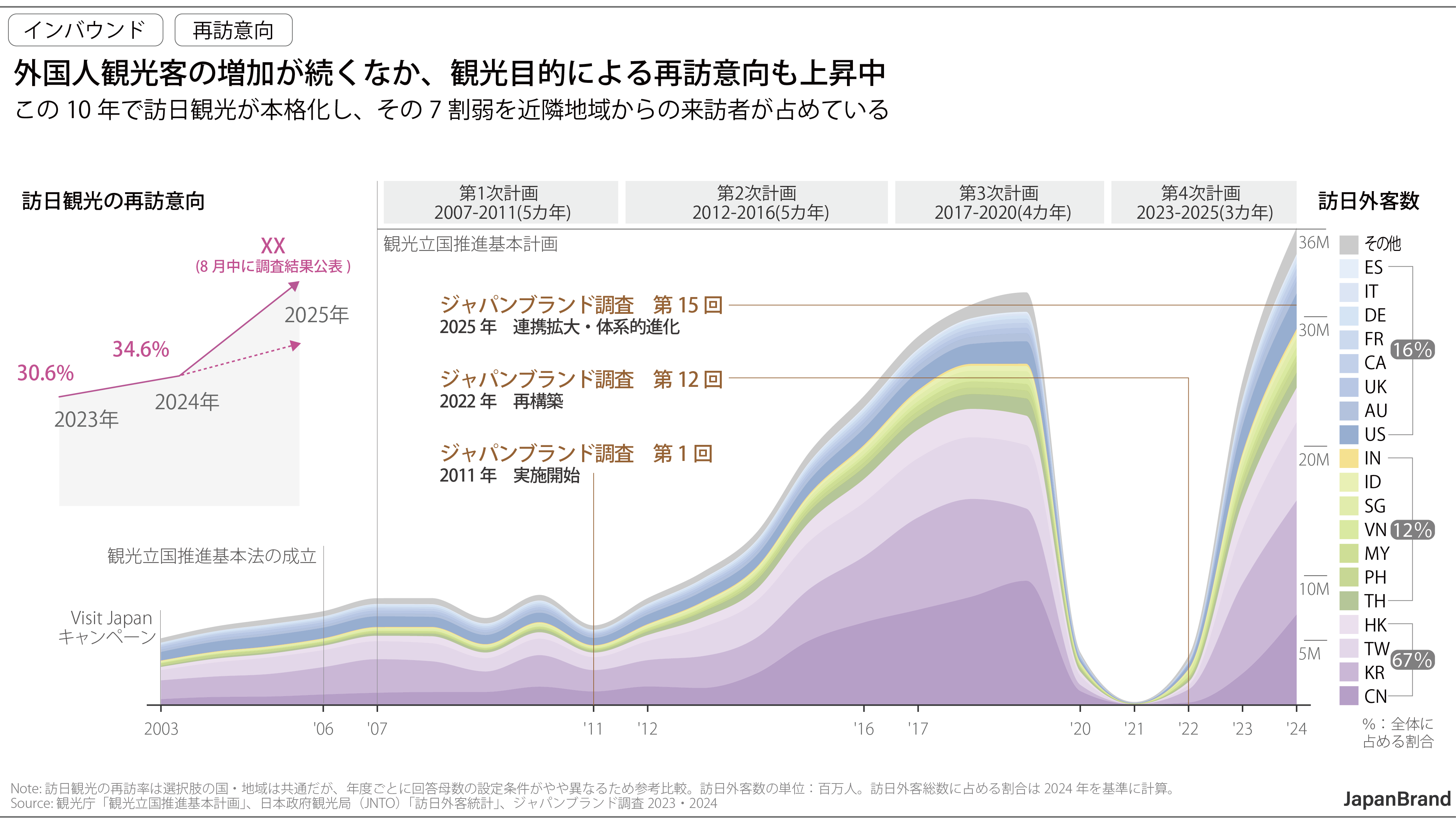
Satisfaction Indicator: Desire to Visit Again
Over the past decade, inbound tourism to Japan has experienced rapid expansion in both market size and visitor numbers. Approximately 70% of visitors come from neighboring regions. Intention to revisit Japan remains high, particularly among countries/regions with high repeat rates and within the Asia-Pacific area.
Note: The revisit intention presented in this chart is based on a multiple-choice, horizontal comparison of revisit intentions to previously visited destinations (countries/regions) among those with overseas travel experience. It is not limited to revisit intentions to Japan among those with prior Japan visit experience.
Expectations for Regional Tourism
As a strategy simultaneously addressing overtourism mitigation and regional revitalization, directing visitors to regional areas is gaining attention as a key approach. Achieving the challenging goal of regional dispersion requires developing tailored strategies and tactics for each area, with the rediscovery and re-editing of tourism resources being particularly crucial for regional tourism. This necessitates regularly identifying potential tourism resources that appeal to overseas consumers, segmented by perspective.
Specifically, on the attribute axis, building engagement with repeat visitors and attracting those with high interest and understanding of Japan are indispensable.On the experiential axis, key elements include: - Seasonal natural landscapes - Environments promoting physical and mental relaxation - Local trains and buses as tourist attractions - Famous hot springs in each region - Historic streetscapes - Local cuisine unique to the area - Gastronomic experiences These elements suggest that what matters most is not material luxury, but the ability to offer the unique scenic and cultural richness of the region through sensory experiences.
Contact:
Japan Brand Project Team
japanbrand@dentsu.co.jp
*Notes and Disclaimers
1. Country and region names in this article are written for a Japanese domestic audience and follow Japanese social norms and business practices.
2. The names of countries and regions used in this survey are for statistical or analytical convenience only and do not indicate any political stance or viewpoint.
3. Percentage figures in this survey are rounded to the second decimal place (or first decimal place for some integer values), so totals may not add up to 100%.
4. Maps used in this survey (world map and Japan map) have been partially modified, processed, or cropped to suit the analysis content and page layout. They do not necessarily accurately reflect national borders or territorial boundaries.
5. For each country/region, samples were collected using equal allocation by gender and age group, and weighted back to population proportions.
6. In creating the charts and graphs for this survey, the names of countries and regions analyzed use the international standard ISO Country Code (ISO 3166-1 alpha-2), with some exceptions.
United States/US, Canada/CA, Australia/AU, United Kingdom/UK, Germany/DE, France/FR, Italy/IT, Spain/ES, Saudi Arabia/SA, United Arab Emirates/UAE, India/IN, Indonesia/ID, Singapore/SG, Malaysia/MY, Philippines/PH, Thailand/TH, Vietnam/VN, Mainland China/CN, Hong Kong/HK, Taiwan/TW, South Korea/KR
Was this article helpful?
Share this article


