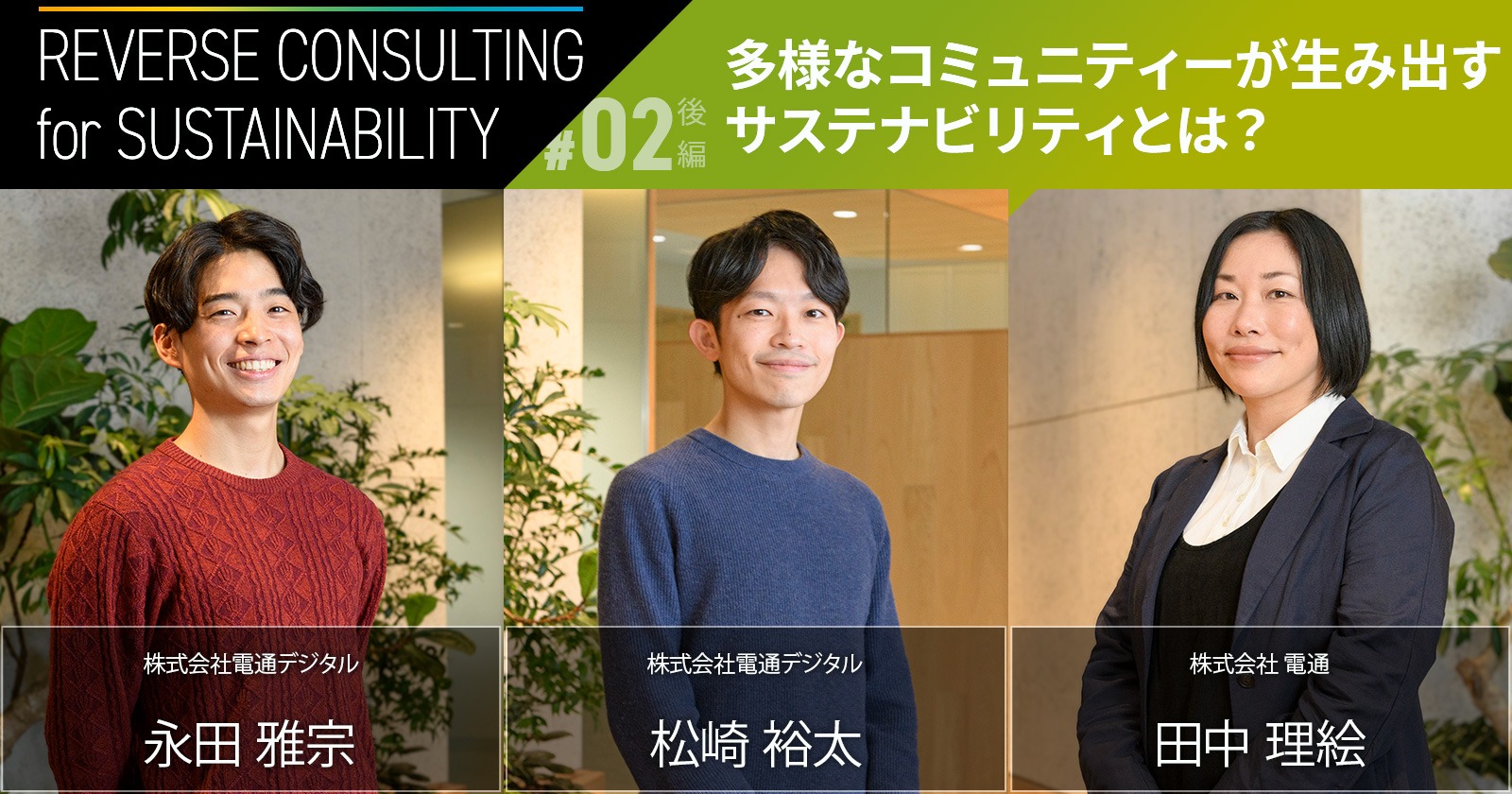
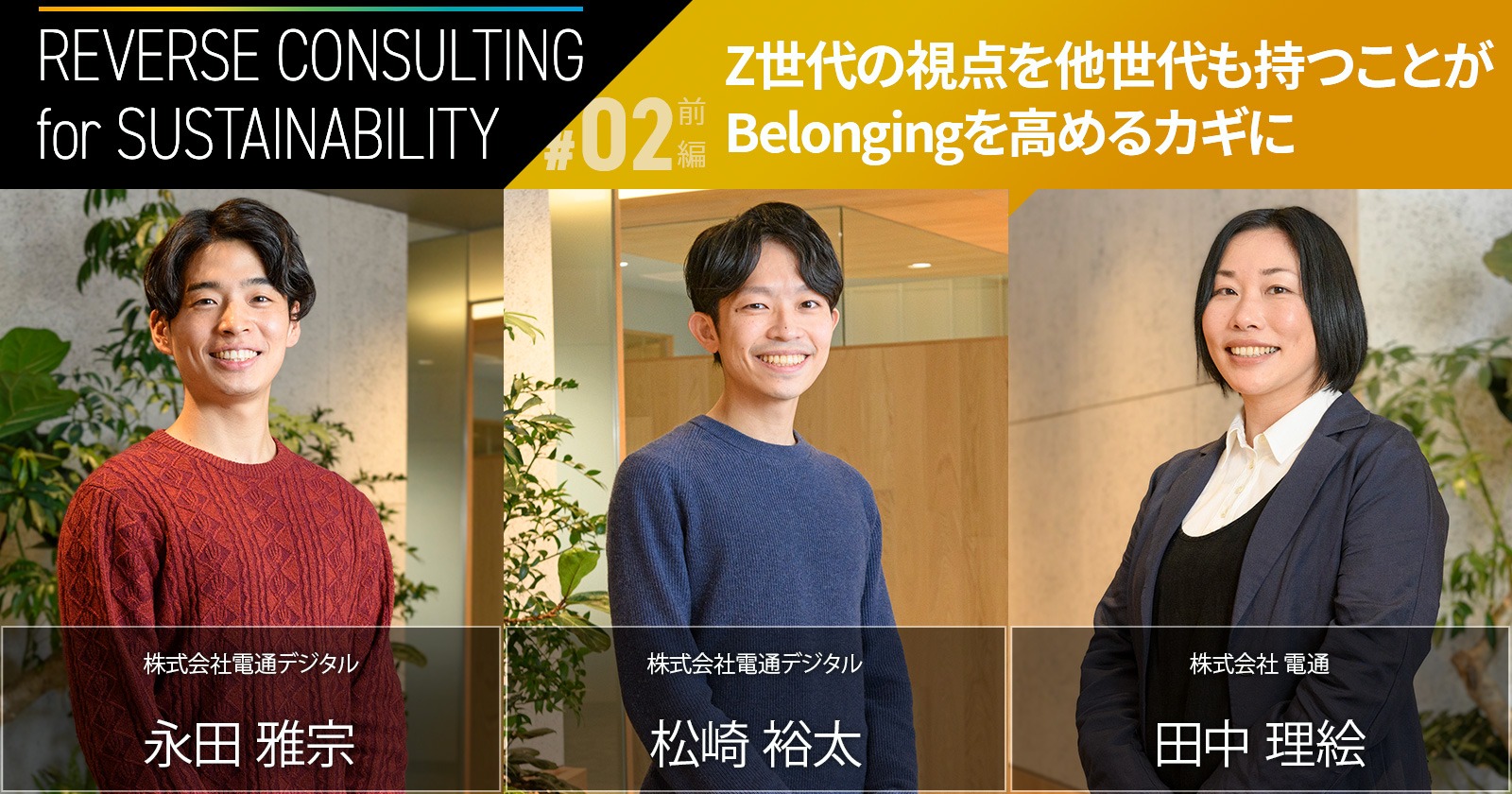
Dentsu Inc. has launched " REVERSE CONSULTING for SUSTAINABILITY," a service that advances corporate sustainability in collaboration with Generation Z, often referred to as sustainability natives.Yuta Matsuzaki, Co-Representative of Dentsu Digital Inc.'s " YNGpot.™ " involved in this service, Masamune Nagata, who serves as a consultant, and Rie Tanaka of Dentsu Inc.'s Sustainability Consulting Office, discuss and interpret the "B" (Belonging) in DEI&B (Diversity, Equity, Inclusion & Belonging), a topic gaining attention in HR and management fields, from a Gen Z perspective.
A culture that leverages Gen Z's "likes" becomes a driver for sustainability advancement
Tanaka: Dentsu Digital Inc.'s "YNGpot.™" is unique because it includes digital native members who approach the entire process—from initial insight research to final impact verification—entirely from a Gen Z perspective. Applying this to sustainability business directly connects to "REVERSE CONSULTING for SUSTAINABILITY." I'd love to hear about the insights you've gained so far.First, could you tell us about YNGpot™'s activities?
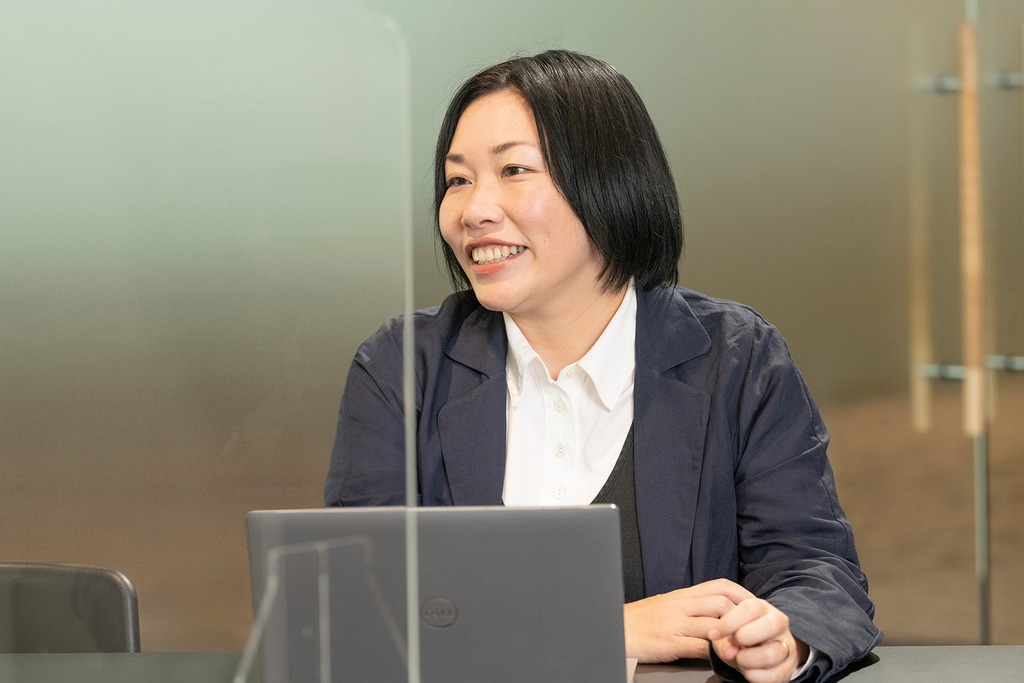
Dentsu Inc. Rie Tanaka
Matsuzaki: As a premise, YNGpot.™ values the concept of the digital native generation more than the Gen Z categorization. People's behavioral patterns and values have changed significantly alongside the volume of information. Consequently, differences in behavior and values exist between the pre-digital and post-digital generations. Therefore, we approach it not through generational theory like Gen Z, but through the lens of "how they engage with digital."
Tanaka: What are the key characteristics of business consulting conducted from the perspective of the digital native generation?
Matsuzaki: It may seem obvious, but the services and products digital native generations seek to resolve their own frustrations and dissatisfactions are often digitally-based. Companies must continuously develop new businesses and services that meet these needs.However, we must not forget that they are a generation that can connect with many people's lives through digital technology. They are also a generation that cannot turn a blind eye to others' misfortune for their own satisfaction. Therefore, when designing services, while the satisfaction of the digital native generation itself is important, we place great importance on developing digital services and advancing projects from the perspective of "how can we balance this with the happiness of others around them and the happiness of the society led by the next generation?"
Tanaka: "Wanting to create opportunities for others' happiness starting from what I love" is a mindset we often hear when interviewing Generation Z. When they say things like, "I started because I liked it, rather than for the sake of the global environment," it really captures the essence of Generation Z changemakers (those tackling social change and solving social issues). Previously, when we held a webinar with Mr. Matsuzaki, a university student who spoke on stage also mentioned, "First, do what you want to do, what excites you," which was very memorable.
Matsuzaki: Ultimately, advancing a business is about "people." While it's crucial for the team to work hard to satisfy customers, I believe the sequence of enjoying creating something we genuinely want ourselves or something we truly believe will benefit someone close to a team member, and then involving customers in that, better harnesses the strengths of the digital native generation.
To achieve this, it's crucial that both client companies and their own members respect each individual on the project team as a person, not just as "labor." In an era where everyone has aspects that make them a minority, it's desirable to create a team environment where anyone can take leadership and diverse perspectives contribute to the discussion. Furthermore, incorporating a sustainable perspective and maintaining a flexible attitude to adapt to societal changes would be even better.
Dentsu Digital Inc. Yuta Matsuzaki
Tanaka: That seems very much related to the recently prominent DEI&B perspective.DEI (Diversity, Equity, Inclusion) is from the corporate perspective, while B (Belonging) is from the individual perspective. Rather than viewing employees solely as corporate resources, recognizing that "work time exists within an individual's life and personal circumstances, and that relationships with colleagues matter" enhances a sense of belonging. This, in turn, fosters a sense of security within the workplace, increases initiative, and ultimately boosts creativity and productivity.
Thinking this way, both DX and sustainability seem to lead back to reframing the focus from the company to the people, as Mr. Hisashi mentioned in the first session. Could you share your thoughts on consulting in the sustainability domain?
Matsuzaki: Whether it's DX or sustainability promotion, I see both as corporate transformation. Success hinges entirely on whether the frontline staff and employees genuinely want to implement it.Unless everyone—from executives, project leaders, to frontline staff—shares a genuine sense of commitment and a common vision of the desired future state, DX and sustainability initiatives risk becoming ends in themselves. That's precisely why I see tremendous potential in the digital native generation, especially Gen Z. They accept digital and sustainability as natural elements and are a generation capable of viewing issues from diverse angles.
How to foster employee belonging in offices that have become third places due to remote work proliferation
Tanaka: Mr. Nagata, you yourself are Gen Z. What do you think is crucial for achieving the "inclusion that involves not just Gen Z, but other generations too," as Mr. Matsuzaki mentioned?
Nagata: I've personally experienced what was mentioned earlier about "starting from what you love and creating opportunities for others' happiness." At Dentsu Digital Inc., for example, something I did as a hobby was recognized by the company and became part of our internal culture, serving as a catalyst for interaction among people of various ages and job roles.
Tanaka: Could you share a specific example of what you did?
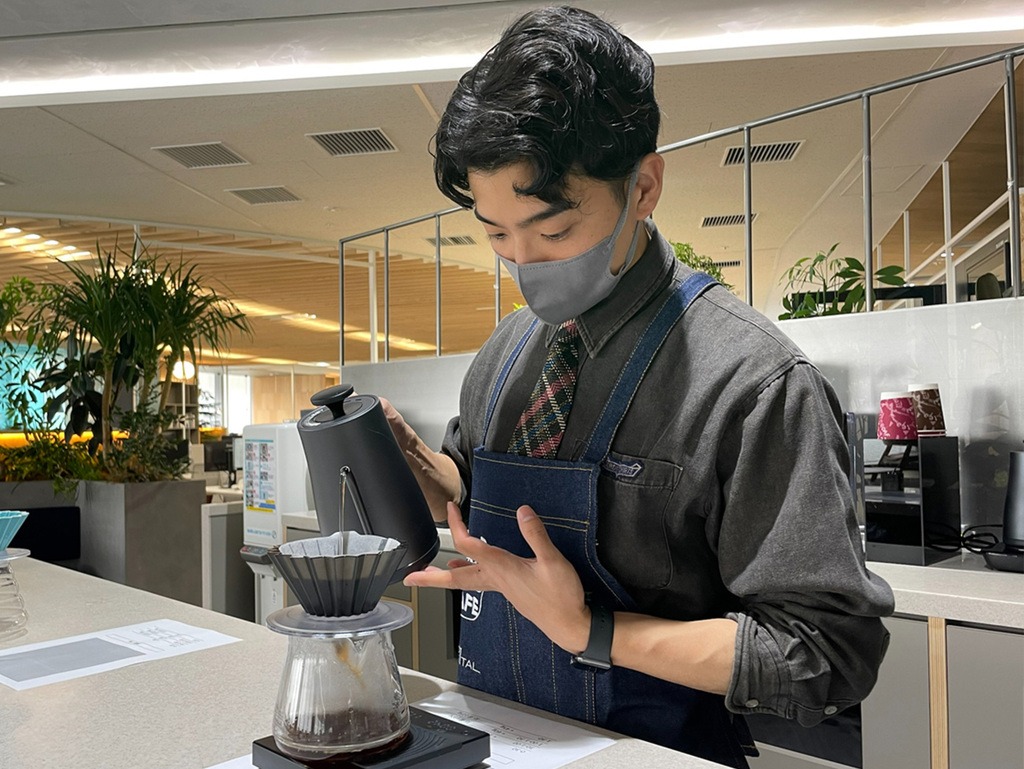
Nagata: Dentsu Digital Inc. has had a "Circle System" since fiscal year 2018.It's a community where people deepen connections through shared interests like sports or music. Within this, I established and now lead the Coffee Circle. Initially, we'd go to cafes for tasting sessions or host events with professional baristas visiting the office. Now, circle members take turns serving coffee at the counter. Collaborating with HR, it's become an official company event where employees from different departments and age groups gather to enjoy coffee.
Dentsu Digital Inc. Masamune Nagata
Tanaka: I recently had the chance to join Dentsu Digital Inc.'s sign language circle. It included several people from outside the company, with a wide range of ages, and I experienced a very open and enriching space. So you have a coffee circle too? I'm envious that you can enjoy freshly brewed, delicious coffee every month right at work. With bottom-up initiatives like this, there's often a risk that only a select few get excited, or that it becomes a gathering of "regulars" where others feel hesitant to join. How do you manage that?
Nagata: On average, about 130 people come to each event, but it's not always the same faces—many are meeting for the first time. We ensure diversity among the baristas, so there are people older and younger than me, and from different departments too. Even if acquaintances gather, the person sitting next to you at the counter varies in age and department. Sometimes the baristas act as coordinators, introducing people sitting next to each other.The waiting time while coffee brews might also be a good opportunity to connect. When orders pile up, I sometimes say, "Please chat a bit while you wait!" and people accept it without issue. That time might seem like wasted time at first glance, but I think it's crucial for building a sustainable organization.
Mr. Nagata, who serves as a barista at company events
Tanaka: I get the impression that digital-only companies, which often prioritize efficiency and quantitative KPIs, are increasingly embracing a trend of actively organizing internal events. These events aim to foster new networking cultures or create digital detox time. Research also shows that teams where people feel connected, not just efficiently divided by tasks, tend to have higher psychological safety and better work performance.
Matsuzaki: That's true. However, if it becomes "We have to make employees get along, so let's assign someone to organize parties and events for that purpose," the means become the end, and I think that often leads to failure.When you make socializing a mandatory task, the organizers get burned out. Especially with Gen Z, they're more receptive to an atmosphere where it's not "I sacrifice myself to make everyone else happy," but rather "I do what I enjoy and feel satisfied. If that happens to make others happy too, that's great." Communities aren't something you build; they emerge as a result. So, isn't the most important thing not to confuse the means with the end?
Tanaka: That's the tricky part. We want people to participate spontaneously and freely, but to get many people involved, we also need company approval to hold it during work hours. How did you secure company support for the coffee event?
Nagata: First, we got permission to use "the most prominent, central spot in the office." They also promoted it as an official company event and covered expenses like coffee beans. Plus, it's huge that the president comes to drink with us.Rather than drawing a line and saying "the young staff are just doing this on their own," he actively participates. Dentsu Digital Inc.'s office won the Minister of Economy, Trade and Industry Award at the 2022 Nikkei New Office Awards. It has a casual, conversation-friendly "lounge" concept, so the culture of everyone drinking coffee together probably fits well with the spatial design.
Tanaka: Don't people say, "We're too busy with work to be making coffee"?
Nagata: I schedule the barista shifts. As long as I don't force busy people onto shifts when they're swamped, it works out fine.
Tanaka: You mentioned older employees are in the circle. I imagine there are cases where you assign shifts to senior colleagues. Was there any resistance to that?
Nagata: Honestly, I never really thought about it. In our day-to-day work, I don't think anyone pays attention to age differences either.
Matsuzaki: Of course, it varies by company, but recently, in a way, the office has taken on aspects of a third place, right? For example, if you consider home the first place, then traditionally the workplace was the second place. With remote work enabling work anywhere, tasks can increasingly be completed entirely online.Certainly, some tasks still require face-to-face interaction. But beyond those cases, when you think about why you'd deliberately go to the physical office, I believe the motivation is increasingly driven by seeking those third-place elements: a change of scenery in the work environment, discoveries born from casual, aimless conversations, or chance encounters with colleagues. As a result, the feeling of going to the workplace is becoming closer to the feeling of going to a coworking space or cafe, isn't it?
Tanaka: Amidst the focus on best practices for addressing departmental silos, the coffee events planned and promoted by Gen Z's Nagata-san offer a tangible experience of the culture that Dentsu Digital Inc. values. They refresh both those brewing the coffee and those drinking it, while also creating opportunities to talk with colleagues previously unconnected within the company. It's a prime example of successfully balancing internal contribution with self-expression, while also fostering inclusion.
When companies provide opportunities for employees to express themselves through their passions and strengths, it enhances their sense of belonging. This, in turn, boosts individual performance, fosters new relationships within the company, and the quality of these relationships ultimately contributes to long-term business results.Fostering a DEI&B culture that starts with Gen Z and engages other generations is precisely the driving force for business transformation and growth that achieves sustainability. It is the core domain of "REVERSE CONSULTING for SUSTAINABILITY." A company's organizational culture can change dramatically just by shifting mindsets. I was reminded that this approach offers high cost-effectiveness leverage, with the younger Gen Z generation becoming key drivers.
Both DX and sustainability advancement hinge on whether the frontlines genuinely want to implement them. If companies officially support Gen Z's motivation—"to create opportunities for others' happiness starting from what I love"—this could also inspire other generations.
This time, we introduced examples within Dentsu Digital Inc. where Gen Z employees are driving initiatives that foster multi-generational inclusion. In the second part, we'll discuss cases where Gen Z perspectives resonated strongly in advancing sustainability efforts at client companies.
Born in 1992. While in school, he conducted research in neuroscience while studying social innovation. He was involved in designing lessons for junior high, high school, and university students at an education-focused NPO, establishing educational facilities in collaboration with local governments, launching a medical-related general incorporated association, and organizing conferences on social issues.
Joined Dentsu Inc. in 2016. Engaged in end-to-end marketing/brand strategy, encompassing promotion, service design, and UX/UI design. Primary industries handled include automotive, beverages, theme parks, IT, and NPOs.
Founding member of the cross-functional internal organization "Dentsu Japanimation Studio" (2018). Researcher at Keio University SFC Research Institute.
Business Transformation Division Marketing Innovation Design Department
After joining Dentsu Digital Inc. in 2019, he has been engaged in supporting clients' DX initiatives. He excels in a dual-pronged approach combining left-brain thinking based on large-scale data analysis with right-brain thinking utilizing design thinking. Most recently, he has been involved in cross-functional projects accompanying clients from new business development concepts through implementation, as well as customer experience design projects. Core member of "YNGpot.™," a solution specialized for digital natives. Head barista at Dentsu Digital Inc.'s in-house café, "L&R Café."
Assumed current position in 2023. Responsible for talent development and organizational development within the organization, as well as sustainability branding, global research, and circular economy business promotion. After working at a telecommunications company, joined Dentsu Inc. and established multiple labs as a principal researcher in consumer behavior studies. Subsequently, helped launch Dentsu Digital Inc. and was seconded for two and a half years to the data science department of a consumer goods manufacturer to drive DX. After returning to Dentsu Inc., he worked in global business for two and a half years and was seconded to establish the Dentsu Group Sustainability Promotion Office in 2022, and was involved in establishing his current department the following year.
Executive Coordinator, Organization for Advanced Science and Social Innovation, Kanazawa University
Certified NPO Service Grant Partner
Certified facilitator of LEGO®SERIOUS PLAY® method and materials