In recent years, the relationship between cats and humans has undergone a major update, ushering in a new era.
This series, "Neko Lab News," features rotating members of "Neko Lab Tokyo" (hereafter Neko Lab), a cat-specialized innovation team launched within Dentsu Inc.'s creative R&D organization, "Dentsu Lab Tokyo." We deliver the latest cat-related projects and unique research and development that combine technology and ideas.
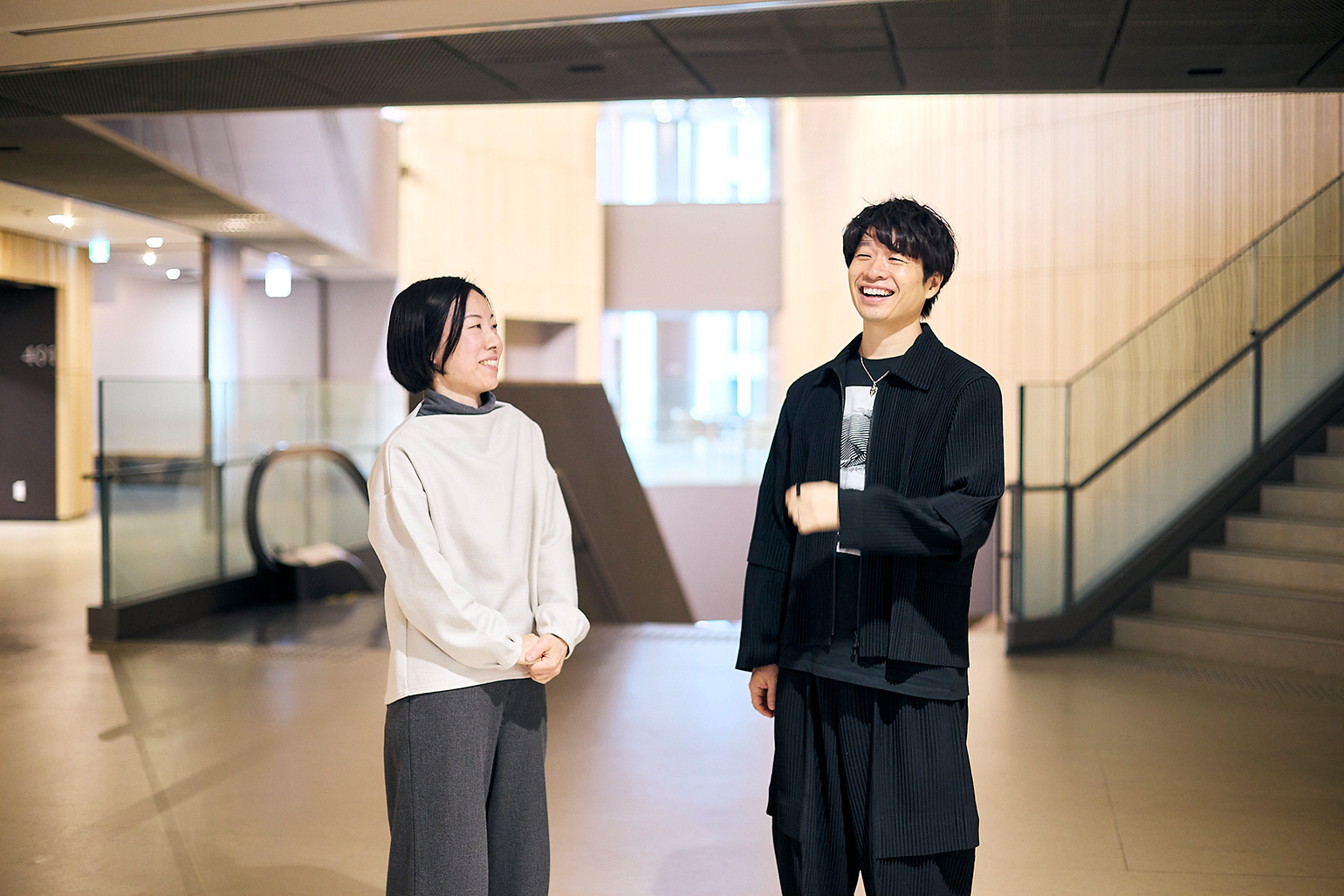
This fourth installment, released ahead of February 22nd, "Cat Day," focuses on the theme of "Childcare and Cats." Creative Director/Creative Technologist Atsushi Otaki spoke with Associate Professor Chiko Saito from Sophia University's Faculty of Human Sciences, known for her cat research.
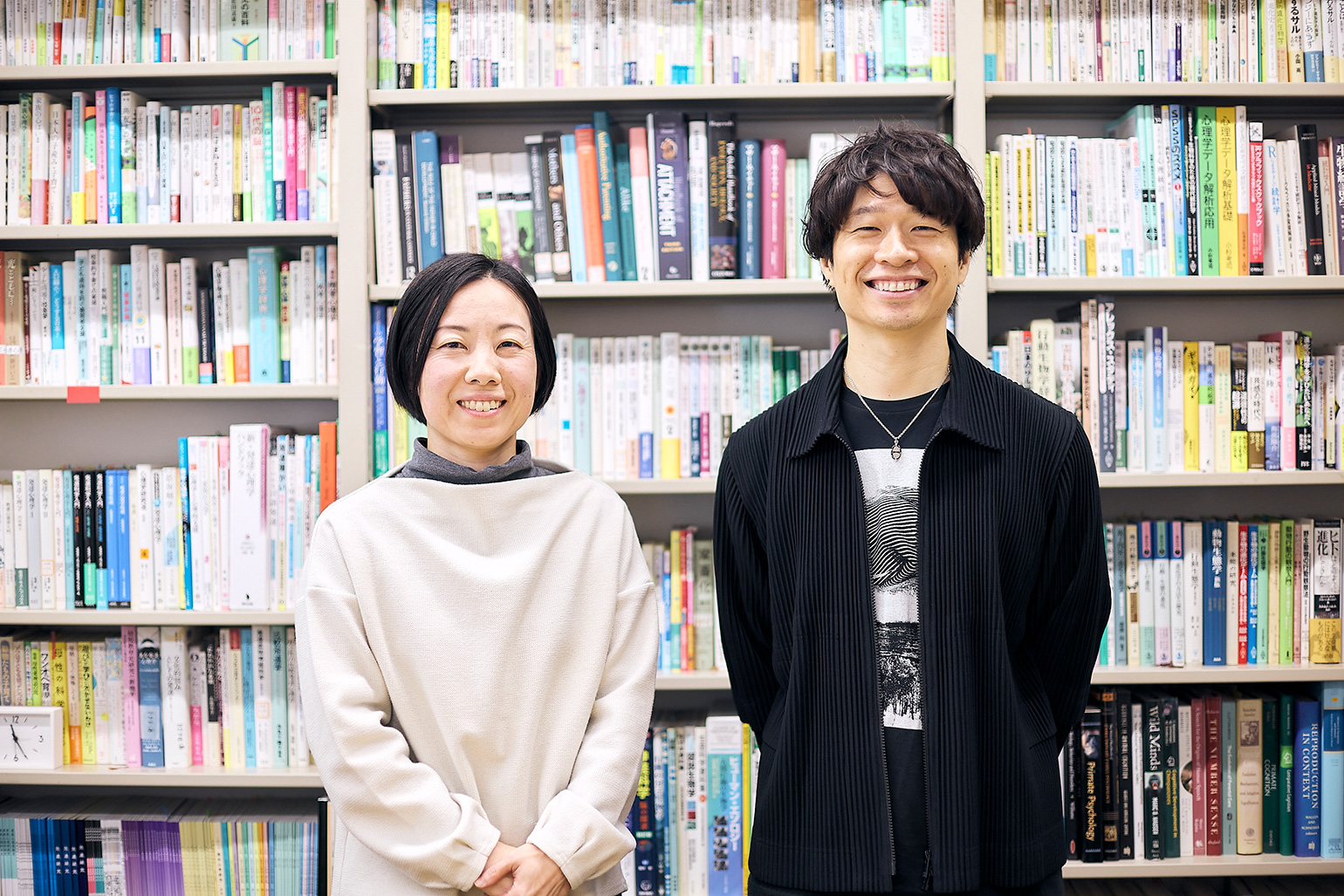
From left: Professor Jiko Saito, Sophia University; Atsushi Otaki, Dentsu Inc.
Cat Research That Started with "Cats Must Understand Humans Too!"
Dr. Saito grew up with multiple cats at his family home. "My beloved cat Okara (male, died at age 16), who I lived with for 15 years, was as calm as a monk. After he passed, I took about a year off, and now I live with the mischievous Mekabu (female, 1 year old)."
Ōtaki: I grew up with cats since childhood. As twins, my sibling and I fought constantly, but cats would often appear and soften the atmosphere. I feel they influenced my own personality development in some way.
These experiences led me to contemplate the subtle distance cats maintain with humans, the communication skills we can learn from them, and—as a dad currently raising my now-adorable 1.5-year-old daughter—the relationship between "child-rearing" and cats.
Today, I'd like to hear from Professor Saito about cats and childcare, and have a discussion.
First, tell us about yourself, Professor Saito! You research the relationship between cats and humans, as well as human childcare. What sparked your interest in this field?
Saito: I started studying cats during my undergraduate years. I joined a lab focused on "behavioral ecology" and "evolutionary psychology," exploring animal evolution through behavior. As I learned more, I became interested in "comparative cognitive science" (*).
When considering what to focus on, I realized I'd grown up surrounded by cats—at my parents' house, my aunt's place, and so on—so I started conducting experiments with cats. However, cat research was scarce back then, and after entering graduate school, I shifted my focus to primates.
Meanwhile, research on dogs was booming. Findings like "dogs deeply understand humans" were being published one after another. But as a cat person, I thought, "Wait, cats are plenty smart too, right?" (laughs). That's when I decided I should study cats and started in earnest.
I also research human childcare. Actually, I used to be really uncomfortable around human babies. After having my own child, I started finding them cute, but I wondered, "Cats are this adorable, so why can't I find human babies equally cute?" That question led me to start researching it.
*Comparative Cognitive Science = A field that analyzes and compares the intelligence and minds of various animal species to clarify how "cognitive functions," including those of humans, have evolved.
Ōtaki: So cat research was that uncommon? Why was it so scarce?
Saito: A major factor is that cats don't behave as you'd like them to. Dogs, for instance, tend to act relatively naturally even in experimental settings, making them easier to study. Cats, however, are creatures that feel strong stress from going outside or environmental changes, so bringing them into experimental settings is difficult in itself.
In recent years, home visits and experiments at cat cafes have been conducted, but many cats dislike the presence of unfamiliar people, making it hard to gather samples. I think these challenges are inherent to cat research.
Ōtaki: Lately, you see it on social media too—people attaching cameras to cats to observe their daily lives. Has this technological advancement made it possible to understand cats, which were previously difficult to handle for research?
Saito: Yes. Cameras like smartphone cameras have become easily accessible, making it possible to film and provide footage of cats in their home environments. This has also made it easier to advance research involving the public, like "citizen science."
Ōtaki: As the Nekobot team focused on technology, we're thrilled that cat research has become easier! It seems like more and more about cats will be revealed as time goes on.
Why do we find cats "cute"?
Mr. Otaki, who grew up with a cat (Aya: lived to 18 years old) that had a profound impact on his family, will now focus on themes like "cats and childcare" and "pet loss," drawing from his personal experience. He will apply his expertise in technology x ideas to develop solutions and conduct research centered around these topics.
Ōtaki: From a comparative cognitive science perspective, are there significant differences in mental cognition and functioning between cats, monkeys, and humans?
Saito: They're completely different. For example, since monkeys are phylogenetically closer to us humans, there are some areas of overlap, but the differences between humans and cats are substantial. However, humans and cats have a long history of coexistence. It's suggested that during this time, cats have evolved to be more easily accepted by humans.
For instance, research shows that the vocalizations of domestic cats are perceived as more pleasant to humans compared to those of their ancestor, the African wildcat. It's thought that during coexistence with humans, individuals that meowed more adorably were more likely to be fed and survive, leading to the evolution of this trait.
Ōtaki: So the "cute" factor is important even in the evolutionary process! Speaking of cats and vocalizations, I also thought the purring sound cats make might play an important role in communication.
Saito: That's right. It's said that the purring sound differs depending on whether the cat wants to show affection or convey a request. Research shows that the purring used to make requests contains frequencies similar to a baby's cry. A baby's cry makes humans feel urgency and triggers a "I want to help" response. Similarly, a cat's purring seems designed to easily grab human attention.
Ōtaki: So, they've acquired these characteristics through the very process of evolution, haven't they? Or perhaps humans evolved to be able to perceive a cat's demands?
Saito: That could be part of it (laughs). Thinking about it that way, you could also see cats as skillfully exploiting this human trait.
Speaking of similarities between babies and cats, there's the "baby schema" facial feature. Large eyes, small mouth and nose, big head... these traits tend to give many people a "cute" impression. Such facial characteristics might also be one reason humans find cats adorable.
Ōtaki: So that's the background behind finding babies and cats "cute." By the way, earlier you mentioned you "couldn't find human babies cute." Yet, when you became a parent yourself, you finally felt that "cuteness" firsthand. Considering that, I wonder if there are factors behind feeling "cute" that can't be fully explained by theory alone.
Saito: Of course, some people likely find babies and cats "cute" based solely on their appearance or voice. But I believe internal factors like hormonal changes within the body, as well as experiences interacting with babies or cats, also shape the feeling of "cuteness."
Ōtaki: Some people start owning cats and switch from being dog lovers to cat lovers. That change might also stem from having experienced interacting with cats. We'd like to unravel that switch too.
Do cats ever mediate disputes between humans?
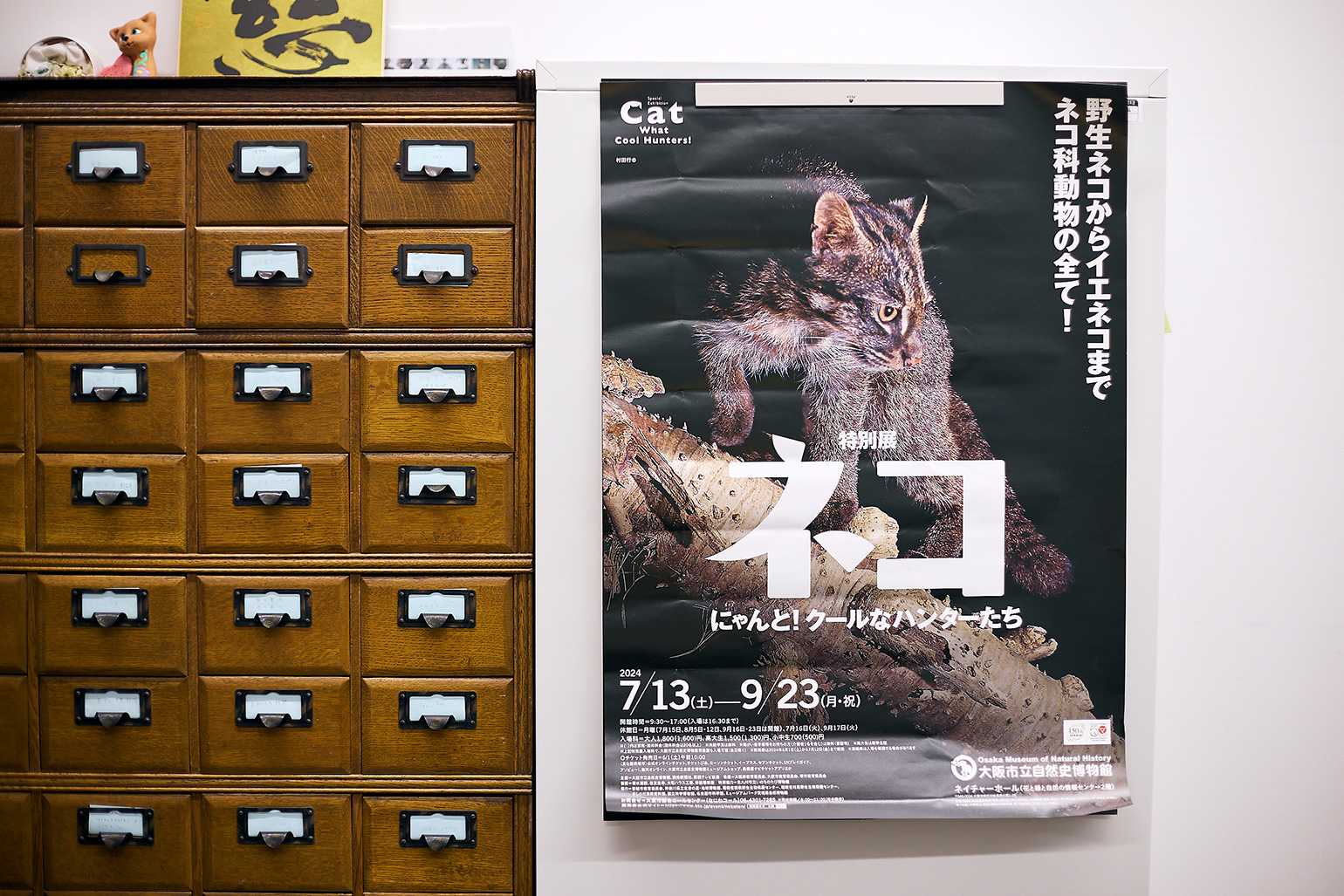
In Professor Saito's lab, one section of the bookshelf is packed full of books related to cat research.
Ōtaki: Cats do have this mysterious presence sometimes. As I mentioned briefly at the start, I often fought with my twin brother when we were kids, but having a cat around would often ease the tension. I think the cat's presence acted like a lubricant. I feel cats might have this power to soften relationships between people.
Saito: I feel that too. My oldest child is going through adolescence, and we sometimes argue. But it's precisely during those times that the cat comes over and meows. Even the cat we had at my parents' house would approach and meow when my parents started arguing, almost as if trying to intervene. That would distract us both, and before we knew it, the fight would calm down.
Ōtaki: So that really does happen. Watching my own parents, I think there were times when they were solely focused on raising their children, and they'd get stuck in this closed-off world of parenting. At those moments, the cat would appear, almost like a neutral third party, showing up just as the tension was thick. I think the cat's presence worked positively for the family dynamics.
Saito: Actually, several studies have reported that cats seem to understand human emotions to some degree. For example, one study asked cat owners about their moods and psychological states via questionnaire, then observed the cats' behavior. It reported that cats showed more rubbing behavior against owners who were in a depressed state.
Thinking about it that way, it seems entirely plausible that cats somehow sense human emotions and adjust their behavior accordingly. As a result, cats might be acting as a kind of relational cushion, softening the interactions between people.
Ōtaki: Hearing this makes me appreciate the significance of cats all over again. And perhaps this "just-right distance" cats maintain could be applied to human parenting. Personally, while raising my own children, I know I need to keep some distance to foster independence, yet I inevitably feel anxious and end up helping with everything... I wonder if we could apply a parenting style like a cat's – maintaining a moderate distance while still being close and supportive.
Can cat-shaped robots replicate a cat's "liquid-like nature"?
Ōtaki: Since Nekoboro is a team focused on cat-related creativity and technology, let me also speak about cats and technology. Earlier, you mentioned that advances in cameras and smartphones have made it easier to collect data on cat behavior, which was previously difficult to study. Professor, do you have any ideas about technologies you'd like to see developed?
Saito: I think it would have to be AI. Recent research is advancing the use of AI to infer a cat's psychological state from images and videos. Since studies show humans surprisingly struggle to accurately judge a cat's emotions, if AI could assist with such judgments, it would likely broaden the scope of research.
In the future, technologies that can detect early signs of illness or monitor a cat's emotional state via camera while you're away might become reality.
Otaki: Beyond the ease of acquiring data compared to before, the dramatic evolution of AI makes the field of cats and AI particularly worth exploring right now. Indeed, if systems develop that can capture emotions through cameras and analyze "current feelings," it seems like there would be many wonderful possibilities.
If we could recognize when a cat is hungry, we could remotely feed them at the optimal time and in the right amount. If we knew they were bored, we could activate interactive pet toys for fun indoor exercise. Accurate emotional recognition will likely accelerate the development of corresponding solutions, which is exciting.
Saito: Additionally, for households with both cats and babies, monitoring tools could be beneficial. When it's just a baby and a cat alone, there's a rare possibility of accidents happening, so having tools to monitor their interactions remotely would be nice.
Ōtaki: Another thought: as technology advances, I wonder if AI-powered "cat-shaped robots" will eventually become more sophisticated. Right now, they aren't as mainstream as dog-shaped robots, are they? There are hardware challenges too – creating a robot with the flexibility of a cat is inherently difficult. But I suspect the real hurdle has been the software design. Unlike dog-shaped robots that follow human commands, there's no single "correct" way for a cat-like robot to behave.
The key point is whether AI can learn and replicate that exquisite behavior—sensing something and distracting you, or making you think "How cute!" without warning. Professor, are there specific elements you think would make a robot feel more cat-like?
Saito: One aspect of cat-like behavior might be that their reactions aren't always predictable. To replicate a cat's capriciousness, making reactions somewhat random could be effective.
Ōtaki: It's interesting that while they might come when called, they don't always respond. Ideally, it wouldn't just feel ignored—it'd be better if they gave that classic cat-like aloof look (laughs). In that sense, studying cat eyes and expressions is crucial.
Personally, I think it would be fascinating to incorporate the characteristic tail movements of cats. While there are robots focused specifically on tails, I don't recall many examples where tail movements are deeply integrated with overall motion and linked to emotions. Even with that cat robot that ignores humans, if its tail were reacting—maybe it's irritated and not responding?—it could suggest a deeper level of communication without feeling disconnected.
Saito: Cats express their emotions with their tails, after all. They might swish it vigorously when angry or hold it straight up as a greeting. It would be cute if a cat-shaped robot could also raise its tail when approaching someone.
Ōtaki: And if we could also recreate that fluffy fur, warmth, and softness, it would feel even more cat-like. When they see someone scary or an unfamiliar cat, their emotions might flare up and their fur might stand on end—is that also very cat-like? Including scenes like that, the hardware advancements will likely open up more possibilities.
Saito: Though people sometimes say "cats are like liquid," how would you recreate that unique softness? It would be fascinating if technology could achieve that!
Ōtaki: Exactly. As materials develop that combine softness and strength, we'll likely see robots with more cat-like bodies emerge. Or perhaps intense cat love will drive technological advancements in this field.
As you mentioned at the start, cats remain largely unexplored, which makes them so compelling to study. It reaffirmed how well our expertise in creativity and technology aligns in this field. Building on our conversation, I hope we can develop even more innovative Neko Lab initiatives.
Faculty of Human Sciences, Department of Psychology
Associate Professor
Completed doctoral program at the University of Tokyo Graduate School of Arts and Sciences. Doctor of Philosophy (Ph.D.).After serving as Assistant Professor and Lecturer at the Graduate School of Arts and Sciences, University of Tokyo, and Lecturer at the Faculty of Education, Musashino University, assumed current position in 2018. Specializes in comparative cognitive science, developmental psychology, and evolutionary psychology. Major publications include "Basic Developmental Psychology" (co-edited, University of Tokyo Press, 2018) and "There's No One Right Answer: Animals Raising Their Young" (co-edited, University of Tokyo Press, 2019).
Atsushi Otaki
Dentsu Inc.
zero/Dentsu Lab Tokyo
Creative Director / Creative Technologist
After pursuing AI research and planetary rover development through graduate school, joined Dentsu Inc. Gained experience in promotion and PR before passing the Creative Exam and assuming current role. Creative Director since 2023. Leverages real-world experiences combined with technology to deliver solutions for corporate and national projects, as well as R&D initiatives. Key projects include integrated communications (CM to digital) for PARCO Grand Bazaar 2024-2025, interactive window displays for SEIKO HOUSE GINZA, overall production for the send-off events for the Japanese Olympic teams at Beijing 2022 and Tokyo 2020, establishment of the JOC Japan Olympic Museum, and production of technological content for the Tokyo 2020 Paralympic Opening Ceremony and Closing Ceremony technological content, the remote communication product "Kibai no Hana" (Flowers of Presence), and the planning and development of the casual sport "Tonton Voice Sumo". He has received over 100 awards domestically and internationally, including the world's three major advertising awards: Cannes Lions, The One Show, and Clio Awards, as well as the ACC Awards and the Japan Media Arts Festival. He is the Chairperson of the Dentsu Inc. Internship "School of Technology and Ideas" (2024-2026). Author of "Creator Job Hunting 2: The Digital Creative Edition." Director, World Yuru Sports Association / Sports Creator

 Nekobako Newsletter [4/4]