Note: This website was automatically translated, so some terms or nuances may not be completely accurate.
 The Cutting Edge of "Messaging" That Supports the Power of Top Management's Words [4/4]
Messages become "delivered" through a PR perspective
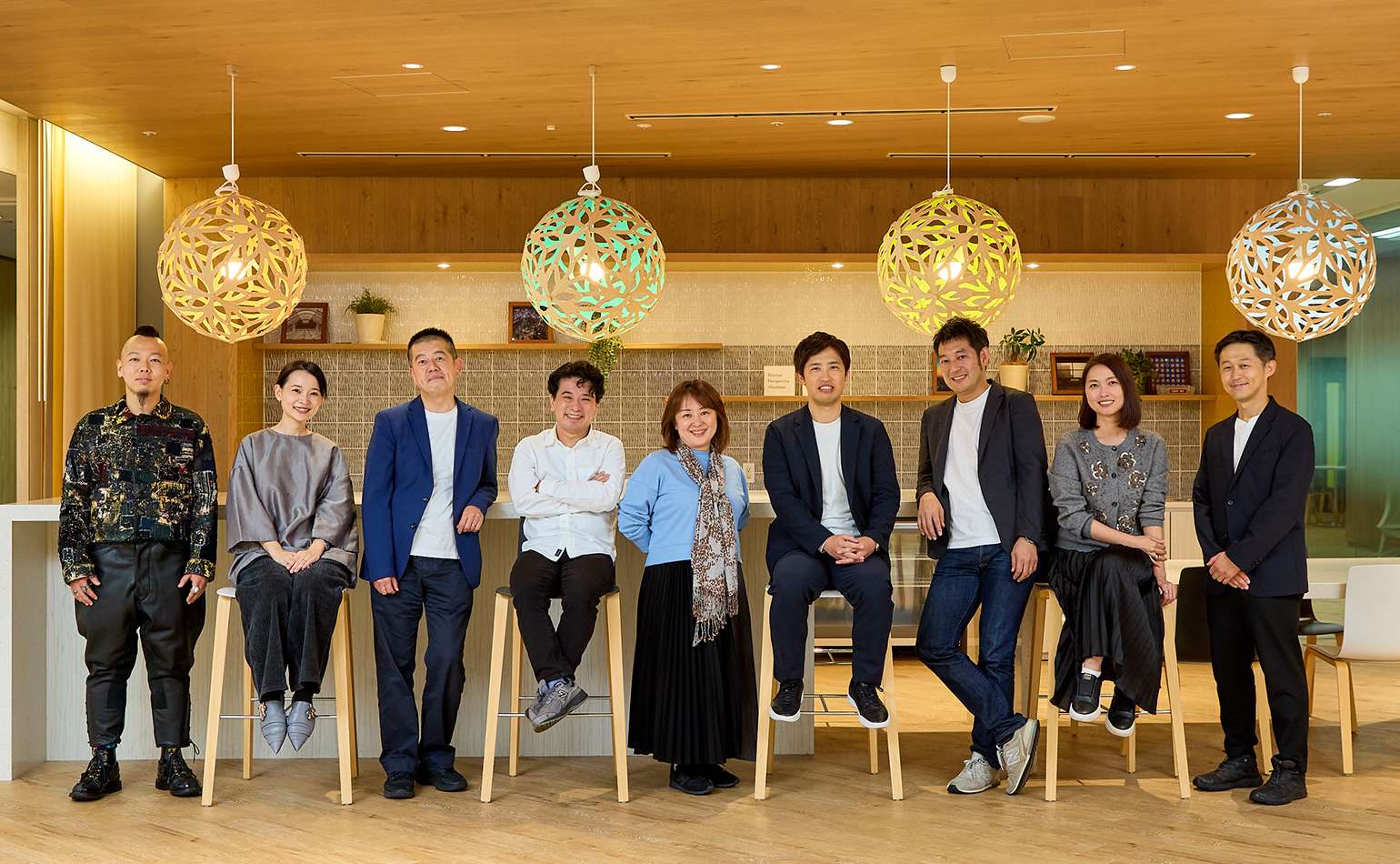
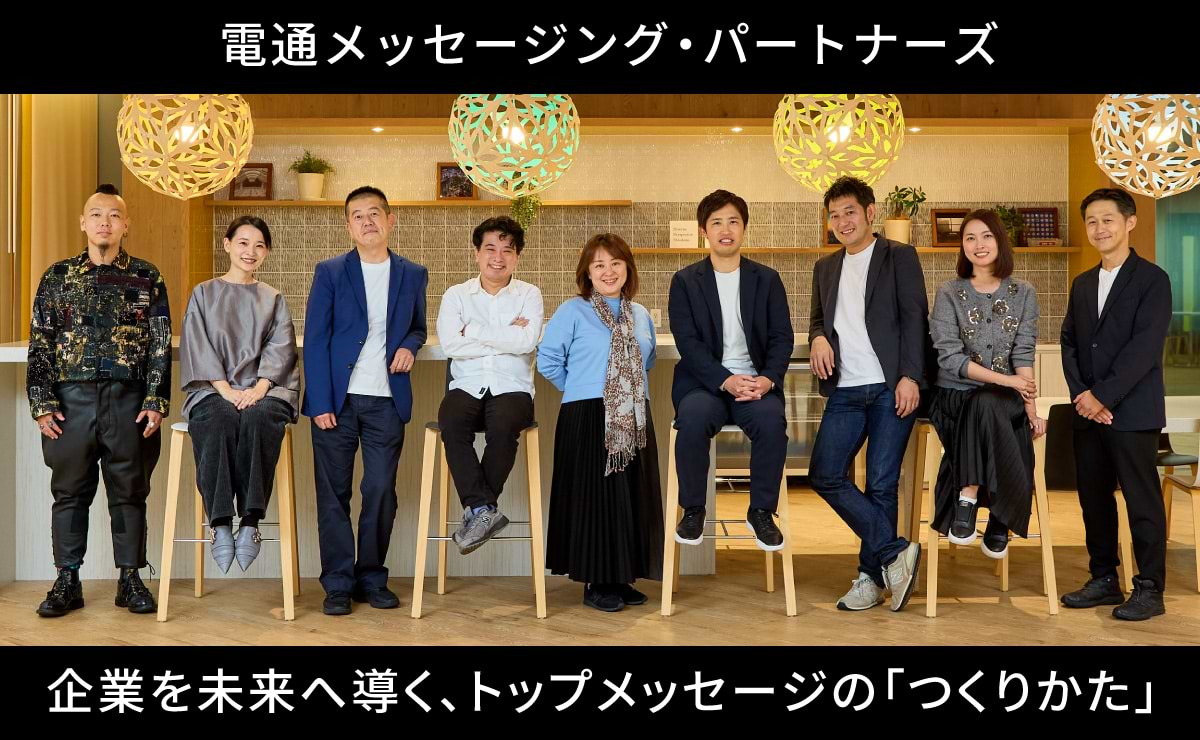
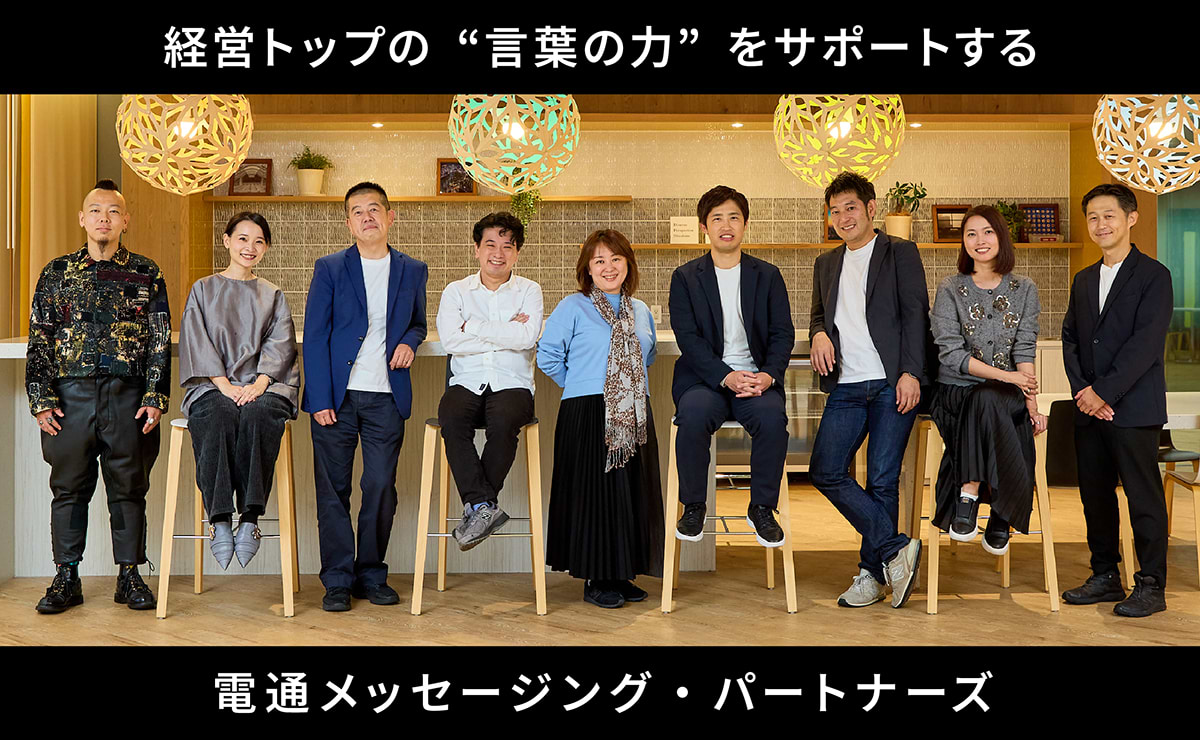
Hello. I'm Shingo Ishikawa from Dentsu Inc. Messaging Partners. In this fourth installment of our series, I'd like to discuss how to deliver messages.
——What is Communication Design that Connects Society and Companies?
When a company engages with society, the first question is "What message should we send?" However, creating a message isn't the end of the story. Only by designing how it is delivered can a company build a healthy relationship with society.
This time, we focus on the "PR perspective" for permeating corporate messages into society.
We will reexamine communication from the perspective of "social dynamics" and outline practical approaches for implementation.
In an Era Where "Wanting to Communicate" Alone Won't Get Your Message Across
In previous installments, we've discussed crafting the core message companies wish to convey.
However, changes in the information landscape, particularly on social media, mean messages are instantly evaluated based on the recipient's interpretation.
Today, it is essential to balance both the "message you want to send" and the "message society will accept." This is where the "PR perspective" – understanding how society will perceive it – becomes crucial.
Five "Eyes" to Develop a PR Perspective
PR has evolved beyond mere public relations activities into a communication strategy that enhances the relational value between companies and society. In other words, the PR perspective means "seeing the company through society's eyes." This time, we introduce five perspectives that connect companies and society.
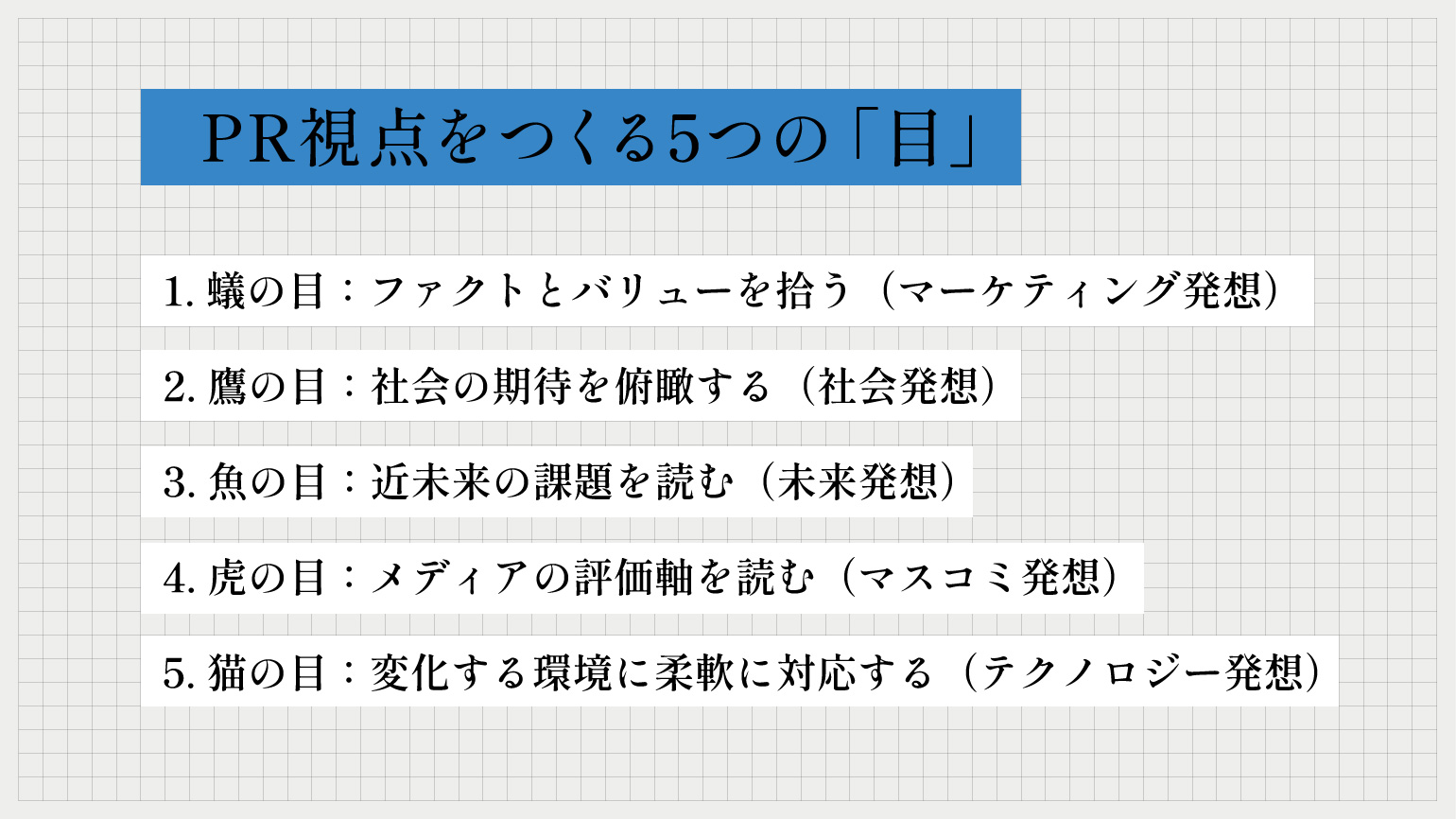
1. The Ant's Eye: Gathering Facts and Values (Marketing Approach)
First, this perspective involves visualizing your company's value by meticulously gathering each "fact" about your organization. By conducting an inventory of concrete, quantifiable value—rather than abstract ideals—your messaging gains persuasive power.
In the third article of this series, we touched on the concept of "taking inventory" of words. Similarly, by broadly examining facts—such as manufacturing processes, service experiences, data, and internal documents—and categorizing and visualizing both facts and value, you can often see what truly deserves to be highlighted.
Overlaying these facts with the developed messages provides material for reframing the message into language that society can more easily understand.
2. Eagle's Eye: Surveying Society's Expectations (Social Perspective)
Next, we take a bird's-eye view of what society as a whole expects from companies, connecting corporate messages with "social expectations." This is a crucial step for determining how well a message will be received by society.
Through sessions and workshops, we survey social trends, public opinion, policies, and industry developments to extract themes impacting our company. We then verify the alignment between the societal perspective and the corporate message, reframing and re-editing the message to incorporate societal viewpoints.
3. Fish Eye: Reading Near-Future Challenges (Future-Oriented Thinking)
This perspective connects future societal challenges with corporate actions, much like reading changes in water currents.
We visualize future lifestyles based on input such as "potential challenges in future society" and "future consumer insights," then determine how the company should respond to these future challenges. By articulating "what kind of society we aim for and what promises we make," we connect future actions with messaging.
In the third installment, we mentioned that "messaging is a map to the future." Connecting to future societal challenges is like navigating toward the destination on that map.
Beyond this, we also collaborate with DENTSU SOKEN INC. to assist in developing new businesses oriented toward the future.
4. Tiger's Eye: Reading Media Evaluation Criteria (Media Perspective)
This perspective involves hunting for newsworthiness with sharp, predatory focus. It also means designing outputs that resonate with media understanding.
The process involves organizing criteria that media outlets find compelling for coverage, such as social relevance, novelty, public interest, and unexpectedness. We then align our company's activities with these axes to identify the specific "angle" that will attract media coverage. Building on this, we construct information content using the "Background → Social Issue → Company Initiative → Future" framework to design a story that media outlets will want to tell.
Since points of interest differ across mass media, online outlets, and specialized publications, identifying "where their interest lies" is key to story design.
5. Cat's Eye: Adapting Flexibly to Changing Environments (Technology-Driven Approach)
Communication environments, including SNS and AI, change frequently. This perspective involves responding nimbly to these changes and selecting the "optimal delivery method."
In recent years, companies have increasingly communicated in their own words through their websites and company-operated SNS. They analyze changes in SNS, video, search, and communities to determine what messages resonate best on each channel. Optimizing how messages are presented—whether "for YouTube" or "for news media"—makes them more readily accepted by society.
By combining these five perspectives, messages evolve into the following state:
- Backed by facts
- Aligned with social trends
- Forward-looking
- Media-approved
- Expanding alongside technology
By refining messages according to this perspective, a company's "stance" becomes something that "communicates" to society.
To ensure message penetration
To maximize the value of your message, the process of spreading it both internally and externally is essential. Here are three representative methods for message penetration.
1. Communicate through top leadership (Top-down messaging)
Words spoken by top management carry unique weight.
Top-level communication gains greater trust and persuasiveness when leaders "speak in their own words" and "structure messages in a way society can readily accept." To support this, we also provide speech training for top executives.
2. Employees Making It Their Own (Internal Penetration)
The moment employees can "speak in their own words," the message becomes part of the organizational culture.
Through workshops and creating internal guidelines or credo books, we cultivate a culture where employees can articulate the company's message.
3. Expanding to Media and Customers (External Communication)
As touched upon in the five perspectives section, messages spread throughout society by providing the media with "reasons to cover" and customers with "empathy and experiences." By extracting news value to capture journalists' interest and designing customer experiences and content, messages naturally permeate society.
Messages that resonate with society
Corporate messages won't be received simply by being communicated.
- Corporate Facts
- Society's Expectations
- Future challenges
- Media Perspective
- Changes in the Communication Environment
Only by integrating these five perspectives can communication emerge that creates resonance between society and the company.
Messaging Partners provide consistent support from message design to implementation, accompanying companies to ensure their "voice" holds meaningful significance within society.
Dentsu Inc. Messaging Partners
Email:messaging@dentsu.co.jp
Was this article helpful?
Share this article


Newsletter registration is here
We select and publish important news every day
For inquiries about this article
Back Numbers
Author

Shingo Ishikawa
Dentsu Inc.
Marketing Division 4 Future Scenario Consulting Department
Senior Consulting Director
After joining Dentsu Inc., worked in the Media Services / Newspaper Division, involved in various aspects of news reporting including advertising, editing, and database support, handling support and negotiation tasks. Joined the current Marketing Division 4 in 2021. Supports corporate rebranding, election-related SNS strategy, corporate communications, and government PR needs analysis. Numerous other achievements.