Note: This website was automatically translated, so some terms or nuances may not be completely accurate.
Kumiko Shimamoto × Ken Awaihara The "Visual Impact" of the Social Media Era

Kumiko Shimamoto
Getty Images Japan

Ken Awaihara
Dentsu Inc.
In this era of social media, where annual smartphone shipments exceed one billion units worldwide and information sharing and dissemination through SNS deepen, the information-conveying power of visuals like photographs and their ability to evoke empathy and emotion are becoming increasingly important. Kumiko Shimamoto, President of Getty Images Japan, a leading visual content service company, and Ken Awaihara, General Manager of the Community Management Department at the Dentsu Inc. iPR Bureau, which pursues communication utilizing social media, discussed the powerful influence of contemporary visual content and the nature of information dissemination.
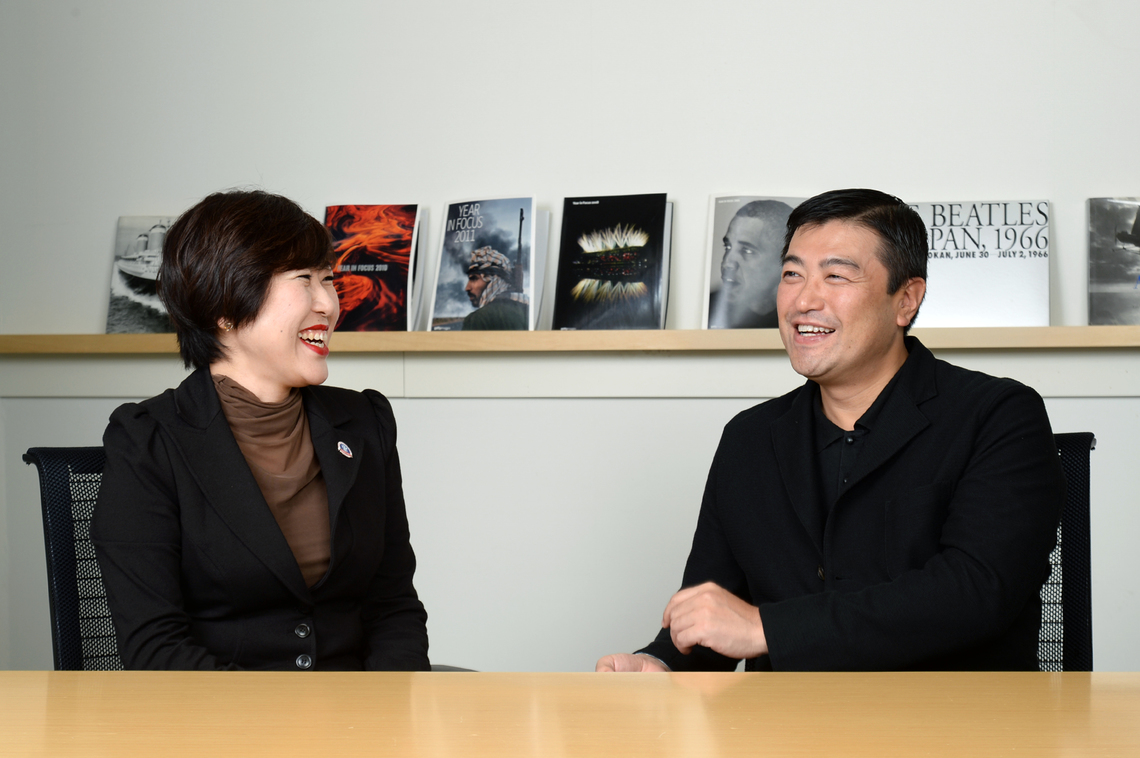
Photographs possess the power to convey everything in an instant
Aihara: My department manages communities using social media, and I see daily how powerful photos are at evoking empathy and emotion. Looking back at Getty Images' long history, many photos have had a significant impact on society. I'd like to ask you again: based on your experience, how do you perceive the power of photography?
Shimamoto: For instance, photos of Princess Diana shaking hands with an AIDS patient or holding an AIDS-infected child played a major role in deepening understanding of AIDS. Diana herself understood the power of photography well. I believe she was very conscious of how her photos would be used in the media, like when she sat alone in front of the Taj Mahal in India.
Furthermore, we've provided numerous photos taken by war photographers. I believe many of these images have sparked public interest in conflicts happening around the world. Text alone can make events feel distant and like someone else's problem. Photography's power lies in making such issues feel personal and relatable.
|
|
|
|
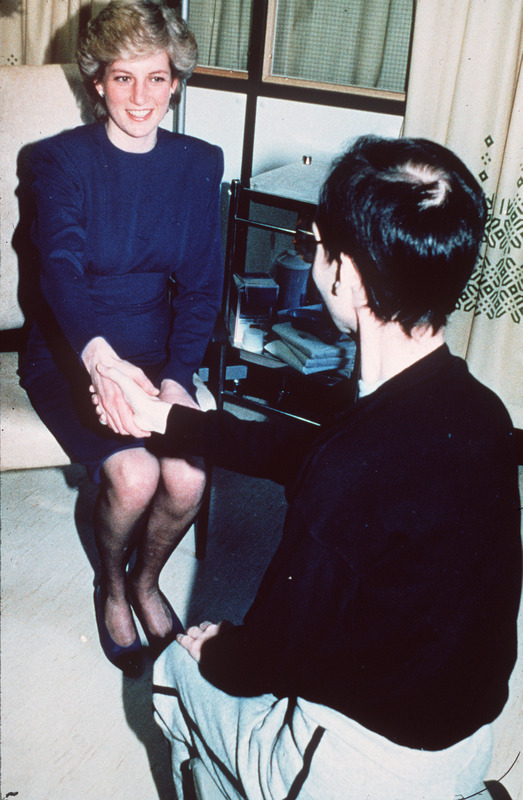


Left: WireImage. Center and right: Tim Graham/Getty Images
Aihara: Sometimes a single photograph conveys everything more effectively than lengthy explanations.
Shimamoto: That was true during the Great East Japan Earthquake. Our company also distributed photos taken by photographers who went to the scene worldwide. People around the world were deeply shocked by each photo, realizing, "This is what's happening in Japan right now." The impact visuals have is truly immense.
Aihara: Visual content includes video, and certainly video offers a reality and wealth of information that photos lack. But photos have the power to capture a single moment. That moment can sometimes reveal the very essence of something.
Shimamoto: The power to capture a moment is also the power to communicate instantly to the viewer. I believe that's a characteristic videos lack.
The keyword of the SNS era is "anti-vanity."
Aibara: The recent proliferation of social media has likely had a major impact even on Getty Images, which has provided vast visual content, including historically famous photographs.
Shimamoto: First, the sheer volume of photos taken has skyrocketed. It's said that 3.8 trillion photos have been taken since photography was first invented in 1826. But actually, 10% of that total was taken just last year alone. With the proliferation of smartphones equipped with cameras, sharing photos has become incredibly easy. For companies like ours in the licensing business, this represents an enormous impact; we truly feel the momentum of the times.
In our business model, we license photos not only from professional photographers but also from ordinary people who upload their snaps to Flickr. We sell these as the "Flickr Collection" on our own site, and it's selling extremely well. The key reason for its success is the "relatability" of the content. With the rise of social media, anyone can now routinely take snapshots and share them on platforms like Facebook. Viewers feel a sense of familiarity with photos uploaded by people they trust. That familiarity breeds empathy and drives sharing. From a business perspective, it becomes a purchasing motivation.
Today, a major theme for companies and brands is how to connect emotionally with users and consumers. Even in the advertising industry, there's a growing preference for photos that evoke a sense of familiarity. This is a global trend, not just limited to Japan.
Aihara: Looking at old photos, people always pose. That was the style back then. Now, both photographers and viewers prefer natural, unforced shots. We sometimes advise on photo techniques in our social media guidelines, and we're very conscious of this point.
Shimamoto: Essentially, what's valued is authenticity, not artificiality. At our company, we constantly analyze trends, and one key term is "anti-vanity." It carries nuances of being a bit relaxed, imperfect, and unadorned. I believe this anti-vanity aesthetic is precisely what resonates in today's era.
As Mr. Awaihara mentioned, while photos where the subject faced the camera directly were preferred in the past, today we tend to favor more natural shots—where the subject avoids direct eye contact with the camera, glances casually to the side, or appears more relaxed. Even in photos using models, we increasingly see people who look like they could be someone you know, rather than obvious models. This trend is especially strong overseas. Recently, Getty Images even added the new term "real models" to its search keywords. The growing preference for models who look like ordinary people is likely part of this broader trend favoring relatable, natural-looking subjects.
Content Marketing Driven by Trial and Error
Aihara: Even with photos of famous people, there are shots that convey an anti-vanity vibe. Photos like President Kennedy playing with children in the Oval Office or images from around the time of the Cuban Missile Crisis leave a strong impression. I imagine the photographers went through a lot to capture those moments.
Shimamoto: At our company , which prioritizes expertise , our four staff photographers covering news in Washington, D.C., have remained consistent. Human relationships are crucial. Once you build a close rapport, subjects relax and grant access to private settings. Recently, we've captured President Obama walking his dog or playing with children in Halloween costumes.
Aihara: That shows how much trust they place in you. On the other hand, as with the story of Princess Diana earlier, those being photographed are naturally aware of the power of photography.
Shimamoto: Politicians themselves post anti-vanity photos on Facebook or use them in election campaigns. They know voters prefer such photos and that they are effective.
Awaihara: Those photos spread instantly through social media. In the social media era, the social influence of "personal photos" is growing ever stronger. In our content marketing, we also focus on this natural connection between "personal touch" and "storytelling" to create proposals that resonate with people.
Shimamoto: Another defining feature of the social media era is the growing trend of companies conducting their own content marketing without relying on mass media. The US is particularly advanced in this regard. By using social media, companies can reach an overwhelmingly larger number of consumers. One major company reportedly tripled the number of consumers they could directly reach compared to traditional methods. In some countries, TV commercials face very strict regulations for certain products. In such environments, companies are streaming TV programs themselves via owned media. Our visual content is frequently utilized for this type of content marketing.
Aihara: The US also moves very quickly with trial and error in content marketing. In the digital media era, rather than investing time the old way, they test various content and refine what works. Even U.S. digital agencies, which until recently spent 80% of their time and resources on planning, now allocate 20% to planning and 80% to execution. The mindset is to rapidly cycle through PDCA to achieve results. The ease of conducting content marketing trials is a unique feature of the SNS era.
Shimamoto: The effectiveness of online ads is immediately clear by looking at the CTR (click-through rate), and underperforming ads can be easily replaced. It's pure trial and error.
There are concepts and keywords that sell consistently over the long term.
Awahara: Earlier we mentioned Flickr collections . When amateurs can register their own photos on a site and actually get them sold, it really lowers the barrier between pros and amateurs. In such an era, I think the very nature of being a "pro" is being questioned.
Shimamoto: I agree, but there remains a fundamental difference between amateurs and professionals. While amateurs often capture great photos by chance, professionals meticulously plan to shoot what will sell. One of our contracted photographers, Gandi Vasan from the UK, is the world's top-selling photographer. He meticulously analyzes data from his past best-selling works to determine what to shoot next. One of his most impactful photos (below) shows a single goldfish leaping out of a small bowl filled with many fish, attempting to jump into a larger bowl next to it. It was so powerful that imitations appeared online after it went viral. Gandee earns twice the royalties of the second-best-selling photographer.

Gandee Vansan
Aihara: That's amazing!
Shimamoto: Of course, his numerous works aren't taken by chance. He consistently captures photos that fit long-selling concept keywords. Moreover, he takes many highly original photos that aren't easily imitated.
Aihara: By the way, what are these high-selling concept keywords?
Shimamoto: Words like "teamwork," "development," and "diversity," for example. Content based on those concepts always has high demand.
Aihara: I see. We should probably keep that in mind too.
Metadata is key even for visual content
Aihara: Right now, "social" and "big data" are the keywords, and Dentsu Inc. is actively working on them too. Big data especially brings benefits through the metafication of society, but how does that play out in the world of photography?
Shimamoto: This overlaps with concepts and keywords, but a defining aspect of the social era is the importance of metadata. While photos are indeed visual, in an age where content is frequently searched for and shared online, that metadata takes on immense significance. It enables the analysis of what visuals are popular and effective.
This means what used to be judged by intuition—like "this theme sells well"—can now be objectively evaluated. By analyzing with more granular keywords, we can determine, for example, that this visual is effective for this age group in Facebook ads.
Our company currently provides assets via API, but the ability to search directly within a massive database means access to that metadata. We recently partnered with the image-based social network Pinterest, and what interested them most was precisely our metadata. How content with specific keywords circulates was their primary concern.
Aihara: In our digital communication field, since banner ads and posts can be changed relatively instantly, we practice a method where we vary combinations like copy color and design, using the most responsive ones from thousands of creative variations each month. I suppose that kind of operational approach will become possible with photo assets too.
Shimamoto: While this is still emerging in Japan, in the U.S., services exist where users themselves create ads for social networks, and they can select photos from Getty Images' database for those ads. They then adjust the creative based on the click-through rate (CTR).
Aihara: I saw the metadata processing operation at the New York office, and it's impressive, isn't it? Once such systems become widespread, professional photographers will inevitably start consciously adopting a marketing perspective.
Shimamoto: All data—like which photos sold for how much and how they were used—goes directly to the photographers. Successful photographers thoroughly analyze these results and their own images. Mr. Gandhi, whom we mentioned earlier, actually does a tremendous amount of this analysis.
The Era of Smartphone Cameras in Photojournalism
Aihara: Beyond just photojournalism, when professional photographers go on assignment, we imagine them lugging around tons of gear—like huge telephoto lenses for sports photography. Yet, on the flip side, amateur photos snapped with smartphones get sold too. It's a simple question: do pros ever use smartphones?
Shimamoto: For instance, in places like battlefields, or depending on the time and circumstances, using a smartphone or a compact mirrorless camera can sometimes be more effective. I don't think it happens much in Japan yet, but in US newspapers, photos taken with smartphones are sometimes accepted if deemed appropriate. Our company also ran a series called "The Presidential Election Chased with Smartphones" during the last presidential election. Overseas, such photos are becoming more commonly accepted.

Getty Images
Aihara: So, for buyers of the content, the substance and impact of the photo matter more than what it was shot with.
Shimamoto: Exactly. In the UK, when announcing the national budget, the minister appears carrying the historic "Red Box," a red attaché case. It's somewhat ceremonial, but the press always captures that scene. However, our photographer felt shooting the same predictable scene was boring, so during the last budget announcement, he tried using a smartphone app. That photo turned out surprisingly interesting. The next day, almost all British newspapers used it.

Getty Images
Combining News Agency Capabilities with Communication Business Functions
Aihara: At Getty Images , we've also been actively involved in "ImageNet," a digital material distribution service for media.
Shimamoto: ImageNet was originally a system created by film distribution companies to distribute movie stills online, replacing the old method of distributing them on film positives. Because film materials have high demand, this became a magnet, attracting registrations from media outlets worldwide. We've now expanded this into fields where visuals are especially crucial, like sports, providing not just photos but also video to TV stations. For example, when Japanese films are likely to win awards at the Cannes or Venice Film Festivals, we deliver footage to TV stations via ImageNet.
Awaihara: How about providing materials for marketing purposes?
Shimamoto: In news photography , we typically avoid capturing photos where a sponsor's logo is clearly visible. Even if a logo is in the background, we deliberately shoot to blur it. However, our company does take photos at corporate request where the sponsor's name or logo is in sharp focus. This is because companies have a need to distribute such images for publicity purposes. But capturing such photos isn't something that happens by chance at sporting events. For soccer, it must be an exciting action shot, and the logo must be clearly visible in the background. That's where the photographer's experience and skill really matter. We distribute these photos to media outlets under sponsorship agreements.
U.S. newspapers have strict publication standards called "editorial integrity" and rarely use such photos. However, among media outlets worldwide, many want to use World Cup photos for free, even if they include a sponsor's logo.
Aihara: So, in Getty Images' news business, it functions both as a news agency and as a communications business, right?
Shimamoto: Exactly. Furthermore, globally, few companies operating visual content businesses for both news and advertising effectively manage both sides. Stock photo services are like a dry goods store stocking products long-term, while the news agency distribution service is a perishable goods business. Balancing these two functions is extremely difficult. Field staff photographers are also required to have a sense that considers both aspects. When a photographer who's spent years shooting news photos takes images that can also be used for advertising, surprisingly interesting results can emerge.
Aihara: That's the unique strength of Getty Images' professional photographers.
Visual communication power is a major challenge for Japan going forward.
Aihara: With the 2020 Tokyo Olympics decided, Japan's ability to communicate information will be scrutinized across all fields—politics, economics, culture. Mr. Shimamoto, you have extensive overseas experience. Seeing Japan from the "outside," how do you perceive the challenges Japan faces moving forward? And what do you think Getty Images can contribute?
Shimamoto: When I was at Getty Images in the UK handling European media, I keenly felt that information from Japan simply wasn't reaching their media. Text-based information might still get through, but visual content was truly scarce.
At Getty Images, we globally distribute information to media outlets daily about events we're covering. Media outlets also check to see if we have visuals that fit their upcoming news stories. British newspapers, for instance, are extremely sensitive to such visual content information. Unlike Japan, where newspapers are often subscribed to, they are frequently bought at newsstands. Therefore, the front-page photo significantly impacts newspaper sales. Sometimes, the layout of the paper is determined more by whether there is an effective visual than by the article itself. Conversely, if there isn't a good visual, the article gets less prominence. That's how much they value the impact of visuals.
This visual-focused approach to content evaluation is crucial when considering Japan's future information dissemination. When globally distributing a single news item, the presence of compelling visuals can completely transform how it's received overseas.
Awaihara: Newspapers primarily target domestic readers, but considering that their pages reach overseas audiences too, the power of visuals is undeniably significant.
Shimamoto: I believe it's vital to understand that the emphasis on visuals is particularly strong in Europe and America, and to communicate information globally with that in mind.
Effectively communicating visuals could also increase the number of overseas tourists.
Aibara: Visuals appeal to the senses. Shaking those senses can sometimes be more effective than appealing through context when changing preconceptions. This is also crucial from a marketing perspective.
In global product communication, those disseminating information sometimes misjudge their marketing strategy because they don't understand how information is received overseas or how it permeates consumers. In that sense, services like Getty Images' ImageNet can become a global infrastructure for emotionally resonant communication. If doing everything in-house is too difficult, leveraging ImageNet is a viable solution.
Shimamoto: You can also analyze and learn from data like which media outlets downloaded what, what content was popular, and which visuals resonated strongly at specific events.
Awaihara: I hope not only companies but also countries and public institutions take the lead in using it effectively.
Shimamoto: By effectively utilizing visual content, we could attract even more international tourists. Currently, the materials circulating overseas are pretty set: Mount Fuji, cherry blossoms, bullet trains. But Japan has countless other fascinating materials. For example, being surrounded by ocean, Japan has many surfing competitions, and there must be great photos of surfers looking cool. Yet, such photos rarely make it overseas. If we effectively showcase the visuals that Japanese people enjoy in their daily lives, we could better promote Japan as a tourist destination internationally.
Aihara: That's precisely why we in advertising must consciously consider what image we're projecting and carefully calculate its impact before proceeding. Otherwise, it won't resonate globally.
Establishing Visual Guidelines is Essential for Global Expansion
Shimamoto: What concerns me is that Japanese brands are slipping in global brand rankings. Especially in business, the markets Japanese companies are now targeting are countries and regions with low literacy rates. To compete effectively in those markets, visual communication holds the key. In brand strategy too, the unity and consistency of visual imagery become critically important.
For this reason, I urge top management at companies to adopt visual guidelines. While some of our clients have already established them, they remain relatively rare in general. These guidelines shouldn't be vague, covering only color schemes or how people are portrayed. They must address minute details, like insisting on specific curves even for a single line within a composition. The ideal is for people to instantly recognize, "Ah, that's that company," just by seeing the visuals. Consciously focusing on this approach should prove highly effective for overseas branding.
Aihara: In global advertising work, it's quite challenging to determine how much to unify the concept globally. There often seems to be a line drawn between global and local, and while visual guidelines might appear to exist, in reality, it's often left up to the local team with no clear rules.
Shimamoto: My personal experience is that guidelines are surprisingly scarce. Companies that have robust guidelines are typically the ones with strong momentum right now. Companies with powerful headquarters marketing functions manage this unification thoroughly and seem to handle it well. They clearly define what can be adapted locally and what must be decided centrally.
Awaihara: I see. We've heard many fascinating insights today. Thank you very much.
Shimamoto: Thank you very much.
<After the Discussion>
Talking with Representative Shimamoto always makes me realize new things, and this time was no exception. Communication won't resonate unless you convey things honestly and as they are. In that sense, I felt we've entered an era where we must be even more conscious of using the power of photography to aid our communication. (Ken Aihara)
Was this article helpful?
Share this article


Newsletter registration is here
We select and publish important news every day
For inquiries about this article
Author
Kumiko Shimamoto
Getty Images Japan
Getty Images Japan Representative
In 2001, he joined the UK publicity portal site "ImageNet." Following its acquisition by Getty Images, he joined Getty Images UK in 2004. After serving as Senior Director of Sales for News Photography in Europe, he returned to Japan in 2009 and was appointed Vice President for Asia at the US headquarters and Representative Director of Getty Images Japan.
Ken Awaihara
Dentsu Inc.
Business Process Management Bureau
Department Head
Joined Dentsu Inc. in 1990. After working in television stations, serving as a San Francisco-based representative, and working in the Digital Business Division, he became General Manager of Community Management in April 2012 with the establishment of the iPR Division, which practices social marketing. He has held his current position since January 2014.