
Note: This website was automatically translated, so some terms or nuances may not be completely accurate.
Mr. Hiroshi Osaki: "The Essence of Yoshimoto is 'Family-Like,' and It Will Remain That Way for the Next 100 Years" Part 2
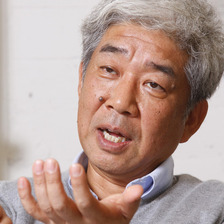
Hiroshi Osaki
Yoshimoto Kogyo Co., Ltd.
[Part 2] There's definitely something we can do
Through the film festival, we send a message of encouragement: "Let's join hands and do our best together."
From a "regional" perspective, I also have deep feelings for the Okinawa International Film Festival.
The catalyst was when Hitoshi Matsumoto's first film, "Dai-Nichi Co., Ltd.," was selected as an invited work for the Directors' Fortnight section at the Cannes International Film Festival.
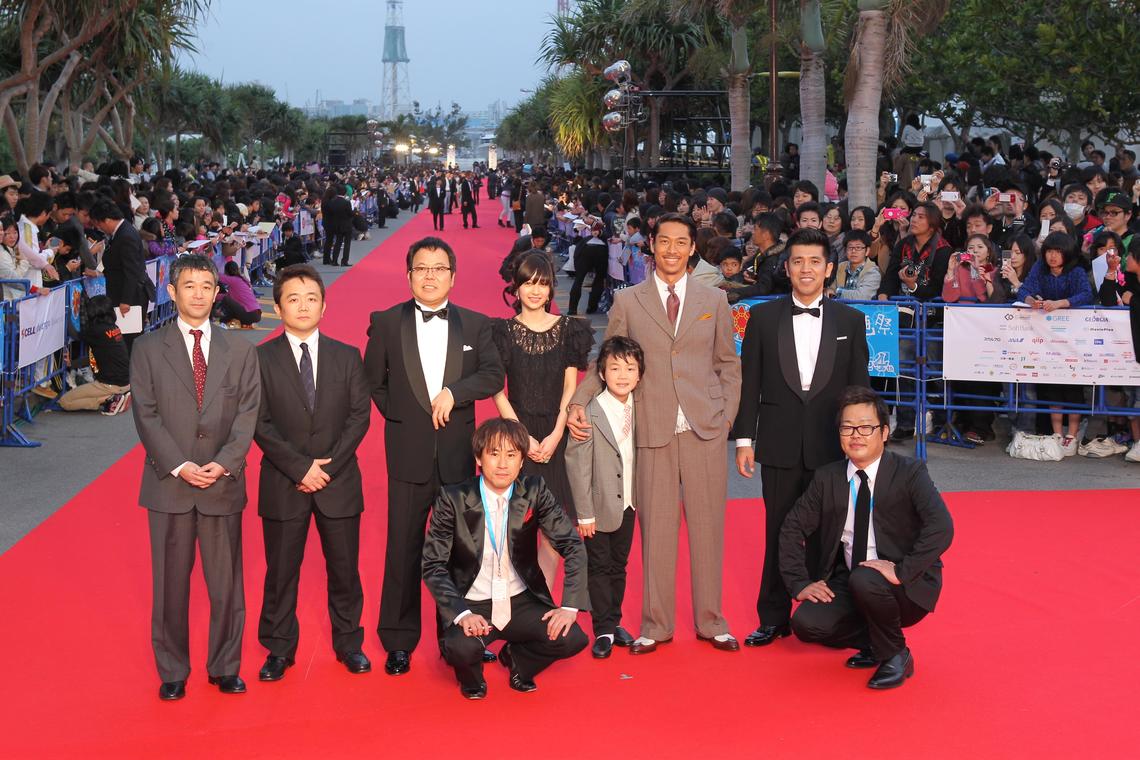
The Okinawa International Film Festival is now in its fifth year, but the 3rd edition in 2011 faced a critical crossroads. The festival is held annually from mid to late March, but the Great East Japan Earthquake struck just before it was scheduled to begin. We were forced to decide whether to proceed as planned or cancel.
To be honest, my first thought was for the staff who had worked so hard to get us this far. Staff who normally manage talent would come home from work around 1:00 AM, then head straight to festival meetings. Meetings lasting until 4:00 or 5:00 AM were commonplace. They'd catch a quick nap before heading back to their regular management duties. Seeing them like that, I simply couldn't bring myself to say, "Let's cancel this year." That was the first reason.
And then there was another thing. We were forced to reconsider the very meaning of "working" in our field—the entertainment business. When major disasters or other tragic events shake society, we're often told to refrain from entertainment. Or at least, that's the prevailing mood. But if we ask ourselves why we do this work, isn't it to bring happiness to those around us? While restraint might be one form of wisdom, isn't it precisely at such times that we need to do something to give people strength? Resolved by this thought, we decided to hold the event.
The Okinawa International Film Festival had previously used "Laugh & Peace" as its subtitle. For its third edition, we changed it to "Yell, Laugh & Peace," believing that "there must be something we can do." The intent was to send a rallying cry from Okinawa to the mainland, and to the disaster-stricken areas of Tohoku: let's join hands and keep pushing forward together. To connect that rallying cry to the world, we sought support from other film festival organizers and held a charity film festival in Iwaki City, Fukushima Prefecture.
We want to make Okinawa the "Island of Entertainment"
I believe the Okinawa International Film Festival is increasingly resonating with the local Okinawan community. Beyond just screening submitted films, we also energize the festival with comedy events. Initially, there were some cool, skeptical eyes, seeing comedians from the mainland coming and making a big fuss. However, the festival's goal of energizing Okinawa is gradually being understood by the local people.
As mentioned earlier, the festival's concept is "Laugh & Peace." Okinawans love to sing and dance. They have unique regional cultures and traditional performing arts not found on the mainland. Holding a lively, fun festival centered around film right here in Okinawa – to me, that feels just right.
Fundamentally, what Yoshimoto Kogyo does is like "every day is a cultural festival." It might sound like a grand vision, but my dream is to expand that cultural festival not just to Okinawa Island, but to the entire Okinawan archipelago. And not just as a temporary event, but to create a year-round "cultural festival state." In other words, I want to make Okinawa an "entertainment" island. We'll also fully develop facilities to train not just comedians, but actors, directors, dancers, and more. It would be great if it could be not just a place to showcase entertainment, but also a place to nurture it. Of course, we'll properly preserve traditional performing arts too.
Naturally, this would create many job opportunities. The entertainment world offers diverse roles that don't require advanced knowledge or skills like those of a finance professional—just your physical presence. It's not just about planning, promotion, or management. There are jobs in theater set and prop work, poster hanging, and ticket tearing. Even young people who feel lost, thinking "I have no talents," would surely find some role. This industry has a wide range of entry points for work.
Realizing this vision might take more than 10 or 20 years. But I dream that in about 30 years, such an "Entertainment Island" could become a reality. I believe the Okinawa International Film Festival, held annually now, is taking a tiny step toward that goal.
The "vitality" of local people spreading outward
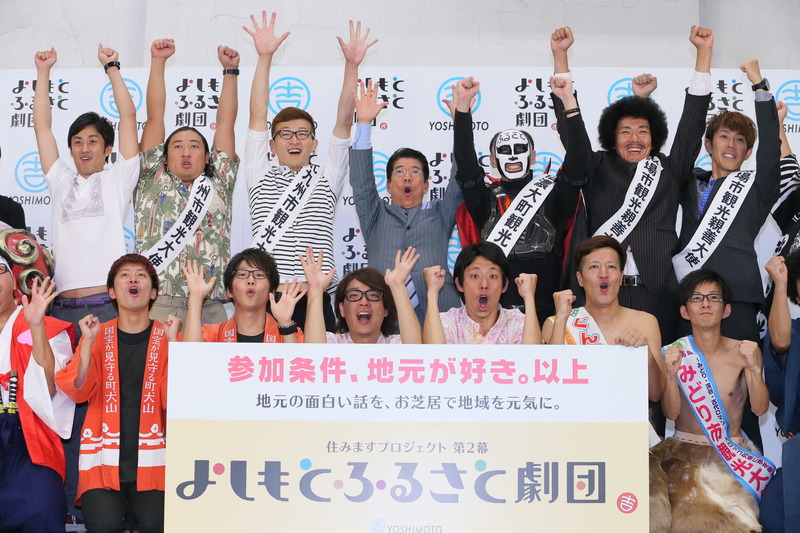
As a project centered on the keyword "local," there's also an idea that could be the second act of the "Resident Project." It's called the "Yoshimoto Hometown Theater Company." The concept is to create theater companies centered around people from regions all over Japan. Not only would local "resident comedians" be involved, but Yoshimoto's own scriptwriters and directors would also join in, and actors would be recruited from the local community. It's a project where everyone works together to create these "hometown theater companies."
Each region surely has countless stories rooted in its local culture and environment. There are likely fascinating tales well-known to locals but completely unknown to the rest of the country. There are probably comedic gems and deeply moving stories too. The idea is to share these not just with the local community, but with the whole nation.
Behind this idea lies the "good feeling" from a project I did long ago.
Nearly 30 years ago, in Amino Town (now Kyotango City) on Kyoto's Japan Sea coast, I worked with Sanma-kun to create a variety show using an abandoned school. Sanma-kun became the principal, gathering not just the children from the closed school but also their parents, grandparents, and others to teach subjects like Japanese and math. It resulted in a truly heartwarming and entertaining variety program.
The "local theater" we did in Nozu Town (now Usuki City), Oita Prefecture, known for Kicchom, was also a lot of fun. We thoroughly researched the area's famous products, specialties, landmarks, and local experts, then created a play incorporating all that with Yoshimoto's talent and staff, along with people from the local tourism association and youth group. We'd cast the town mayor as the corrupt magistrate, and he'd get beheaded the moment he appeared (laughs). It was a huge hit.
We also did it on the small island of Aka in Okinawa. First, children from Tokyo and local children teamed up to visit grandpas and grandmas scattered around the island, gathering stories about the island's history and famous products. They reported these stories to a professional scriptwriter, and together they crafted the play's script. Meanwhile, local mothers helped prepare rice balls for the audience, fathers in construction were enlisted to build the stage sets, and young men and women from the youth group drove trucks with banners to promote the show and sold tickets around the island.
Working together with local people like this to create theater reveals a "local community" we hadn't known before and deepens the bonds among the people there. In other words, the circle of mutual knowledge and understanding grows steadily and firmly, like the rings of a tree. Not only does the community become more vibrant, but that "vitality" spreads outward.
We hope the Yoshimoto Hometown Theater Troupe will become a source of that very power.
The "Asia" network built through frequent visits
The keyword "Asia" also connects to "local" in my mind. From Japan's perspective, Asia is overseas, but from the world's perspective, Asia is also a region—a "local area." Therefore, it's not simply about expanding into Asia; it's about the idea of creating content together with people from regions like China, Korea, and Taiwan. By creating content together, we can also deepen our relationships of trust.
Of course, we also consider establishing frameworks and environments to trade popular content like Yoshimoto Shinkigeki in international markets. However, as with many companies expanding overseas, I believe "localization" is the most critical challenge in the content business world. In China, we've been developing Shanghai Yoshimoto Shinkigeki using local talent and planning/operating various events for several years now. In 2010, we established a joint venture with Shanghai Media Group, positioning it as our base for content business in China. The international satellite channel "Yoshimoto Dongfeng Satellite TV," launched last year as a joint venture with a Taiwanese company, has created a system capable of delivering content to approximately 15 million households across Asia, North America, and Europe. We aim to actively produce not only content made in Japan but also programs specifically for Asian audiences.
Furthermore, "Yoshimoto Entertainment Seoul," established two years ago to handle management operations in South Korea, has steadily gained a foothold in localizing content. This is evident in the positive reception of "Comedy Japan-Korea Battle," a co-production with KBS (Korea Broadcasting System).
This level of achievement is only possible thanks to the network of connections built over more than 20 years. I believe I've visited Shanghai alone in China about 400 times and Seoul in South Korea about 350 times. Especially in China, where the political system and business practices differ, personal connections hold the key. My frequent visits enabled me to build pipelines with key media figures and Communist Party officials.
With content business as our base, we're also developing schools and vocational training centers.
My own focus on Asia began long before I became president. To be honest, it happened by chance, or rather, it just naturally evolved that way. In my younger days, I wasn't particularly more capable than my peers who joined the company at the same time, nor was I the type to fiercely compete, striving to catch up and overtake others. As I sought my place, I found myself turning my attention to the Asian market, which even within the company at the time, was an area of relatively little interest.
In Shanghai, China, I debuted a group of girls who could sing and dance. In Taiwan, I organized fashion events similar to Tokyo Girls Collection. I believe these accumulated efforts led to the network I have today. Connections made with local people through work formed small circles with those around them. These small circles grew larger and overlapped with other circles, expanding my network in this way.
Shanghai Disneyland was scheduled to open in 2015. I've maintained a close relationship with the person who served as its president until recently. About 17 or 18 years ago, I visited his home and passionately proposed, "Let's create a live TV show in China like Japan's 'Young Oh! Oh!'" Thanks to that effort, we plan to assist with training and dispatching personnel to work at Shanghai Disneyland.
This business of training entertainment professionals locally shares the same spirit as Japan's "Sumimasu Project" mentioned earlier. By establishing new hubs for the content business across Asia, we can create job opportunities for local youth. Furthermore, if we can link this to developing educational and employment environments like schools and vocational training centers, wouldn't that be just perfect?
As a business focused on profitability, we're still in the early stages. We've only recently begun to build the necessary talent base, including employees well-versed in rights management and individuals strong in overseas marketing. While we're only halfway there, I feel something akin to conviction: "Yes, we're heading in the right direction." Personally, after visiting for over twenty years, I haven't built a profitable business, but I have built trust. So, I tell my employees, "The rest is up to you!" (laughs).
Was this article helpful?
Share this article


Newsletter registration is here
We select and publish important news every day
For inquiries about this article
Author
Hiroshi Osaki
Yoshimoto Kogyo Co., Ltd.
President
Joined Yoshimoto Kogyo in 1978. Served as manager for numerous talents. Launched the "Shinsaibashi-suji 2-chome Theater" as a producer in 1986, which produced many popular talents. From 1997, as Chief Producer, launched numerous new ventures including music and publishing, sports management, digital content, and film businesses. Appointed Director in 2001, Senior Managing Director in 2005, Vice President in 2006, and assumed his current position in 2009.