
Note: This website was automatically translated, so some terms or nuances may not be completely accurate.
 What Do "IoT Home Appliances" Bring to Marketing? The Challenge of domus optima [1/1]
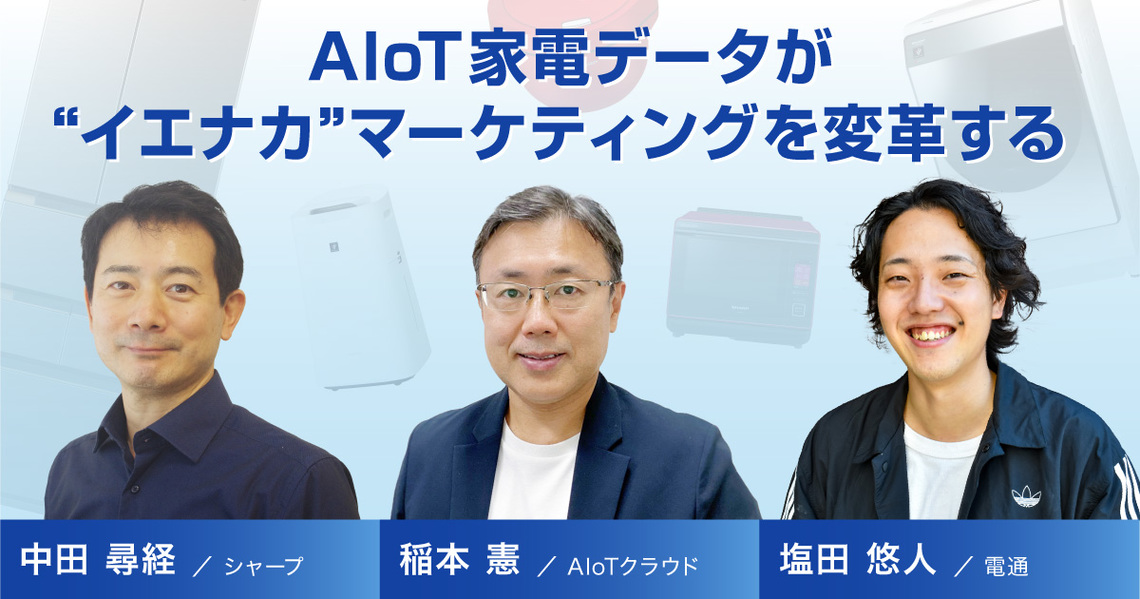
IoT Appliance Data Visualizes the "Home Space"! Consumer Insights for the Smart Life Era
Nakata Hirotsune
Sharp Corporation
Ken Inamoto
AIoT Cloud Co., Ltd.
Yuto Shiota
The Internet of Things (IoT), where all kinds of "things" connect to the internet, is permeating our lives.
Among these, IoT appliances are gaining prominence for delivering convenient and comfortable living—a smart life—to consumers. This series will explore how companies can use IoT appliance data to provide unique experiences for consumers.
In Part 1, we welcome Mr. Hirotsune Nakata from Sharp's Smart Appliances & Solutions Business Division and Mr. Ken Inamoto from the Data Business Development Department of the company's AIoT Cloud. They will discuss these topics with Yuto Shiota from Dentsu Inc.'s Data & Technology Center.
<Table of Contents>
▼AIoT Appliances: "Life Partners" That Learn and Evolve with Users' Lifestyles
▼Analysis at a granular level enables companies to visualize "real-life consumer experiences"
▼Analyzing "Inside the Home" Data Reveals "Latent Needs" for Products and Services!
▼Data Utilization "Audits" Enhance the Reliability of IoT Appliances
AIoT Appliances: "Life Partners" That Learn and Evolve with Users' Lifestyles
Shioda: Today, I'd like to discuss with both of you how IoT appliances will transform businesses and consumers, while introducing domus optima.
"domus optima" Transforming "Home Life"
Dentsu Inc.'s solution that provides consumers with enriched life experiences both inside and outside the home through integrated marketing utilizing IoT appliance data.
As the first initiative, we are collaborating with Sharp, which promotes the utilization of "AIoT Appliance Data" (*), to conduct ad delivery and effectiveness verification based on insights derived from data collected from approximately 400,000 IoT appliances nationwide.
https://www.dentsu.co.jp/news/sp/release/2021/0607-010387.html
※ AIoT
A vision combining AI (artificial intelligence) and IoT (Internet of Things), connecting everything to cloud-based artificial intelligence to transform home appliances into companions that support people. A registered trademark of Sharp.
According to a survey by Japan's Ministry of Internal Affairs and Communications, the number of smart home appliances and IoT-enabled electronic devices worldwide is projected to increase to 3.9 times the 2015 level by 2022.
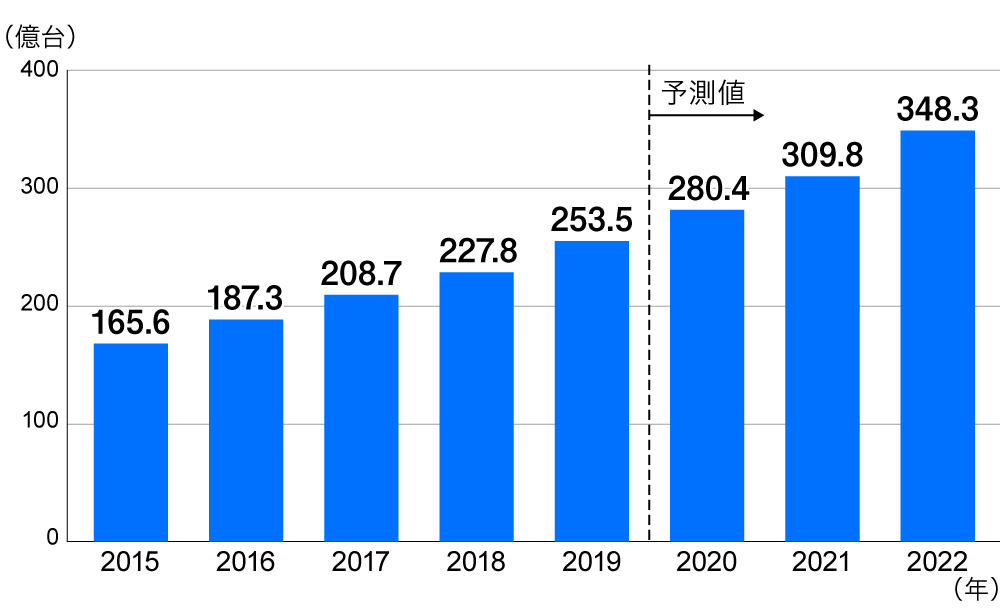
Graph created based on Ministry of Internal Affairs and Communications, 2020 "Information and Communications White Paper": Rapid Proliferation of IoT Devices
Shioda: We developed domus optima anticipating the widespread adoption of IoT appliances in Japan in the near future. However, we often receive questions from clients like, "What can IoT appliances actually do?" or "Will they really catch on?"
So, first, we'll ask Mr. Nakata, who is driving the AIoT business at Sharp. Could you tell us about the characteristics of AIoT appliances and their current adoption status?
Nakata: Our "AIoT appliances" are guided by the principle of "IoT that stays close to people." We aim for them to be more than just convenient tools; they should become partners that stay close to our customers' lives. A major feature of AIoT appliances is that they "optimize for the customer and continuously evolve in terms of functions and services."
Traditional appliances were at their "best state" when purchased. Their functions generally didn't evolve, and the products deteriorated over time. While buying a new model might offer new features, you'd have to reconfigure everything from scratch.
AIoT appliances, however, become their "best state" over time after purchase. They learn your family composition and daily usage patterns, accumulating data on the cloud-based "AIoT platform." They continuously optimize themselves for your lifestyle and evolve their functions and services.
And even if you decide to replace it, your learning history is carried over. This means that from the very day you purchase the next product, you can use "appliances optimized for your home, just like before."
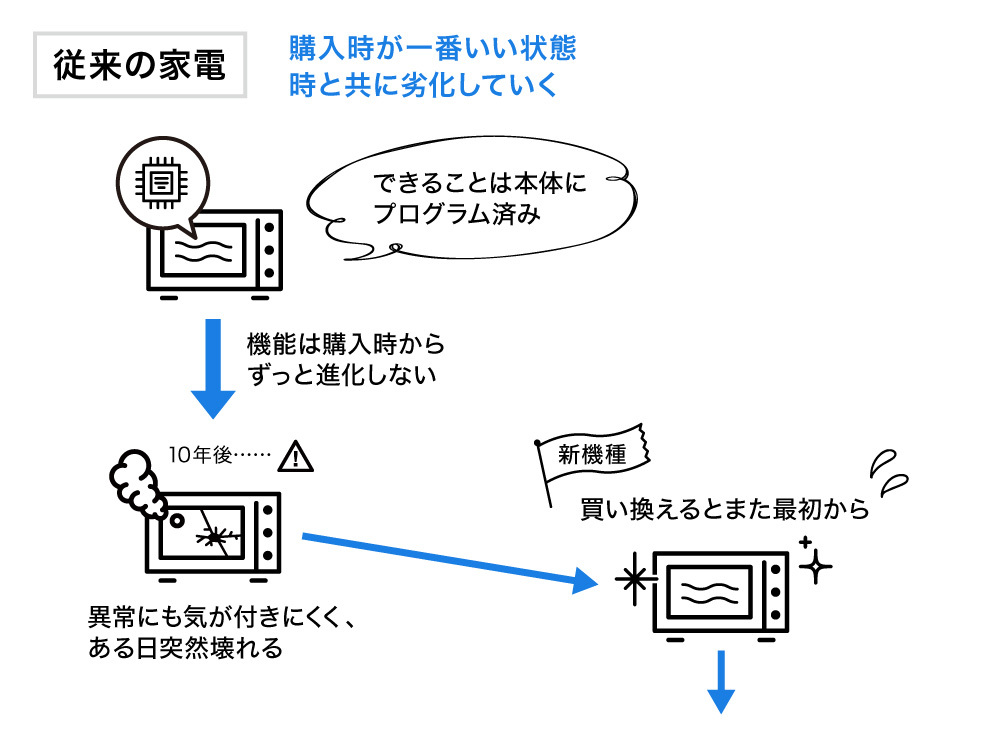
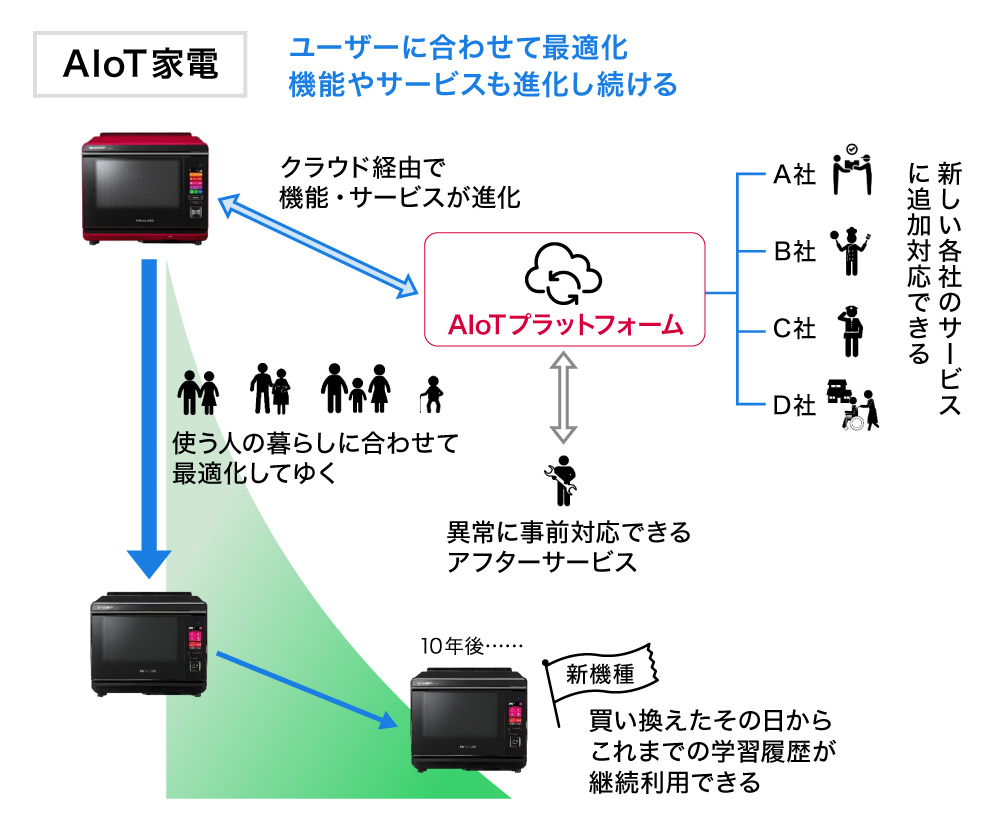
Shioda: The more you use them, the more convenient and comfortable they become. Even when you replace them with new ones, that comfort carries over. Once you experience the appeal of AIoT appliances, you might never go back to conventional appliances.
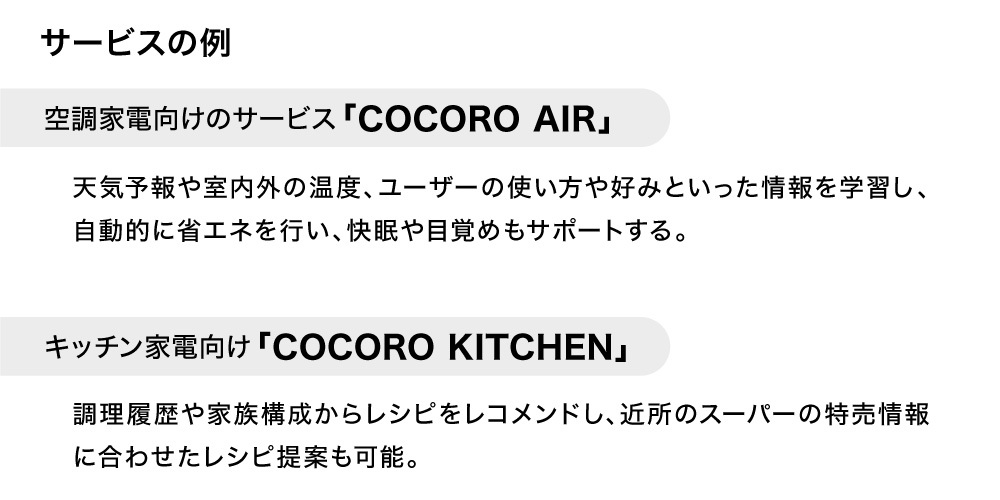
Nakata: To leverage these learning capabilities of AIoT appliances, we also offer various services like "COCORO AIR" and "COCORO KITCHEN." Of course, whether to use these services is entirely up to the customer.
Nakata: Another important point is that our "AIoT Platform" is not closed to Sharp products alone; it's an open platform. It can connect to products and services from other companies, allowing customers to flexibly advance their "smart home" setup according to their lifestyle.
Shioda: Is there actually growing market demand for AIoT appliances?
Nakata: At Sharp, the proportion of AIoT appliances is steadily increasing. Over 580 models across 11 categories are already operating as AIoT appliances in homes nationwide.
By analyzing data, we can provide services that promptly reflect customer feedback. We believe the value of AIoT appliances will increase exponentially as more data is collected.
Of course, the data is ultimately entrusted to us by our customers. It is the manufacturer's responsibility to continue delivering new value to customers' lives within the scope of our terms of use.
Analysis at a granular level enabling companies to visualize "real-life consumer experiences"
Shioda: So you utilize various data to make users' lives more convenient and comfortable. One destination for that data is domus optima. Currently still in beta, it analyzes Sharp's AIoT appliance data to estimate consumers' "latent needs" and provides a marketing solution that delivers useful information to users at the optimal time.
The AIoT Cloud platform develops and operates the underlying AIoT platform. I understand the collaboration between the AIoT Cloud and Dentsu Inc. has a long history. Mr. Inamoto, could you share the background of when you began working with Dentsu Inc.?
Inamoto: Originally, our company planned and operated a "portal site utilizing viewing data collected from TV devices." To effectively utilize the vast amount of accumulated viewing data, we consulted Dentsu Inc., which has strong expertise in analyzing and utilizing TV viewing data. That's how we started using TV viewing data for marketing solutions back in 2012.
Subsequently, at Sharp, the AIoT transformation of its home appliances advanced, gathering unprecedented 'in-home' data. We wanted to utilize this data for marketing in the same way as TV data. Following discussions with Dentsu Inc., this led to the current release.
Shioda: Thank you for our very long-standing relationship. Thanks to you, domus optima has received numerous inquiries across various industries immediately after its release. With opportunities to communicate with users decreasing during the pandemic, many companies are seeking touchpoints within the home environment. I believe this timing for the release is why it has attracted so much attention.
Inamoto: We've also received inquiries from mass media outlets and other manufacturers in our industry. The scale of the response really underscores the high level of interest in the "at-home" space.
Shioda: Next, could you explain specifically what kind of data the AIoT home appliance data provided to domus optima entails?
Inamoto: Currently, we provide data from approximately 450,000 units across five appliance types: air conditioners, air purifiers, microwave ovens, automatic cooking pots, and washer-dryers.
We collect data every 15 minutes, including the power status of each device. For air conditioners, this includes "outdoor temperature," "indoor temperature and humidity," and "operation mode." For air purifiers, it includes "indoor temperature and humidity," plus "odor," "dust level," and "PM2.5" information.
Cooking appliances provide "cooking history" showing what was cooked and when, while washer-dryers provide "wash cycle name" and "detailed rinse, spin, and dry process information" linked to the date and time.
Shioda: By providing not only appliance usage data but also surrounding data like indoor/outdoor temperatures, we can perform high-granularity analysis that allows us to visualize consumers' "real-life routines."
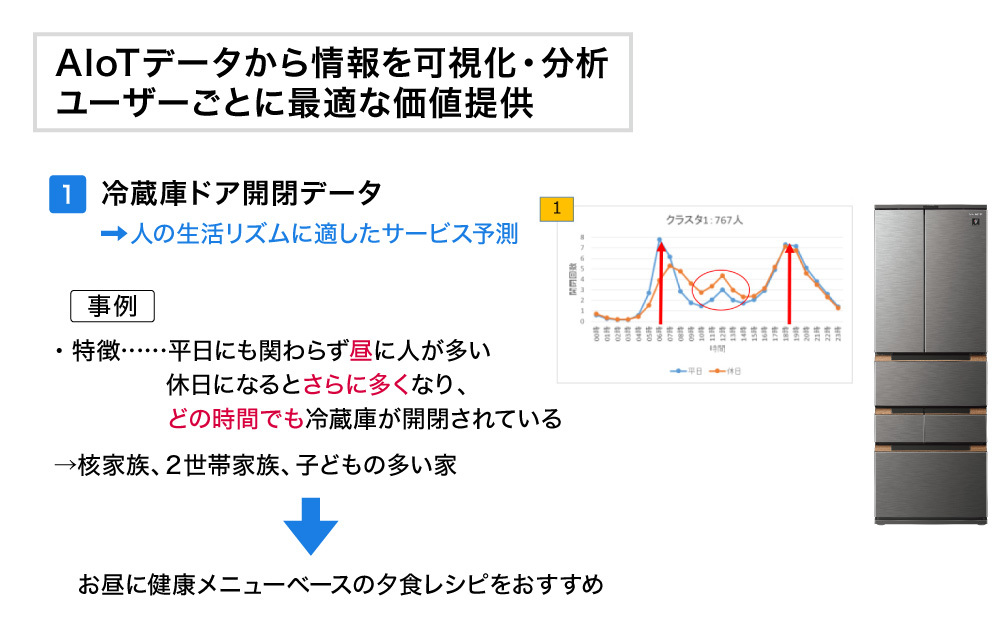
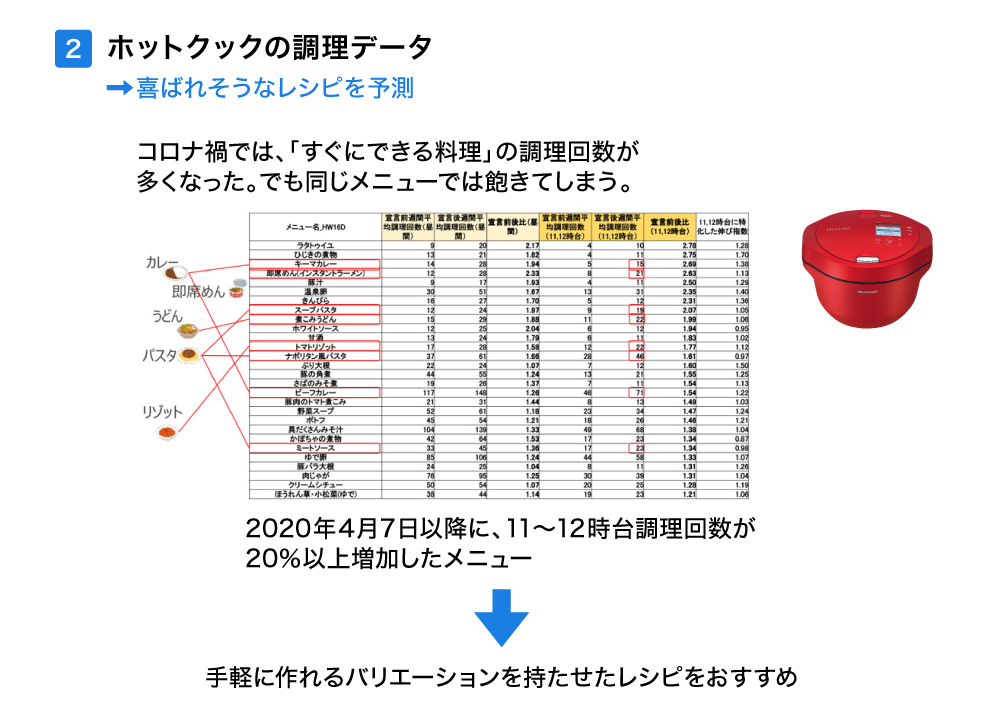
Data analysis of "home life" reveals the "latent needs" for products and services!
Shioda: Allow me to briefly introduce the types of analysis we perform at domus optima using AIoT appliance data. The following graph shows the usage time distribution for five appliance models.
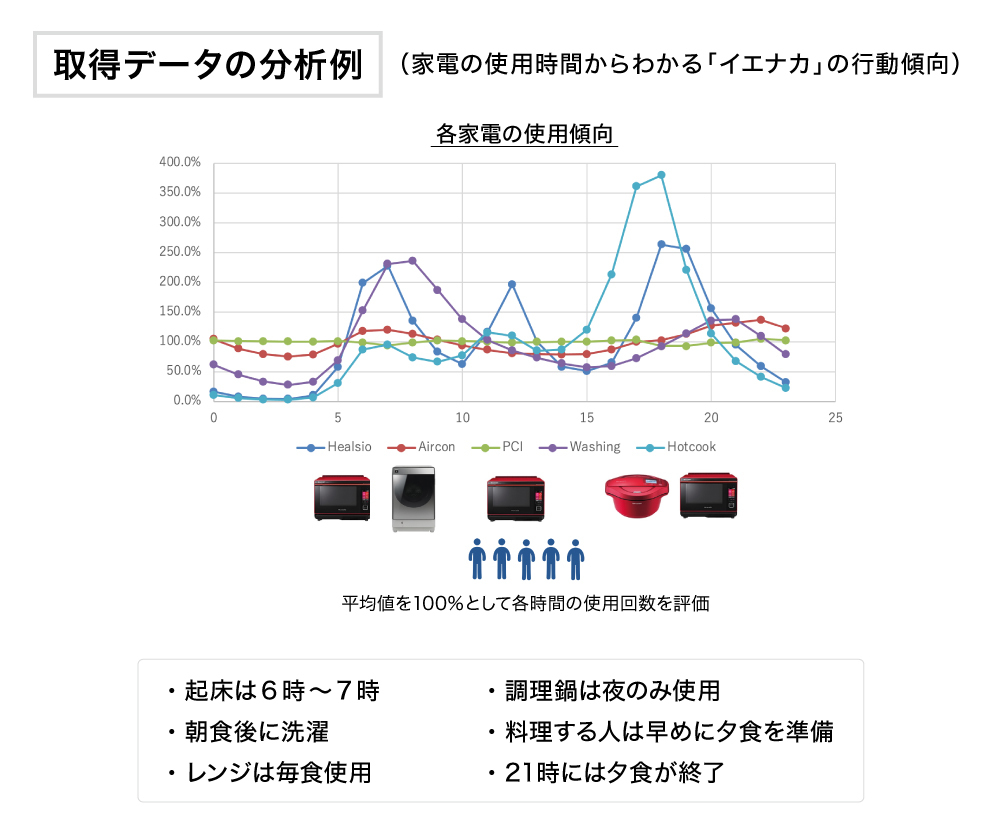
Shioda: For example, we can discern what kind of daily rhythm a household follows based on appliance usage: waking up around a certain time in the morning, having breakfast, running the washing machine in the morning, microwaving lunch. Then, starting in the evening, preparing dinner using an automatic cooking pot, followed by the microwave oven being used, and having dinner before 8 PM. Air conditioner usage drops around midnight, indicating bedtime.
By analyzing appliance usage patterns, we can uncover what kind of daily rhythm people follow.
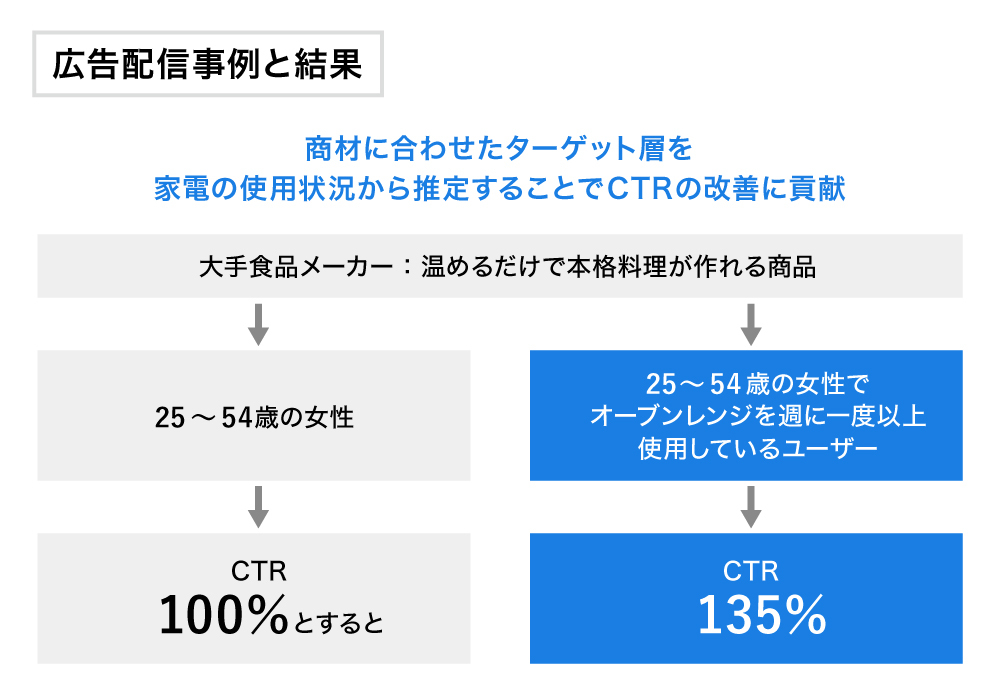
This data can also be leveraged for ad delivery. In a proof-of-concept experiment with a major food manufacturer, targeting "users who use their microwave oven at least once a week" with products that let you make gourmet meals just by heating them resulted in a 35% increase in CTR.
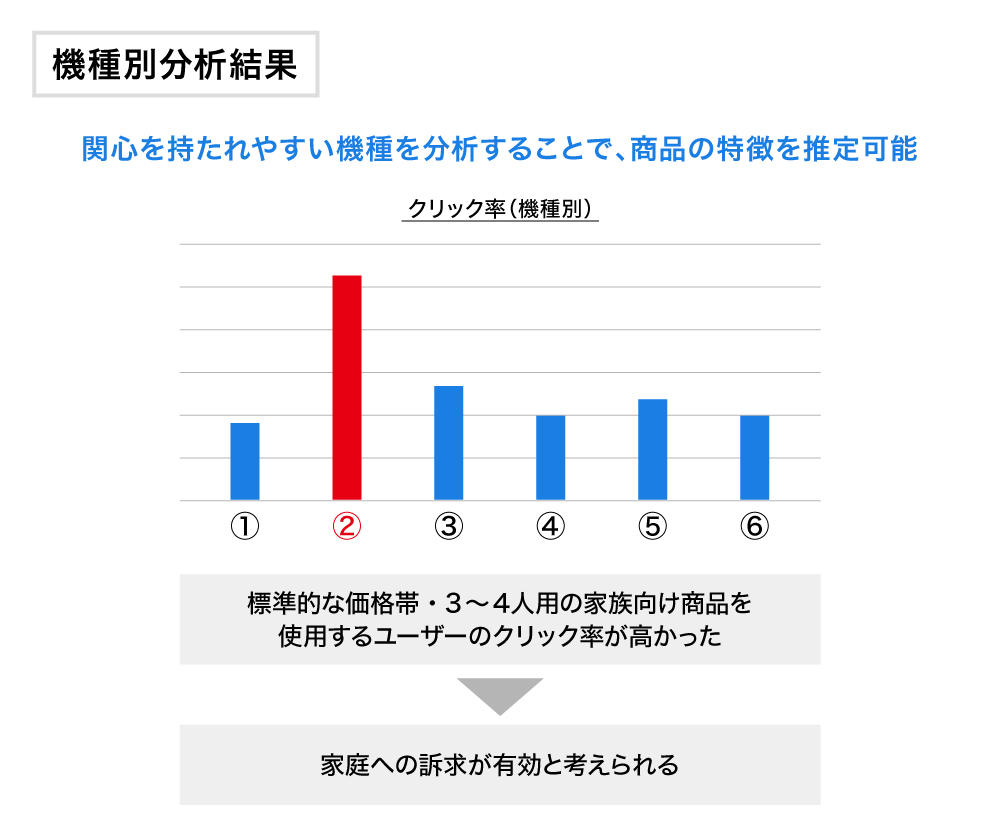
Shioda: Furthermore, comparative analysis by model revealed that the click-through rate was higher among "users of family-oriented microwave ovens," allowing us to infer that "targeting families is effective for that product."
Shioda: Furthermore, purpose-based analysis showed that the click-through rate was higher among "users utilizing the 'bread and pizza warming' function" compared to "users utilizing the 'frozen food defrosting' function." This suggests that users with relatively higher cooking awareness may have a need for this product.
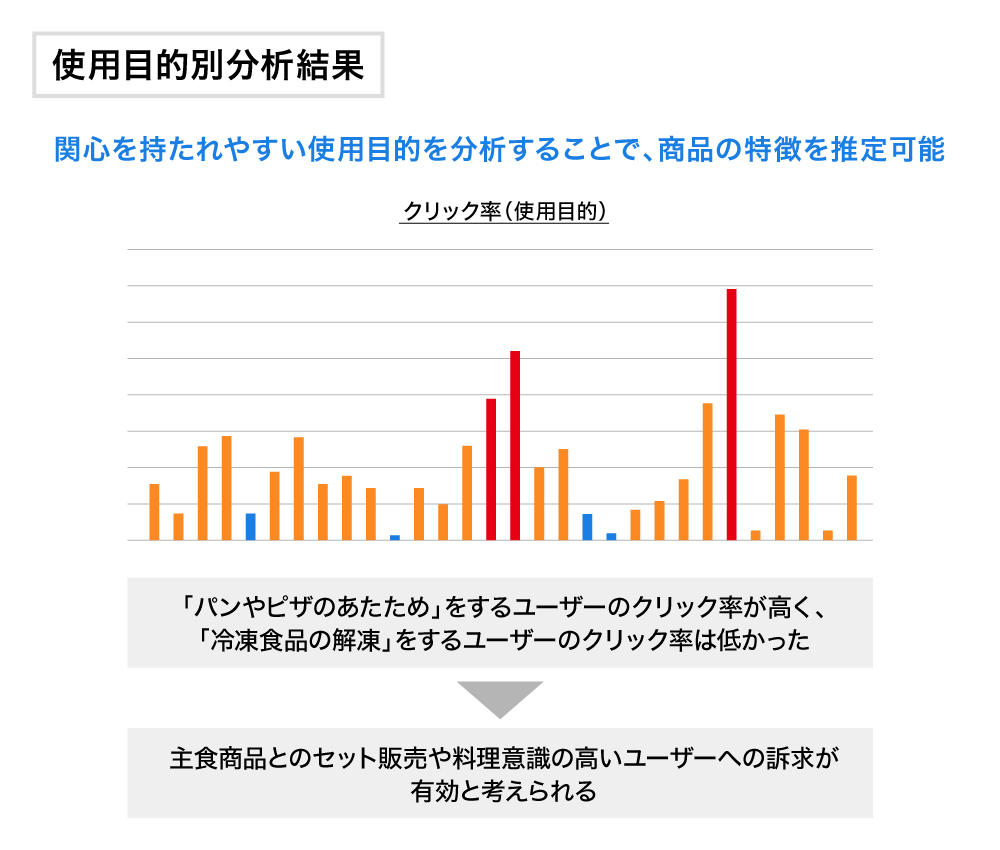 Shioda: By leveraging home appliance data in this way, we can perform analyses based on previously unseen lifestyle scenarios and consumption behaviors.
Currently, we have data from 450,000 appliances, which is a sufficient number to serve as an analytical foundation for gaining customer insights. We believe that by applying the insights gained from domus optima analysis to various marketing initiatives, we can already solve our clients' marketing challenges.
Inamoto: What I feel is a crucial point regarding "Ienaka" data is the "licensing process." While we analyze data that cannot identify individuals, each piece of data itself belongs to our customers. These initiatives would not be possible without our customers' understanding and cooperation.
Shioda: What do you focus on to obtain user consent?
Inamoto: We focus on clearly communicating what data we collect, why we collect it, and which companies we might share it with third parties. We're constantly refining this process. Our ultimate goal is to enhance product convenience and improve customers' lives. Data must never be used in ways customers didn't intend.
To achieve this, while laws like the Personal Information Protection Act are amended as societal conditions change, we constantly monitor developments and strive to comply with national guidelines.
Shioda: When obtaining user consent, it's essential to communicate the scope and nature of data usage in a more understandable way. Beyond that, we also believe it's necessary to design services—including communication—to ensure users continuously perceive the benefits of granting consent.
Data Utilization "Examination" Enhances the Reliability of IoT Appliances
Shioda: IoT is expected to become increasingly widespread in the future. What kind of future do you two envision creating with AIoT appliances?
Nakata: Creating new value requires a certain level of adoption. Specifically, I believe the world will change dramatically once the "cloud connection rate" exceeds 30% nationwide in Japan. The positioning of appliances will shift rapidly, and I expect they will become truly indispensable to customers, evolving into partners that stay close to them.
Crucial to this is collaboration with other companies. While any single company can collect vast amounts of data, attempting to significantly expand that value alone creates an extremely limited, narrow world. That's precisely why we want to build an open AIoT platform that transcends boundaries like competition and industry, enabling collaboration with diverse companies.
Inamoto: We want to pursue providing better services to our customers and enriching their lives. Starting with televisions and now extending to white goods like this, we've accumulated diverse data. Working with this data daily, I realize it represents the very essence of people's lives. Combining this varied data should enable a deeper understanding of consumers than ever before. The scope of data utilization also extends beyond digital marketing, offering numerous possibilities.
The AIoT Cloud possesses extensive know-how in accumulating big data, enabling cloud-to-cloud integration, and utilizing data for services. We are also advancing the development of new systems. Moving forward, we aim to collaborate with many companies using these systems.
Shioda: Thank you. I'd like to share three points regarding the future of domus optima and IoT home appliance data.
First is creating value through data cross-referencing. Household appliance data alone is not sufficient to perfectly solve corporate marketing challenges. By cross-referencing it with "Iesoto" purchase data and other diverse datasets, we can generate greater value.
While combining data involves many critical considerations—legal, business, security—we also prioritize customer experience. Key questions include: "Does this approach cause user discomfort?" "Can users revoke consent after granting it?" "Is the intended data usage clearly communicated upfront?"
In the world of advertising expression, there is a concept called "pre-screening" when considering customer experience. This occurs one step before determining whether a product sells or not, preemptively confirming "Will users even find the information received unpleasant? Will they perceive any benefit?" We feel this pre-screening should also inform planning when utilizing data with the user as the top priority.
The second point is enriching various aspects of life starting from the foundational "home base." While attention has recently focused on "third places" outside the home, workplace, or school, the ultimate foundation of life remains the secure "first place" – the home base, or "home." Precisely because we are in the era of the pandemic, we want to work through domus optima to "enrich users' entire lives starting from the home base."
The third is "visualizing thoughtfulness." Through various analyses, we've come to realize that home appliance data isn't just usage logs; it's the footprints of actions taken by someone for someone else. There's a sense that home appliance data reflects a certain kind of "family thoughtfulness." Through domus optima, we hope to focus on this kind of "thoughtfulness" that is often difficult to visualize.
Inamoto: With domus optima, Dentsu Inc.'s data technology and experience are opening up new worlds beyond digital marketing. Let's deepen our collaboration and create an even better world for our customers.
Nakata: We expect domus optima to become a catalyst where various companies leverage vast amounts of data to create new value in Japan, and ultimately spread it globally. While we call the AIoT platform open, to create new value with diverse companies, we also rely on the expertise of Dentsu Inc. in effectively managing relationships with many businesses.
Shioda: Thank you. If you're interested in utilizing domus optima after reading this article, please feel free to contact us!
And finally, a promotional note: Dentsu Inc. will be presenting on "domus optima," featured here, at CEATEC 2021 ONLINE!
CEATEC is Asia's largest international exhibition for IT technology and electronics, hosted by the Japan Electronics and Information Technology Industries Association (JEITA).
While many participants are engineers from home appliance and automotive manufacturers, we will be participating as a company from the marketing and advertising industry. We hope you will join us.
[DX] The Potential of Home Appliance Data: AIoT Cloud (Sharp Group) · Dentsu Inc. / Mitsubishi Electric's New Challenge | CEATEC 2021 ONLINE
https://www.ceatec.com/ja/conference/single.html?contentId=3059
※ No individual session registration required. You can attend directly after completing the entry registration.
※To avoid peak access times, we recommend registering in advance.
▼△CEATEC 2021 ONLINE Registration Here▼△
https://www.ceatec.com

Was this article helpful?
Share this article


Newsletter registration is here
We select and publish important news every day
For inquiries about this article
Author
Nakata Hirotsune
Sharp Corporation
Smart Appliances & Solutions Business Division AIoT Business Promotion Department
Joined the company in 1990. After developing software for information and communication devices, including the industry's first cordless image scanner (UX-5), he was responsible for product planning for devices such as the Zaurus, mobile phones, and smartphones. Since 2015, he has served as the leader driving the AIoT transformation of Sharp's white goods, enabling open integration with cloud-based services.
Ken Inamoto
AIoT Cloud Co., Ltd.
Data Business Development Department
Joined Sharp in 1993. Gained experience in technical planning, product planning, and sales promotion planning for information devices, then engaged in planning and business development for network services for home appliances. Launched the AQUOS TV portal site "AQUOS.jp" in 2006, establishing numerous new business models there. Joined AIoT Cloud upon its spin-off as a separate company in 2019, serving as the responsible officer for promoting the utilization of log data from network-connected home appliances and the owned media advertising business.
Yuto Shiota
Master of Science in Life Science and Technology, Osaka University. Currently enrolled in the Master of Fine Arts program at Kyoto University of the Arts. Led the bid for the 2025 Osaka-Kansai World Expo as a citizen representative. After joining the company, developed "domus optima" and was responsible for business development as a member of "XRX STUDIO" and "web3 club". Member of the World Economic Forum Global Shapers. Sixth cohort of the Ministry of Economy, Trade and Industry/JETRO "Startup" program. Left Dentsu Inc. at the end of December 2023.