Note: This website was automatically translated, so some terms or nuances may not be completely accurate.
 DENTSU DESIRE DESIGN's Approach to Marketing Reconstruction Based on "Theory of Desire" [30/32]
The "desire" that pushes consumers hesitant about exclusivity is a sense of "superiority" and "security" over others.
Dentsu Inc. Desire Design (DDD) is an organization that develops various solutions and disseminates information based on the relationship between consumption and desire. This time, we analyze the "Heart-Moving Consumption Survey" conducted by DDD in November 2025. We will share insights and findings derived from the survey results.
This article focuses on "limited-edition items" and "exclusive information." Manabu Tachiki of DDD examines their relationship with the "desire" that pushes consumers to act.
65% of people "always use" limited-time coupons
You've probably bought products or services advertised as "region-exclusive!" or "seasonal limited edition!"
From my own experience, during a business trip to Osaka, I found Osaka-exclusive character goods displayed near the cash register and couldn't resist picking some up. Similarly, seeing winter-limited chocolate snacks at convenience stores makes me want to buy them.
The thought that missing out on something available only "right now" or "here and now" might mean never getting it again drives the purchase.
Other prime examples that trigger that "I have to buy it now!" feeling include "limited-time coupons," "discount vouchers," and "special offer tickets." Many of us can probably recall the experience of folding such a ticket into our wallet, forgetting about it over time, and then regretfully tossing it in the trash after it expired.
To explore this consumer behavior and its underlying reasons, we present two findings from DDD's "Heart-Moving Consumption Survey" conducted in November 2025.
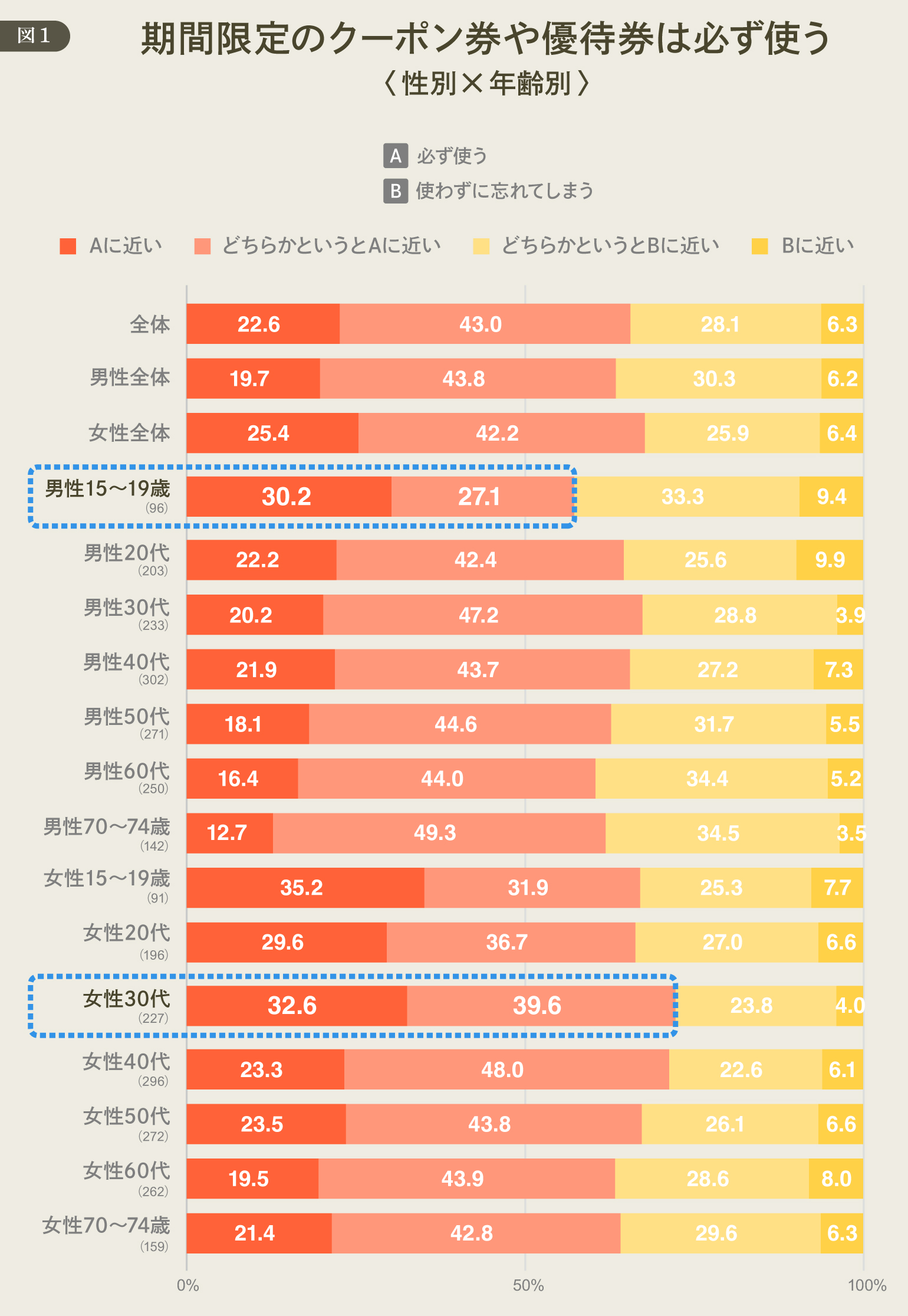
Figure 1 shows the results of the question: "Do you always use time-limited coupons or special offer tickets?"
Overall, 65.6% of respondents answered that they "use" time-limited coupons or discount vouchers ("closer to A" + "somewhat closer to A"). This means that about two-thirds of all respondents are conscious of time-limited coupons when shopping.
Furthermore, examining the combined score of "Close to A" + "Somewhat closer to A" by gender and age group reveals that while there are no significant differences, women tend to score relatively higher.
When considering age groups, the highest score was 72.2% among women in their 30s, while the lowest was 57.3% among men aged 15-19, a difference of about 15 points. The particularly high score among women in their 30s likely reflects the prevalence of homemakers in this age group, who are likely to be more stringent about household finances in this era of rising prices.
Those sensitive to "good deals" are people driven by the desires for "recognition & superiority" and "self-preservation & safety"
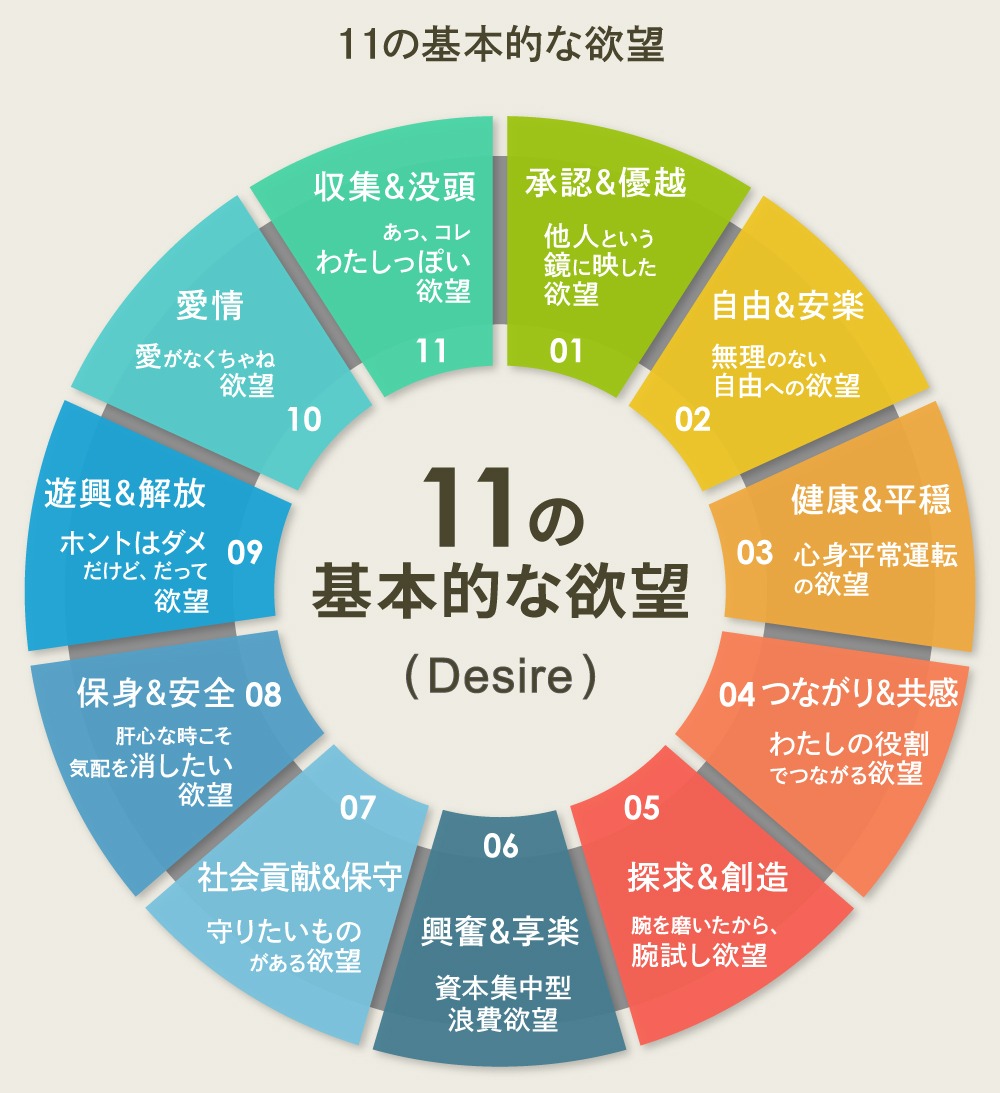
So, what consumer desires are most closely linked to this mindset of "always using limited-time coupons and discount vouchers"? Figure 2 shows the results broken down by each of the 11 desire factors that form the basis of DDD's modern "11 Desires."
■ For more details on the "11 Desires," please see here.
・ "Naming New Desires" (Dentsu-ho)
・DENTSU DESIRE DESIGN Announces 2024 Edition of "11 Desires" Influencing Human Consumption Behavior
■The 11 Basic Desires and Desire Factors
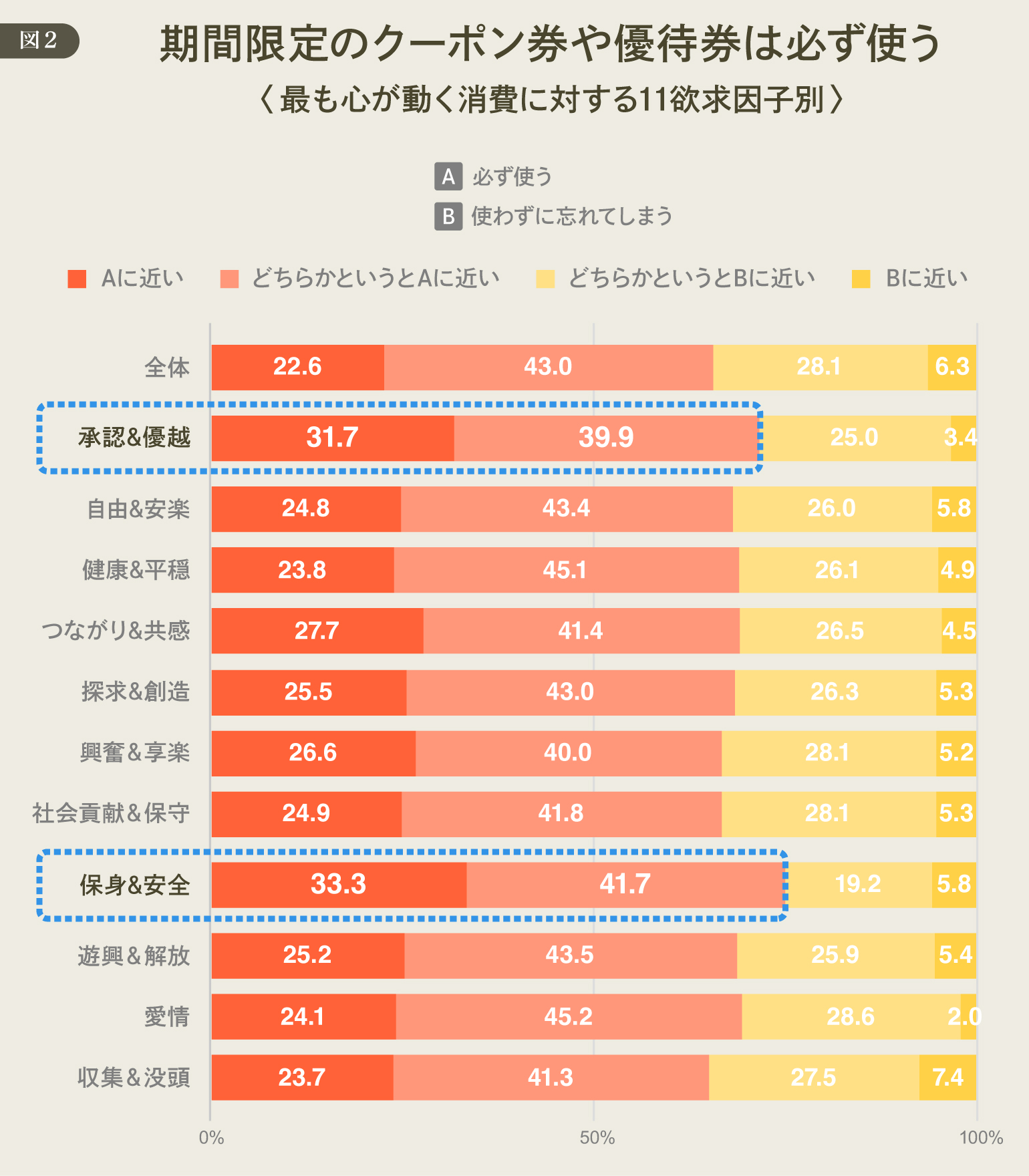
Looking at the graph, we see that the combined score for "Closer to A" and "Somewhat Closer to A" is slightly higher for the two desire factors "Recognition & Superiority" and "Self-Preservation & Safety" compared to the others.
Regarding the former, it can be inferred that consumers feel a certain "sense of superiority" when using discount or coupon vouchers. For the latter, a "sense of security" from getting a slightly better deal seems to be the point where satisfaction is felt.
While the questions specifically asked about attitudes toward coupons, this sense of "superiority" or "security" likely contributes to purchasing behavior in time-limited situations, a pattern that extends beyond coupons.
A recent social phenomenon from 2024 to 2025 that remains fresh in memory is the "Reiwa Rice Riots." Nationwide rice price surges triggered rice hoarding movements across the country, leading to a temporary disappearance of rice from store shelves.
Similarly, during the Showa era (1970s), false rumors about toilet paper shortages during the oil crisis became a major driver of consumer psychology, triggering hoarding. We also saw phenomena like people rushing to gas stations out of fear of running out of fuel.
Behind such consumer behavior, we can see the influence of two desires: "recognition & superiority" and "self-preservation & safety." Specifically, the sense of superiority from "getting ahead of others!" and the relief from "having bought it."
Why does "limited availability" drive consumption?
Below is a pattern of "limited availability" that triggers such consumption behavior, along with specific examples, systematically organized by the author.
Limited Patterns
① Discount Vouchers & Coupons: Coupons distributed by retailers, etc.
② Limited "feel" created by mass psychology: Rice riots, closing-down sales, etc.
③ Seasonal exclusivity: Winter-limited chocolate, autumn-flavored beer, etc.
④ Regional exclusives: Craft beers, etc.
⑤ Special editions: Collaborative products with high-end brands or fashion labels
In consumer behavior theory and behavioral economics, the psychological tendency to perceive "hard-to-obtain items as having high value" is called the <Principle of Scarcity>. This principle primarily relates to types ②, ④, and ⑤ above. Regardless of whether the item is genuinely hard to obtain, the anxiety that "it might disappear" and the sense of exclusivity that "it can only be bought here and now" become the triggers pushing consumers to act.
Additionally, the phenomenon known as "psychological reactance" can also drive consumption. This term originally refers to "the feelings of resistance or backlash that arise when one feels their freedom is restricted (or forced)."
In consumption behavior, it manifests as a psychological phenomenon where the perceived restriction of freedom—"if I don't buy it now, I might miss out"—sparks a reaction that heightens the desire to purchase. This applies to types ② and ③ in the above classification. When such psychological phenomena occur, consumers become more prone to what could be considered somewhat irrational behavior—that is, leaning toward intuitive judgment.
Real-world examples where "limited availability" swayed hearts
The open-ended responses in DDD's survey on emotionally driven consumption included examples illustrating this effect. Here are a couple:
The first example is from a woman in her 60s: "Video streaming service. Yuzuru Hanyu ICE STORY 2nd 'RE_PRAY' TOUR." When asked, "What feeling did you want to experience when you purchased this?" in response to her answer that this service moved her, she provided the following comment:
"It's a 2024 ice show, but I'd been wanting to see it again when it was broadcast. It's an artistic work that moves me deeply and leaves me feeling fulfilled, no matter how many times I watch it."
Yuzuru Hanyu's ice show, meaning events like sports or performances, are typically limited in time and place—a classic example of something you can only experience "right now, right there." For the respondent, even if she wanted to see the show again after experiencing it live, going back twice would be difficult. Learning she could watch this "limited-time show" exclusively on a certain video streaming service likely appealed to her and gave her the push she needed.
Another example comes from a woman in her 60s: "Mont Blanc cake. While out, I passed a seasonal pop-up shop and saw a delicious-looking cake. Though pricey, I thought 'why not treat myself occasionally?' and bought it. It was far more delicious than I imagined, and I was truly moved." This is a perfect example of the appeal of "seasonal exclusivity" working effectively.
In this era of high prices and sluggish consumption, creating a sense of exclusivity will undoubtedly become a key marketing driver once again. The "limited" driver offers diverse ways to appeal. One approach might be to consider new forms of appeal based on contemporary desires.
At DDD, we will continue to explore consumer insights from various perspectives through our "Heart-Moving Consumption Research."
[Survey Overview]
<11th "Heart-Moving Consumption Survey" Overview>
・Target Area: Nationwide, Japan
・Subject Criteria: Men and women aged 15–74
・Sample Size: Total 3,000 samples (allocated according to population ratio across 7 age groups: 15-19, 20s-60s, 70-74, and 2 gender groups)
・Survey Method: Internet survey
・Survey Period: November 7 (Fri) to November 12 (Wed), 2025
・Survey Sponsor: Dentsu Inc. DESIRE DESIGN
・Survey Agency: Dentsu Macromill Insight, Inc.
Was this article helpful?
Share this article


Newsletter registration is here
We select and publish important news every day
For inquiries about this article
Back Numbers
Author

Manabu Tachiki
Dentsu Inc.
Future Business Research Institute
Since joining the company, I have been responsible for generational research, male consumer trend research, and projects focusing on trending and notable products. After handling major automotive companies in the Sales Division, I worked at DENTSU SOKEN INC. developing insights for the Chinese and Indian markets. From January 2012, began producing "Japan's Advertising Expenditures," "World Advertising Expenditures," and the "Information Media White Paper," while also building various audience insights. Transferred to a section handling internet advertising sales at Dentsu Inc. in 2016. Joined Dentsu Inc. Media Innovation Lab in 2019, and has been with Dentsu Inc. Future Forecasting Support Lab and Future Business Creation Lab since 2020.
Insight MemoOmni-Viewing of Accelerating VideosShiodome Media Researcher CommentaryDigest of the Opening Feature: 'Information Media White Paper 2016'Women's Audience Insights Special FeatureExploring Pathways from the "Quality of Society Survey" to a "Society" Where People Find Meaning in LifeCurrent State of Public Awareness and Values as Seen in the "Quality of Society Annual Survey 2021"DENTSU DESIRE DESIGN's Approach to Marketing Reconstruction Based on "Theory of Desire"Building the future begins with visualizing the will of the future.