Note: This website was automatically translated, so some terms or nuances may not be completely accurate.
 Active Learning: How About This? Research Institute ~ 10th Anniversary Relay Column [2/2]
Common Ground Between Education and Business Revealed Through a Decade of Evolution
Combining education and creativity to make Japan's original education more engaging.
The Active Learning "How About This?" Research Institute was established within Dentsu Inc. by copywriters, art directors, creative directors, marketers, and others. To commemorate its 10th anniversary, we present a relay column series where each member shares discoveries and changes they've observed through their involvement in education.
It's been over ten years since the Active Learning: What About This? Research Institute was established in the fall of 2015. In the decade from 2016, when I joined the institute, to 2025, the landscape surrounding "education" has changed significantly.
Looking back on the past decade for both the education world and the lab, I want to explore hints for the future.
2016-2025: A Decade of Education and the Institute, Reviewed Through Keywords
We will divide this period broadly into two phases: 2016–2020 and 2021–2025. We will look back on each year, picking out education-related keywords and examining them alongside the Institute's initiatives.
【2016–2020: The Launch of Education Reform and the Dawn of Digitalization】
- 2016: "Programming Education" and "Active Learning"
With the next generation curriculum guidelines in sight, making programming education mandatory in elementary schools became a focal point of discussion. Around this time, Ezaki Glico also released its free app "GLICODE®," which uses snacks (like Pocky) to teach the basics of programming. Furthermore, "Active Learning (self-directed, interactive, and deep learning)" became a common language in the education sector during this same period.
However, the term "Active Learning" peaked in search popularity in 2016 and has been declining ever since, showing signs of fading as a buzzword. When the research institute was established, its director, Hidetoshi Kurashige, mentioned on the institute's website, "Perhaps we should change the term 'Active Learning' itself." His prediction (?) has come true.
- 2017: "Three Pillars of Qualities and Abilities"
The new National Curriculum Guidelines were announced. The focus shifted from "what (teachers) teach" to "what (students) can do," outlining three pillars: "Knowledge and Skills," "Thinking, Judgment, and Expression," and "Learning Attitudes and Humanity." Preceding this, the Institute had been conducting original collaborative and practical lessons at various schools, including Osaka public high schools, since the previous year, 2016.
- 2018: "Work Style Reform" and "Curriculum Management"
Teachers' long working hours became a societal issue, accelerating discussions on "Work Style Reform in Schools." "Curriculum Management," which optimizes educational activities across the entire school, also gained prominence. Around this time, principals and superintendents with backgrounds in private companies, as well as teachers engaged in pioneering school reforms, began appearing in mainstream media.
The previous year, 2017, saw the broadcast of dramas like Nippon TV's "I'm Just Older Than You," featuring a protagonist from a trading company who becomes principal of a private high school and turns it around.
The research institute also advanced relationships with teachers from various schools, with institute members speaking at education events like "Edvation × Summit" and the "Future Teacher Exhibition."
- 2019: The "GIGA School Initiative"
This was the year the Ministry of Education, Culture, Sports, Science and Technology (MEXT) launched the "GIGA School Initiative," aiming to provide one device per student and establish high-speed communication networks, signaling the beginning of major changes in the educational environment. I remember how EDIX, Japan's largest education exhibition event, suddenly transformed into something resembling an IT trade show. Around this time, the Institute saw an increase in initiatives not only with schools but also with corporate employee training programs.
- 2020: "Online Learning" and "New Elementary School Curriculum Guidelines"
This year saw the nationwide school closures due to the COVID-19 pandemic make online instruction an urgent necessity, rapidly accelerating the "GIGA School Initiative." Simultaneously, the new elementary school curriculum guidelines were fully implemented, introducing English as a subject and programming education. Around this time, the research institute launched the "New Learning Utilizing ICT" project in collaboration with the Yamaguchi Prefectural Board of Education. (Three-year period: 2020–2022)
[2021–2026: ICT Integration and Deepening "Individualized Learning"]
- 2021: "Individualized Learning and Collaborative Learning"
The Central Council for Education's report emphasized the integrated enhancement of two key approaches: "individualized learning" (personalized instruction and learning), where children advance their studies according to their own characteristics and interests, and "collaborative learning," which cultivates qualities and abilities through interaction with diverse peers.
- 2022: "Inquiry-Based Learning"
High schools made "Comprehensive Inquiry Time" and "Information I" (including programming) compulsory. Learning transformations aimed at university entrance exams became a hot topic. "Inquiry" was increasingly discussed in connection with problem-solving learning.However, while problem-solving learning emphasizes the importance of "questioning skills (i.e., the ability to set challenges)," challenges emerged: the difficulty in eliciting student initiative, the complexity of creating teacher lesson plans, and the difficulty of assessment. Even in 2026, terms like "inquiry fatigue" continue to surface.
- 2023: Generative AI
With the rapid proliferation of generative AI, guidelines for AI utilization in educational settings were established. The central discussion shifted from viewing AI as an adversary to focusing on how to effectively harness it (AI literacy).At the Institute, members also delivered lectures on "How to effectively utilize generative AI in educational settings" as part of the teacher training program ("Preemptive Training Sessions by Teachers, for Teachers," commonly known as "Saki 3"), a joint project with the Showa Women's University Institute of Contemporary Education.
- 2024: "Digital Textbooks" and "Measures Against School Refusal"
Full-scale introduction of digital textbooks for English began in upper elementary and junior high schools. Furthermore, as a full-fledged response to the era of 300,000 school refusers, support for learning environments outside of schools (such as free schools) was strengthened, making the shift away from school-centered education a key policy issue.
- 2025 (present): "Establishing Education DX" and "Well-being"
ICT became fundamental to learning, advancing AI-powered personalized learning drills and school administrative efficiency. Simultaneously, a trend emerged emphasizing the well-being of both children and educators. Education reached a stage where its core objectives shifted from "academic performance" to "well-being" and "respect for diversity."
Reflections on the Past Decade
Looking back, it becomes clear that the keywords consistently discussed in the education sector are precisely the same keywords being discussed in the business world. The similarities are so striking that I've organized them.
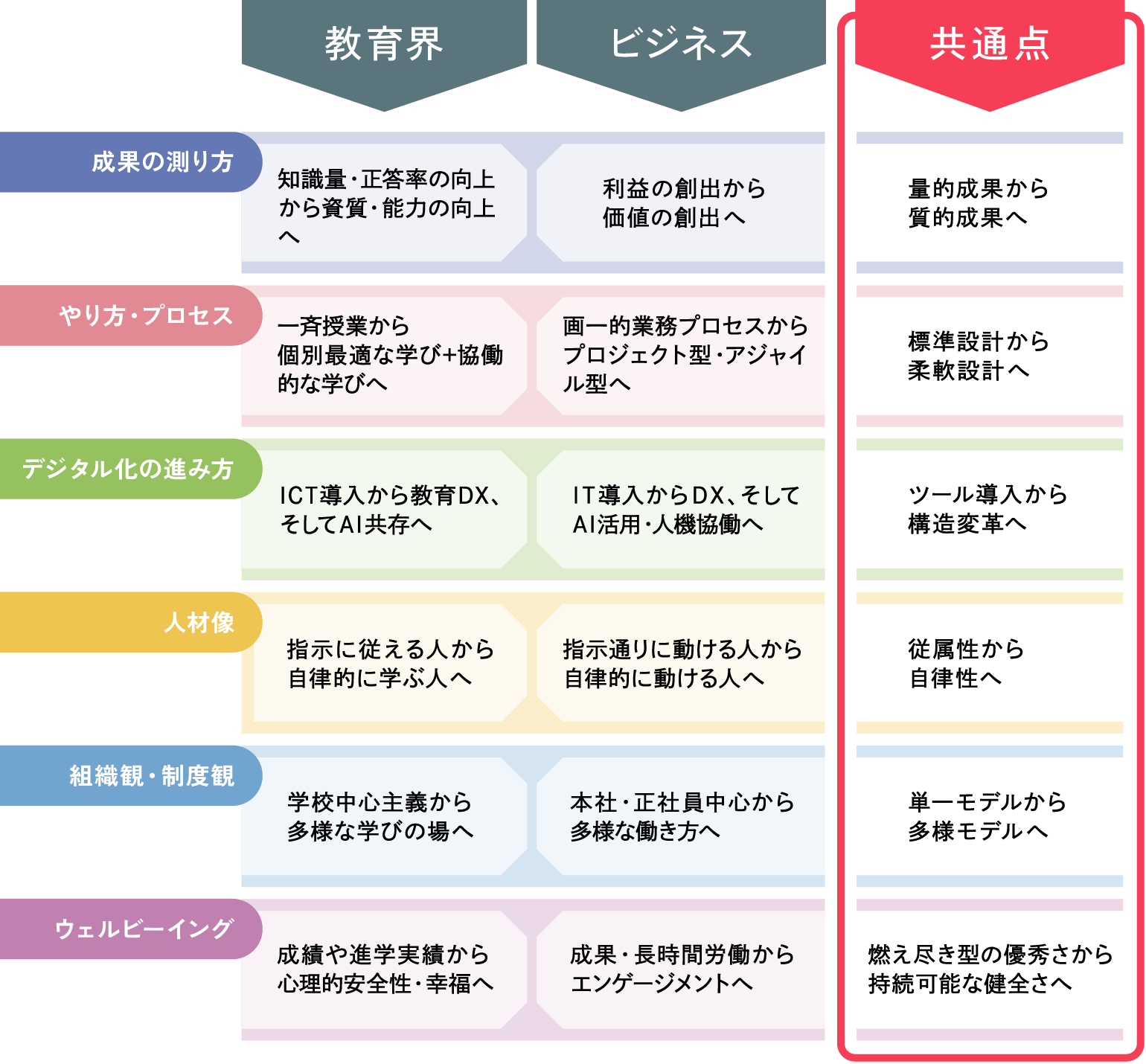
Our institute was founded with the goal of applying insights from advertising creation – specifically "creativity × education" – primarily to public education. However, I now feel we have entered an era where insights from the education sector can be applied to business.
I vividly recall the institute's former director once stating, "School teachers managing classes of 30 to 40 students are management professionals." Now, in our eleventh year, I firmly believe the education sector is brimming with insights that can inform business.
Active Learning: How About This? Research Institute Website
https://www.konnano-dodaro.jp/
Related Series:Active Learning: What About This? Reports
Was this article helpful?
Share this article


Newsletter registration is here
We select and publish important news every day
For inquiries about this article
Author
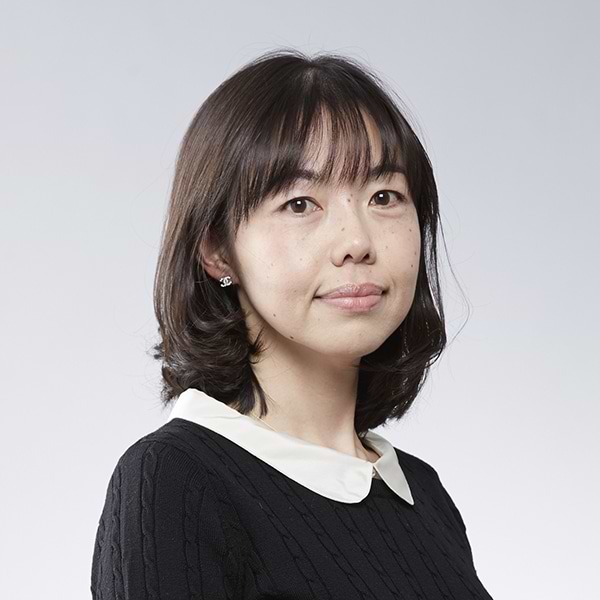
Chihiro Noda
Dentsu Inc.
データテクノロジーセンター
マーケティング・コンサルタント
Joined the Active Learning "How About This?" Research Institute in April 2016. Majored in Educational Administration during university. Graduation thesis topic: "Working Adult Education and Recurrent Education." Handles marketing for clients across various industries while leading research at the institute. On secondment to DENTSU CROSS BRAIN INC. since January 1, 2026.