Desire Trend: "Reversal Toward Single Tasking." The Luxury of Concentration
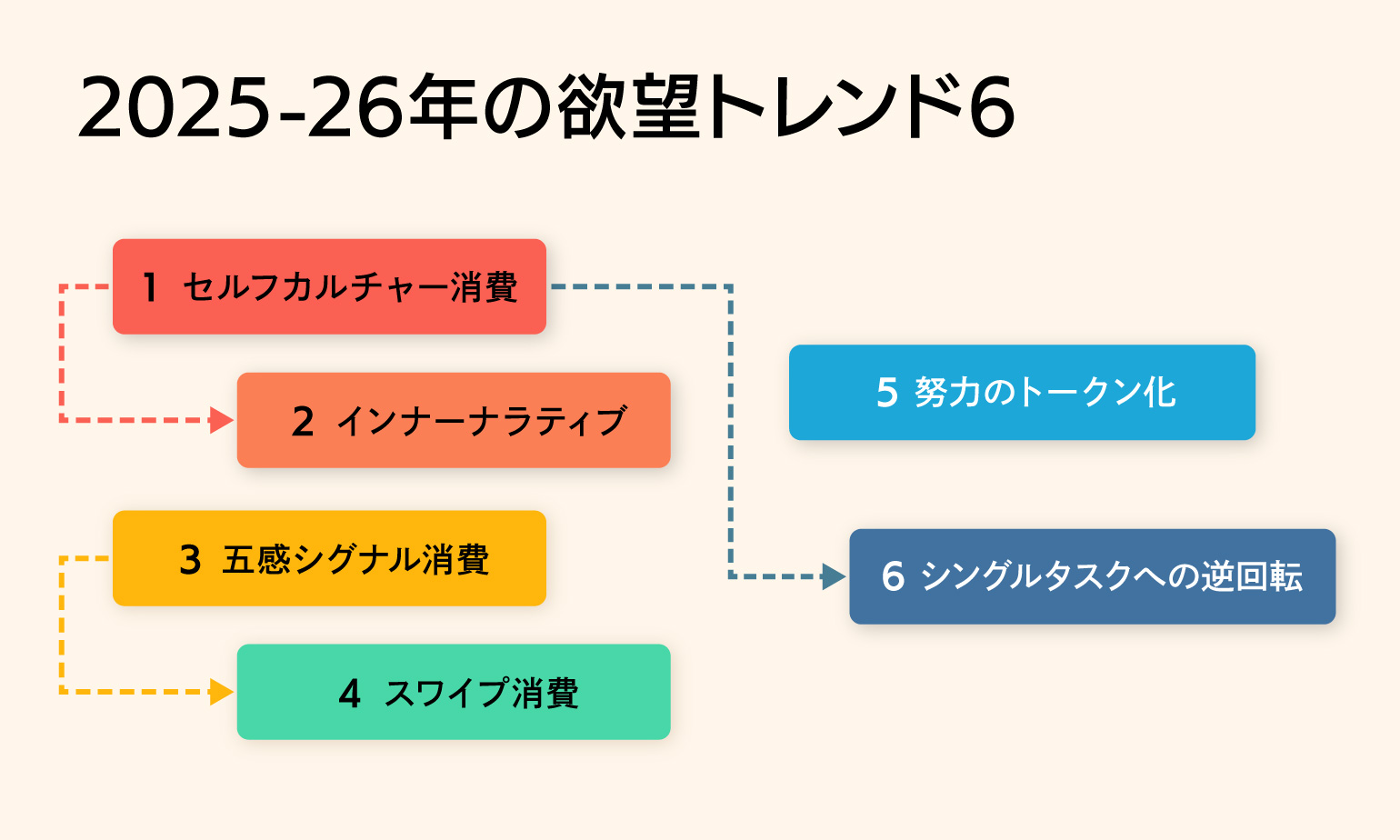
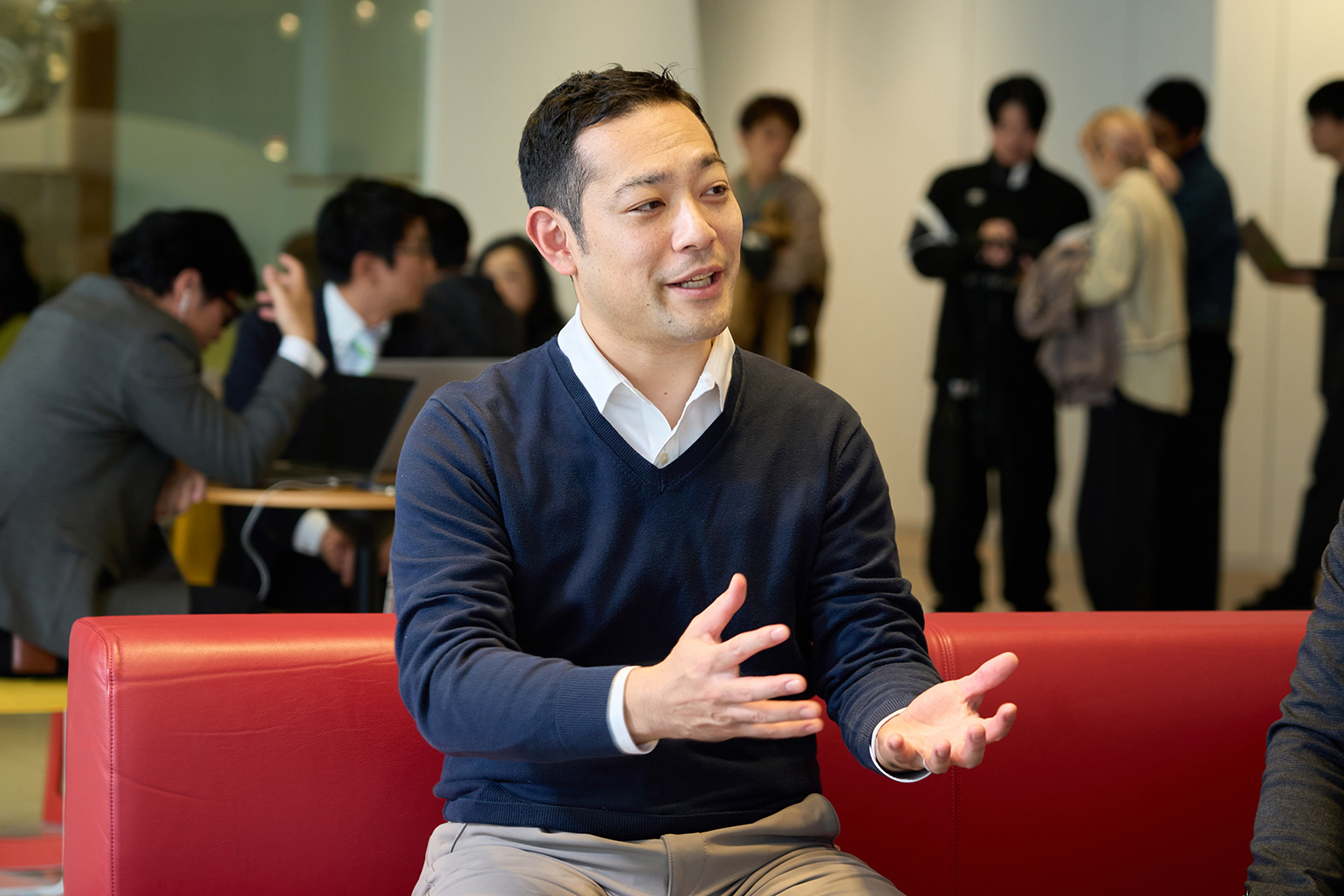
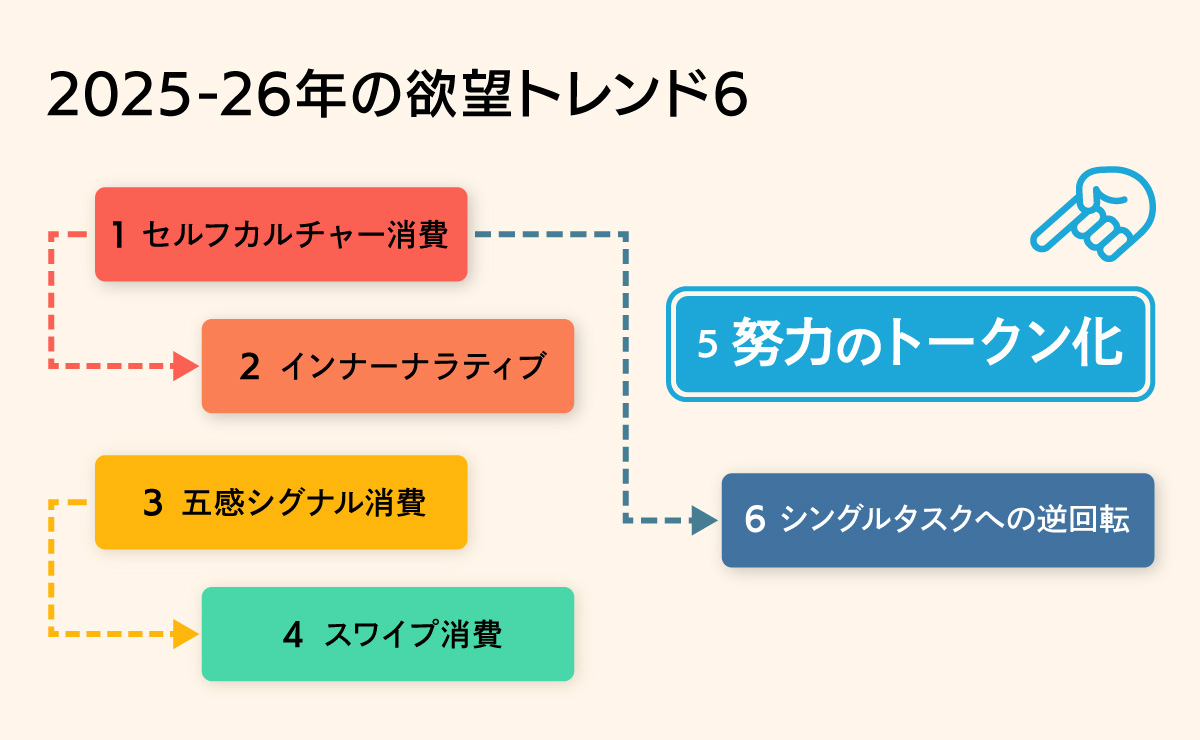
Sato: Finally, the sixth desire trend is the "Reverse Shift to Single Tasking." Throughout the 2000s, 2010s, and 2020s, products and services have continuously evolved. Multi-functionality became the norm. As a result, people embraced this evolution, particularly favoring the direction of increasing time efficiency, achieving a more efficient lifestyle.
So what's happening now? Many convenient functions are consolidating onto smartphones or major platform providers. It's like, "Just access Google and you can do anything." The current reality is that a single device or account can handle all kinds of multitasking.
On the other hand, as functions become increasingly sophisticated, performing multiple tasks simultaneously has become quite difficult. Furthermore, being surrounded by digital devices that provide precise answers like "A means B" can paradoxically make us long for more human connection.
There's also the risk of becoming overly dependent on a single device or account. If, one day, the platform provider decides to suddenly make that device or service unusable, you could find yourself unable to do anything.
Now, in this era, filmmaker James Cameron made an interesting point. He said that going to the movie theater is a decision to not multitask. By doing so, you're making a contract with yourself to focus all your attention on the screen, between yourself and the artwork. Hearing this, I thought it was a brilliant reversal of perspective.
Indeed, when we watch movies at home via streaming services, multitasking is practically a given: watching while holding a smartphone, chatting with someone, or eating. I do it too—pausing when an email pops up, replying, then resuming the movie.
In contrast, movie theaters are spaces with the constraint that "you can only watch the movie." This constraint, ironically, becomes their value. Multitasking is blocked, allowing total focus on the work. In other words, there's a growing trend of valuing the very act of single-tasking.
Movie theaters are one prime example, but this movement of narrowing "function" to single-tasking, thereby creating an "environment for concentration," is gradually spreading. It aims to enhance performance or allow for a fully immersive experience.
The knitting boom mentioned earlier also requires complete single-tasking focus, as both hands and eyes are occupied during the activity. Like movie theaters, the value lies in that concentrated experience. Similarly, the appeal of the SNS "Jiffcy" might stem from its "only-that-possible" nature, allowing users to enjoy real-time text-based conversations exclusively.
Is single-functionality seen as "evolution" by younger generations over multi-functionality?
Naofumi Sato (Dentsu Inc.)
Sato: And this trend is happening among young people who've had smartphones since they were old enough to remember, making them "multitasking natives." Conversely, it might be an idea our generation wouldn't have thought of. What I mean is, there are many patterns where they deliberately reverse technological evolution. Like turning digital things analog, or turning multitasking into single-tasking.
For example, if you reverse-engineer a smartphone back to analog components, you get a wristwatch, a film camera, a record player, a notebook, or even a movie theater. Each of these is extremely single-purpose.
We're so accustomed to smartphones handling multiple tasks in one device that we tend to see single-purpose cameras or records as inconvenient. Yet, precisely because they can only do one thing, they feel warm and comforting. There's also a sense of "I'm deliberately choosing to use this." That's what makes it feel stylish.
Especially for the digital native generation, who grew up with smartphones and accounts on major platforms, seeing digital functions break down into single tasks feels "fresh" and like "evolution." It's the opposite of our generation.
Take compact digital cameras (compact digicams) as an example. While their market has steadily shrunk in recent years due to smartphone proliferation, sales actually rose slightly in 2025. Why? Beyond the appeal of single-tasking, as touched on in Trend 01 "Self-Culture Consumption," there's also the aspect of acquiring a sense of self – "me wearing a camera around my neck."The same goes for wired earphones. People find fashion appeal in asserting "this is where I'm particular about myself."
A prime example of a new product designed with single-tasking in mind is the hugely successful sink bowl cleaner. While it could technically be used anywhere near water, like in the bath, its success came from deliberately naming it for sinks, designing it to fit on a sink counter, and focusing on UX/UI that lets you open the lid and clean immediately. Another fascinating approach is seen in washing machines and TVs that shift from multi-functionality to minimal functionality, allowing for lower prices.
To summarize, if spaces or experiences where one can immerse themselves in just one thing begin to hold value, then in future marketing, "what to eliminate" and "what to make impossible" may also become important. Current product development seems to be moving towards integrating various functions, like "our product has this feature and that feature." However, I believe focusing all attention on a specific single task will also become a key factor.
By "segmenting" or "dividing" products and services, the value of total focus emerges.
Tetsuo Katsumata (Nikkei BP)
Katsumata: That's fascinating. The idea that limiting features can create value is particularly intriguing. In an era where everything is becoming generic—"we have everything," "we can do anything"—extracting one distinctive feature to highlight might indeed be necessary.
In Nikkei Trendy's 2026 Hit Predictions, we featured "All-You-Can-Eat Frozen Food & Ice Cream Day." It's an initiative by Japan Access where they designate supermarket frozen food and ice cream sections as "all-you-can-eat zones" for events. By clearly demarcating "this is the all-you-can-eat area," I believe it creates new value.
Then, the discussion on focus struck me as very important. I touched on this in a webinar: there's a trend called "Text Hip" emerging in Korea and the West. It's a worldview where deliberately focusing on reading physical books is considered cool. Ultimately, this represents a shift towards time spent away from smartphones and digital devices becoming incredibly valuable. In that context, I deeply resonated with Mr. Sato's insights.
Sato: Precisely because multitasking makes it possible, opportunities to "concentrate" are being lost. That's why the act of "concentration" itself is gaining greater value, isn't it?
Katsumata: I think that's exactly right. In my own life, I feel like I'm constantly multitasking. I'm checking various apps on my phone, and I'm definitely not "concentrating."
Sato: I think in the 2000s, "multitasking" and "distraction" were highly valued, but now I sense a reversal happening – like, "Isn't focusing actually more interesting?"
Katsumata: Living a normal modern life, the environment just isn't conducive to concentration. Creating spaces or scenarios for single-tasking seems like it could become a key selling point for future products and services.
Sato: When someone asks, "What can this product actually do?" saying "It's a stick for cleaning your sink" is crystal clear, right? If you greedily add "It works on water stains," that's technically correct, but it weakens the appeal. Saying "It cleans your sink" outright makes it incredibly straightforward.
Chiba: What I found interesting in your talk, Sato-san, was the phrase "young people today are multitasking natives." Our generation thinks multitasking is "convenient" or "efficient," but for the younger generation, it's been the norm since birth, so they don't even perceive it as convenient or efficient. Is this generational gap really that significant?
Sato: I think it's absolutely huge. Lately, we haven't really been encouraged to divide things by generation, but "smartphone natives" and "AI natives" have such different starting points that their fundamental perceptions are completely different.
For a generation that grew up with all functions consolidated into a smartphone, where movies and dramas can be fully consumed just by watching your phone on the train, the movie theater is an alien experience. It might be unbearable at first, but that's when you suddenly realize something. That time spent facing this huge screen (laughs).
Getting back to the movie "National Treasure," it depicts one person's life and way of living, making the audience think, "What about my own life?" Including that kind of interaction, you gain a fresh realization: "This time spent focusing on such a big screen is actually pretty good."
How does AI relate to human desires?
Takashi Chiba (Dentsu Inc.)
Chiba: The way things are perceived is fundamentally different between the generation that experienced the evolution of devices like smartphones and the generation that started with fully developed devices, right? From a generational perspective, what are your thoughts, Mr. Katsumata?
Katsumata: Smartphones are significant, but I think AI will widen the generational gap even further. However, contrary to today's discussion, I also feel AI might push things towards consolidation rather than dispersion. If AI consolidates everything, it could paradoxically lead to more people naturally becoming single-taskers.
Chiba: So, the idea is that we could delegate things we're not good at to AI and focus on what we truly want to do?
Katsumata: Yes. It might even reach a point where you only have one advisor, or rather, a specific AI.
Sato: When we talk about "mind and body," it seems like a world where AI takes over most of the "mind" functions is coming soon. But the problem remains that "physicality isn't there." So, will humans start spending time and money on analog experiences—on what the body can physically experience?
Chiba: Listening to you both, I suddenly thought: Our generation has this kind of confidence that comes from investing time, right? But if AI can shortcut that, where do we gain that confidence?
Katsumata: Honestly, more people are showing PowerPoints clearly made with generative AI. In the sense that you can decide "where to put your effort," using generative AI is fine.
Chiba: I see. I hadn't considered the perspective of "choosing where to focus your effort" when it comes to using generative AI.
Sato: Chiba-san's concern is perfectly valid. There is a real fear that relying too much on AI could gradually erode fundamental human capabilities. However, there will always be aspects AI can never fully replicate—things like emotions and human relationships.
Even in marketing, there's that emotional element of "someone created this with this kind of feeling." I think there's definitely potential for marketing to unfold within that kind of interaction.
Chiba: Perhaps seeing the creator's intentions and philosophy will become even more important going forward. Now, continuing on the topic of AI, it was also a major theme in the 2026 trend predictions during the webinar. Could you share your outlook again, specifically from the perspective of AI and marketing?
Katsumata: I believe those who truly confront "what AI cannot do" will gain strength in the long term.Nikkei Trendy predicted shopping AI will become widespread by 2026. But no matter how deeply AI penetrates, the essence lies not in "creating products that AI agents will like," but in truly seeing the consumers behind the AI—understanding what they think and how to reach them. That's the core. I want to support companies and services taking on that challenge.
Sato: Earlier, you mentioned AI allows us to "choose where to focus our efforts." I think the same applies to shopping AI. What I mean is, for things I'm not particularly particular about—like small daily necessities for me—it's fine to let AI pick the optimal options. But I need to seriously consider what I'll do with the free time that gains.
Chiba: So it's about clearly defining what you want AI to handle and what you want to focus your own energy on. Beyond AI, what other prospects do you see?
Sato: I firmly believe marketing will shift from "information" to "emotion." From the consumer's perspective, product differences are increasingly indistinguishable. In such a world, emotion becomes the decisive factor in purchasing. Consequently, marketing communication will likely increasingly focus on creating emotional touchpoints—actions that tap into consumers' feelings at emotional touchpoints.
For example, when thinking about hits in 2025, content like "Demon Slayer" or "Chainsaw Man" comes to mind, right? That content has emotion. The key will be figuring out what to link to that content's emotion and how, and what kind of marketing will emerge from that.
This year's major event is the WBC. For Japanese people, it's like an emotional powerhouse of a tournament, so I'm sure special content will be featured there. It's like the Super Bowl in American football, right? Every year, it features ads and tie-in campaigns that represent that particular year.
Chiba: In an era where people choose products based on emotion, I imagine it'll be tough to convince family members to buy expensive items (laughs). Before, you could say, "Look at all these great specs!" But if you can't share the emotion in the first place, you can't persuade them.
Sato: Visualizing emotions might become crucial in future marketing. I think the purchase journey will shift to focus on "how it affects emotions." For example, when parents buy milk, it used to be a functional argument like "buying it for calcium to strengthen bones." Now, the emotional aspect will be more integrated, like "buying this milk makes your child happy, and seeing that makes you happy too."
Katsumata: In that sense, I think companies still have unfinished business.
Even with long-selling products, insights like "Who buys this product and why?" can become obscured. Just as Snow Brand repositioned its "Sakeru Cheese" – originally sold as an adult snack – as a healthy children's snack to create "Bomber Sakeru Cheese," re-examining customer feelings is especially effective for long-standing products.
Sato: Looking at it from the perspective of "Whose emotional needs is it satisfying?" could reveal the product's core concept and even ideas for derivative products. Thank you very much!
Katsumata: Thank you. At Nikkei Trendy, we'll be strengthening our prosumer-focused content going forward. We plan to launch the Nikkei Trendy digital edition this fall, so stay tuned!
As a reporter for the monthly magazine "Nikkei Trendy," he covered the food and beverage, daily necessities, and retail industries. He handled the annual year-end feature "Hit Predictions" for 10 years.Became Deputy Editor-in-Chief of Nikkei Trendy in 2016, then Deputy Editor-in-Chief of Nikkei Cross Trend in 2018. Appointed Editor-in-Chief of Nikkei Cross Trend in April 2023. Has extensively covered emerging fields like MaaS, food tech, metaverse, and retail tech, including book editing. Assumed role as Head of the Trend Media Unit in April 2025.
Hisashi Sato
Dentsu Inc.
Second Marketing Bureau
Planning Director
Armed with humanities knowledge from throughout history and across cultures, I operate as "The Director," whose domain encompasses "everything that improves society"—from business growth consulting and planning development to marketing strategy and workshops. Occasionally a screenwriter.
After gaining experience in sales, digital, and television divisions, he was seconded to DENTSU SOKEN INC., where he handled overall social research and studied the health of the information space. He returned to Dentsu Inc. in 2022 and joined the Future Business Creation Research / Consumer Research Project DENTSU DESIRE DESIGN, which creates future corporate value for clients. He handles diverse business development across industries and sectors, from new ventures to daily necessities, anchored in the future and desire.He is also a joint researcher at the Keio University X Dignity Center.

 DENTSU DESIRE DESIGN's Approach to Marketing Reconstruction Based on "Theory of Desire" [32/32]